 Fairhaven Siding
 Decking Built for Lummi Island, Not Just Installed There
Lummi Island sits out in the wind and salt spray off Bellingham Bay, and that changes what a deck has to survive. A deck built to a generic spec sheet might look fine for a season or two, then start showing corroded fasteners, soft spots at the ledger board, or a slick green film that never fully dries out between rains. Composite decking can handle this environment well, but only when it's installed with the island's conditions in mind from the first joist to the last board.
We're based in Fairhaven and have worked decking and siding jobs across Whatcom County long enough to know that "coastal" isn't a single condition — it's salt air, wind-driven rain, and shade-grown moss all working on a structure at the same time, year-round.
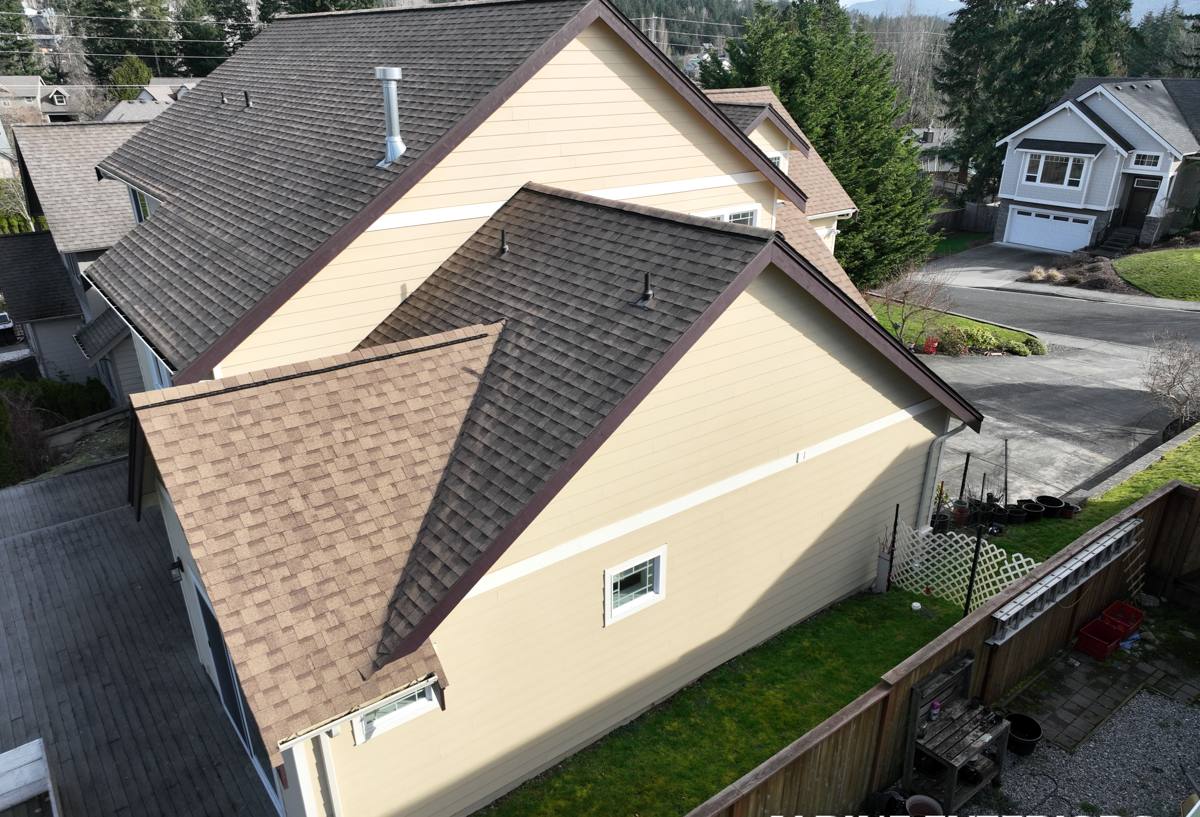
What the Local Climate Actually Does to a Deck
Salt Air and Corrosion
Airborne salt off the water accelerates corrosion on anything metal — screws, joist hangers, railing brackets, post bases. Standard zinc-coated fasteners that hold up fine twenty miles inland can start rusting and staining a deck within a couple of seasons out here. That rust doesn't stay hidden; it bleeds through composite boards and streaks the surface around every fastener point.
Driving Rain and Drainage
Wind-driven rain off the water doesn't just fall straight down — it gets pushed sideways into ledger connections, stair stringers, and any gap where water can collect instead of shed. A deck that isn't sloped and flashed correctly will trap moisture at the framing level even if the surface boards themselves are waterproof.
A Long Moss Season
Shaded, tree-covered lots — common on the island — stay damp for months at a time. Moss and algae need exactly that: shade, moisture, and still air. Composite decking resists rot, but it's not immune to surface growth, and boards installed without enough airflow underneath or without gapping for drainage will green up faster than they should.
Why Composite Decking Makes Sense Here
Wood decking isn't a bad product, but in this climate it asks for a maintenance schedule most homeowners don't want to keep up with — annual staining or sealing, regular inspection for soft or splitting boards, and constant vigilance against moss. Composite boards, especially capped composite, give up some of that maintenance burden in exchange for a higher upfront material cost. That's a fair trade for most Lummi Island homeowners we talk to, but it only pays off if the composite is installed correctly, since composite decking is less forgiving of substructure mistakes than wood — it won't visibly warn you with a soft spot the way rotting wood does.
| Factor | Wood Decking | Composite Decking |
|---|---|---|
| Staining/sealing | Needed roughly every 1-2 years in this climate | Not needed |
| Moss/algae resistance | Depends entirely on maintenance | Better, but not immune — still needs airflow and cleaning |
| Fastener exposure | Often face-screwed, more exposed hardware | Hidden fastener systems available, less exposed metal |
| Rot risk | Real risk if maintenance lapses | Very low for the board itself; framing below is a separate concern |
| Upfront cost | Lower material cost | Higher material cost, lower lifetime maintenance cost |
What a Correct Composite Deck Installation Involves
Composite boards are only as good as what's underneath them. On every Lummi Island project, the framing and prep work matter more than the brand of decking chosen on top of it.
- Framing inspected and, where needed, sistered or replaced — composite is heavier than wood per board foot and needs a substructure rated for it
- Joist tape applied to the top of every joist to keep water out of end grain and fastener holes, since this is where hidden rot starts on any deck
- Ledger board properly flashed where the deck meets the house, so wind-driven rain can't work its way behind the siding
- Corrosion-resistant fasteners and hardware rated for coastal/salt exposure, not standard interior-grade hardware
- Board gapping set correctly for drainage and for the composite's expansion and contraction across our temperature swings
- Adequate under-deck ventilation so moisture doesn't sit trapped against the framing, which is what feeds moss and mildew
- Picture-frame border or hidden-fastener clip system installed to manufacturer spec, since composite systems are more sensitive to fastener spacing than wood
Working Around Ferry Access and Island Scheduling
Lummi Island is reached by ferry, and that changes how a deck project has to be planned, not just how it's built. Materials, tools, and crew all have to be staged around ferry schedules and vehicle space limits, and a missed load or a forgotten piece of hardware can mean losing a day rather than a quick supply-house run. Weather that would be a minor inconvenience on the mainland can also affect ferry service, which is worth building into the timeline up front instead of discovering mid-project.
A crew that already does regular work on the island plans around this instead of getting surprised by it — materials get staged in fewer trips, and the crew isn't relearning ferry logistics on your job.
Board Tiers and What Actually Drives Cost
Composite decking is sold in a range of tiers, and the differences between them matter more here than in a drier, inland climate. Entry-level composite is usually uncapped, meaning the wood-plastic core is exposed on the surface and more prone to moisture absorption and staining over time. Capped composite adds a protective outer shell that resists staining, fading, and moisture absorption — a real advantage against salt air and long wet seasons, for a higher price per board.
| Cost Factor | What It Affects |
|---|---|
| Board tier (capped vs. uncapped) | Material cost per square foot and long-term stain/fade resistance |
| Substructure condition | Whether existing framing can be reused, repaired, or needs full replacement |
| Fastening system | Hidden-fastener clips cost more than face-screwing but leave a cleaner, less corrosion-prone surface |
| Railing style | Composite or cable railing systems add cost versus basic wood or metal picket rail |
| Deck height and stairs | Multi-level decks and stair runs add framing, railing, and code requirements |
| Ferry/site access | Material staging and crew scheduling on island projects |
Because of these variables, a fair estimate has to come from actually looking at the site and the existing structure. Broad ballpark ranges for composite decking installation exist industry-wide, but on Lummi Island the substructure condition and access logistics usually move the number more than the board choice does — which is exactly why we walk the site before quoting rather than pricing off square footage alone.
Railings, Stairs, and Code Basics
Any deck more than a modest height off grade needs a code-compliant railing, and most jurisdictions require guardrails at 36 inches or more with baluster spacing that won't allow a small object — or a child — to pass through. Stair stringers on a coastal deck deserve the same corrosion-resistant hardware and flashing attention as the deck framing itself, since stairs see more direct rain exposure than a covered or house-adjacent deck surface. We build railings and stairs to current code requirements as part of every installation, not as an upsell.
Keeping a Composite Deck Clean in a Moss-Prone Climate
Composite decking is low-maintenance, not no-maintenance. In a climate that grows moss on roofs, walkways, and fences, a deck needs the same basic attention:
- Sweep debris and organic buildup out of board gaps a few times a year so moisture and moss spores don't sit and collect
- Rinse the surface periodically, especially shaded sections, rather than letting winter grime build up over months
- Keep nearby vegetation trimmed back so more light and air reach the deck surface
- Check under-deck ventilation isn't blocked by stored items, planters, or debris
None of this replaces a correct installation — it just keeps a well-built deck looking and performing the way it should for the long haul.
Why a Local Fairhaven Crew Makes a Real Difference
Any contractor can install composite boards. Fewer have actually built decks that hold up against salt air, driving rain off the water, and a moss season that runs most of the year. Working out of Fairhaven and across Whatcom County, we've seen what fails on coastal decks and what doesn't, and we build accordingly — from fastener selection to joist tape to ventilation, not just board selection. On Lummi Island specifically, that local knowledge extends to scheduling around the ferry and staging materials so your project isn't held hostage by logistics we didn't plan for.
If you're planning a new composite deck or replacing one that isn't holding up to the island's weather, we're happy to take a look and put together a straightforward, no-pressure estimate. Use the form below to get started.