 Fairhaven Siding
 What Board and Batten Siding Actually Is
Board and batten is one of the oldest siding patterns in the Pacific Northwest, and it's having a real moment right now on new builds and remodels around Fairhaven. The look is simple: wide vertical panels (the "boards") with narrow strips (the "battens") covering the seams between them. It started as a practical way to weatherproof barns and simple wood-frame homes, and it's stuck around because the strong vertical lines read as clean and modern while still feeling at home on a traditional Craftsman or farmhouse-style build.
What's changed is the material. Traditional board and batten was solid wood boards, which meant every seam, every batten, and every board face was a place for water to get in and rot to start. Fiber cement gave the style a second life by keeping the look while removing most of the material weaknesses that made old board and batten such a maintenance headache.
Why It's a Good Match for Older and Newer Homes Alike
Because the vertical battens create strong shadow lines, board and batten can make a simple rectangular home look more architecturally interesting without adding any actual complexity to the building's shape. It also pairs well with mixed-material exteriors — board and batten on a gable end or dormer, lap siding on the main body, stone or brick at the base. That kind of contrast is common on homes we work on throughout Whatcom County.
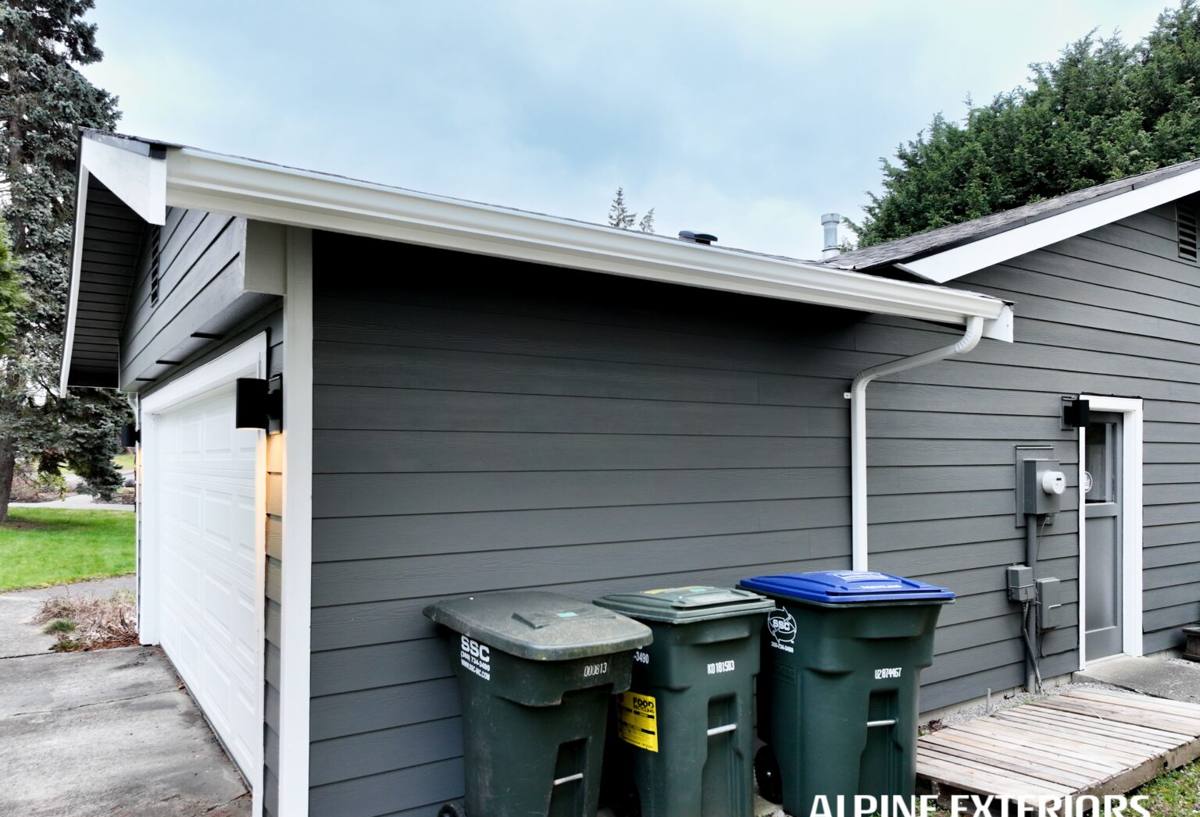
Why This Style Holds Up in Fairhaven's Climate
Fairhaven sits close enough to Bellingham Bay that salt air is a real factor on the exterior of every home here, not just the ones directly on the waterfront. Add in the driving rain that comes through on a west wind and a moss season that can run most of the fall through spring, and you've got a climate that's genuinely hard on siding — any siding, any brand.
Board and batten's vertical orientation actually helps here. Water runs down a vertical board face faster than it sits on a horizontal lap, and there are fewer horizontal ledges for moss spores and organic debris to collect on. That doesn't mean the product is "self-cleaning" — nothing is, in this climate — but the geometry is working with you instead of against you.
The material matters just as much as the shape. Fiber cement doesn't swell, rot, or delaminate the way wood battens can once moisture gets behind them, and it doesn't chalk or become brittle under years of salt-laden coastal air the way some other claddings do. That combination — the right shape plus the right material — is why we lead with this style whenever a homeowner asks about a board and batten look for a Whatcom County home.
James Hardie's Board and Batten Product Options
There isn't just one way to build a Hardie board and batten wall. The main approaches we use are:
HardiePanel Vertical Siding with Applied Battens
This is the classic build-up: a flat HardiePanel sheet installed vertically, then separate Hardie batten strips fastened over the seams. It's the most authentic recreation of the traditional look, with real depth and shadow at every batten line, and it gives us the most flexibility on batten spacing and width to match a specific design.
HardiePanel with Reveal (No Batten) Systems
Some homeowners want the vertical panel look without the batten — a cleaner, more contemporary reveal joint instead. This works well for modern farmhouse and contemporary designs and requires a different flashing detail at each panel seam since there's no batten covering it.
Hardie Artisan Vertical Siding
Hardie's Artisan line is a higher-end product with a smoother, more refined factory finish and tighter tolerances, often used when a homeowner wants board and batten as a featured accent — an entry surround, a gable, a dormer — rather than across an entire elevation.
All three options are engineered fiber cement, which means they carry the same core resistance to moisture, fire, and pests regardless of which look you choose.
ColorPlus Factory Finish vs. Field Painting
This decision affects both the look and the long-term maintenance of a board and batten wall more than almost anything else, so it's worth walking through directly.
| Factor | ColorPlus Factory Finish | Field-Painted (Primed) Panels |
|---|---|---|
| Coating process | Baked-on, multi-coat finish applied under controlled factory conditions | Painted on-site after installation, dependent on weather window and applicator |
| Color consistency | Uniform across every panel and batten, batch to batch | Can vary by coat, painter, and touch-up over time |
| Repaint interval | Typically much longer before a repaint is needed | Standard exterior paint intervals apply, often sooner in coastal salt air |
| Touch-up paint availability | Matched touch-up available from the color line | Depends on saved paint records |
| Upfront cost | Slightly higher material cost | Lower material cost, added labor/paint cost later |
In a climate like Fairhaven's, with salt exposure and near-constant moisture for parts of the year, we point most homeowners toward ColorPlus. The finish is formulated to resist fading and hold adhesion in coastal conditions in a way that field-applied paint on-site struggles to match over a 10-15 year window.
Batten Spacing, Width, and Proportion
The visual success of a board and batten wall comes down to proportion, and this is where a lot of DIY or budget installations go wrong. A few rules of thumb we follow:
- Batten spacing is typically planned in 12", 16", or 24" increments to align with the home's window and door rhythm, not just centered arbitrarily.
- Wider batten spacing reads as more contemporary; tighter spacing reads as more traditional farmhouse.
- Batten width should be proportional to the wall height — a two-story gable needs a visually heavier batten than a small dormer accent.
- Corners, window trim, and fascia widths should be planned alongside the batten layout, not added as an afterthought.
Getting this layout right at the design stage avoids the awkward look of a mismatched batten falling right at a window edge or a corner board that fights with the batten rhythm instead of framing it.
Installation Details That Actually Determine Performance
Board and batten has more fastening points and seams per square foot than horizontal lap siding, which means installation quality matters even more here than on a standard lap job.
Rainscreen and Drainage Plane
Given the amount of driving rain Fairhaven sees off the water, we install vertical siding over a proper rainscreen or drainage gap wherever the wall assembly allows it. This lets any moisture that does get past the cladding drain and dry out instead of sitting against the sheathing.
Fastening Pattern
Both the panel and the battens need to be fastened per Hardie's published fastening schedule — correct nail or screw spacing, correct penetration depth, and fasteners driven into framing or proper blocking, not just into sheathing.
Flashing at Every Horizontal Transition
Window heads, water tables, and any horizontal trim intersecting the vertical panels need flashing that directs water out and away from the wall assembly. This is the single most common failure point we see on board and batten installs that weren't done to spec, regardless of brand.
Caulking and Joint Treatment
Panel-to-panel joints, batten ends, and trim intersections need the right sealant, applied correctly and allowed to cure properly — not just a bead run down every seam as a catch-all.
Color and Trim Pairings Worth Considering
Board and batten's strong vertical lines mean trim color choices show up more prominently than they do on lap siding. A common approach is a mid-tone or deeper body color on the panels with a crisp white or a soft contrasting trim at corners and windows to let the batten lines read clearly rather than blend in. Homeowners going for a more contemporary look often choose a darker, more saturated body tone paired with black-frame windows and matching trim, which tends to hold up visually well against the gray, overcast stretches common to this part of Washington.
What Maintenance Looks Like Long-Term
Fiber cement board and batten is genuinely lower-maintenance than wood, but "low-maintenance" doesn't mean "no-maintenance," especially with a moss season as long as ours.
- Rinse the exterior annually, focusing on north-facing walls and anywhere shaded by trees where moss and organic growth tend to establish first.
- Inspect caulked joints and batten ends every year or two and re-caulk any cracked or separated seams before winter rains set in.
- Check flashing above windows and at water tables periodically, since these are the spots most likely to show early signs of a problem.
- Repaint on the ColorPlus warranty's recommended interval if you ever choose to change color, rather than letting a factory finish go unmaintained indefinitely.
- Trim back vegetation and tree cover that keeps a wall section shaded and damp longer than the rest of the house.
Getting It Right From the Start
Board and batten looks straightforward from the street, but it's an unforgiving style to get wrong — every seam, batten, and reveal is visible, and there's nowhere for a sloppy layout or a rushed flashing detail to hide. Between the salt air, the rain, and the moss this part of Whatcom County deals with every year, the difference between a board and batten wall that looks sharp in ten years and one that's already showing streaking and joint failure almost always comes down to the layout planning and the installation details, not just the brand of panel on the wall.
If you're considering a board and batten look for a new build, an addition, or as an accent on an existing Fairhaven home, we're happy to walk the site, talk through spacing and color options, and put together a straightforward, no-pressure estimate.