 Fairhaven Siding
 Two Very Different Materials, One Big Decision
If you're re-siding a home in Fairhaven, you've probably run into both names: James Hardie fiber cement and LP SmartSide engineered wood. Both are marketed as upgrades over vinyl. Both come pre-primed or pre-finished, install in long planks or panels, and are sold by reputable manufacturers with real warranties behind them. But they are not the same material, and the difference matters more here than it does in a drier inland climate. Whatcom County sits right on the water, which means salt-laden air, long stretches of driving rain off the Strait, and a moss season that can run most of the year on shaded, north-facing walls. Siding here doesn't just have to look good — it has to shed water and resist organic growth for decades without babysitting.
This page lays out what each product actually is, how they behave under real Pacific Northwest conditions, and why our company made the call to install James Hardie exclusively. We're not going to tell you LP SmartSide is junk — it isn't. We'll tell you honestly where it holds up and where it asks more of the homeowner than fiber cement does.
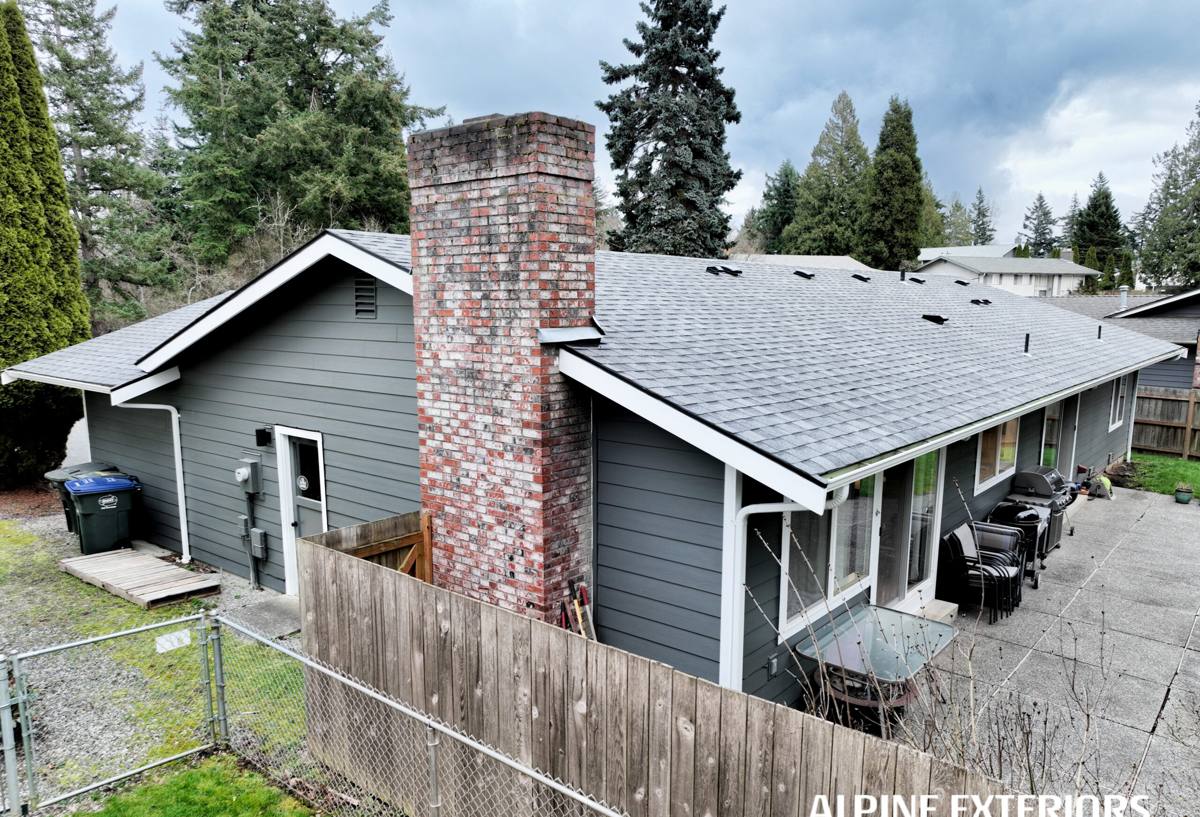
What LP SmartSide Actually Is
LP SmartSide is an engineered wood product. Strands of wood are bonded with resin under heat and pressure, then treated with a zinc borate preservative and coated with a resin-saturated overlay before priming. It's manufactured to resist termites and fungal decay better than raw lumber, and it comes in lap siding, panels, and trim profiles that are lighter and easier to cut than fiber cement.
What It Gets Right
- Lighter weight, which can mean faster install labor on some jobs
- Easier to cut and nail with standard woodworking tools — no specialty blades required
- Warmer, more traditional "wood grain" look for buyers who want that texture without solid wood
- Solid impact resistance for an engineered wood product
For a lot of climates, that's a reasonable value proposition. Our hesitation is specific to what happens at the cut ends, fastener points, and butt joints once the product lives through repeated wet-dry cycling — which is exactly what a marine climate like Fairhaven's delivers, year after year.
What James Hardie Fiber Cement Actually Is
James Hardie siding is a composite of Portland cement, sand, and cellulose fiber, cured into a dense, stable plank. It has no wood core to swell, wick moisture, or feed fungal growth — the cellulose fiber is fully encapsulated in cement, not exposed wood grain. It's factory-finished with ColorPlus Technology, a baked-on finish system that's applied and cured under controlled conditions rather than on a job site, which is part of why the color holds up longer than field-applied paint.
The HZ5 Climate Engineering
James Hardie makes different plank formulations for different climate zones — a wetter, freeze-prone Pacific Northwest region gets a different mix than the arid Southwest. Whatcom County falls into the HZ5 zone, engineered specifically for high-moisture, cooler climates like ours. That's not a marketing footnote — it's the reason the product is formulated the way it is for homes near the Fairhaven waterfront and up into the county's wetter inland pockets.
How They Hold Up in Whatcom County Weather
Three things define exterior wear here: salt air off Bellingham Bay and the Strait of Georgia, sustained driving rain rather than brief downpours, and a moss and algae season that can run nine or ten months on shaded north and east elevations. Any siding product survives a dry summer. The real test is what happens after fifteen winters of that combination.
Fiber cement doesn't have an organic core for moss and mildew to root into, and it doesn't swell or check at cut ends the way wood-based products can when water finds its way in through a nick in the finish or an under-caulked joint. Engineered wood products have improved their resin treatments significantly over the years, but they still rely on that outer coating staying fully intact at every edge, seam, and fastener hole for the life of the siding. In a climate that rarely gives siding more than a few dry weeks in a row, that's a maintenance commitment we don't think most homeowners want to sign up for.
Side-by-Side Comparison
| Factor | James Hardie Fiber Cement | LP SmartSide Engineered Wood |
|---|---|---|
| Core material | Cement, sand, cellulose fiber | Resin-bonded wood strand |
| Moisture behavior | Does not swell or rot; dimensionally stable wet or dry | Resin-treated to resist decay; cut edges and joints require diligent sealing |
| Fire classification | Non-combustible core | Combustible wood-based product |
| Finish | Factory-baked ColorPlus finish, multi-coat | Factory primer; typically field-painted |
| Typical maintenance | Occasional wash; caulk inspection | Regular paint upkeep; edge sealing critical |
| Manufacturer warranty | Long-term, transferable, non-prorated for years | Solid limited warranty, typically shorter coverage window |
| Typical service life when installed to spec | 30+ years common | Often shorter, dependent on maintenance follow-through |
The Moisture Question
This is where the two products diverge the most, and it's worth explaining rather than just asserting. Engineered wood siding fails, when it fails, almost always at the edges — a cut end that wasn't field-sealed, a butt joint where caulk shrank and cracked, a fastener hole that let water track behind the coating. Once moisture gets past the resin overlay into the wood strand core, that's an organic material that can swell, telegraph through the finish, and eventually soften. None of that is a defect in the product; it's the nature of building with a wood-based core in a wet climate, and it's manageable with disciplined maintenance.
Fiber cement doesn't have that failure mode. Cut ends of Hardie plank still need to be primed and back-primed per the manufacturer's instructions, and joints still need to be flashed and caulked correctly — installation quality matters with any siding. But if a homeowner misses a maintenance cycle by a year or two, fiber cement doesn't punish that the way an organic-core product can. For a house exposed to salt air and driving rain nine months a year, that margin for error matters.
Finish, Fire, and Warranty
Three practical differences round out the comparison. First, finish: ColorPlus is applied in a factory under controlled conditions and cures more consistently than paint applied on site, which is part of why Hardie's finish warranty runs longer than what you'd typically get from a field-painted product. Second, fire: fiber cement's cement-and-sand composition is non-combustible, while any engineered wood product, however well treated, is still a wood-based material — an honest distinction for anyone weighing wildfire-adjacent risk or simply wanting one less combustible material on the exterior. Third, warranty structure: Hardie's transferable, long-term warranty reflects the manufacturer's confidence in the product's stability over decades, which is a meaningful consideration if you plan to sell the home before the siding's service life is up.
What Correct Installation Requires
Neither product performs well if it's installed poorly, and this is where a lot of siding problems actually originate — not the material, the install. Before you hire anyone for a fiber cement or engineered wood project in Fairhaven, confirm the crew is doing all of the following:
- Maintaining proper clearance between the bottom of the siding and grade, decks, and roof lines
- Flashing every window, door, and horizontal joint before siding goes on, not caulking over gaps as a shortcut
- Priming and sealing all field-cut ends per manufacturer specification, not just factory edges
- Using the correct fastener type, length, and spacing for the specific product and wall assembly
- Installing a drainage plane or rainscreen appropriate for a high-moisture coastal climate
- Following the manufacturer's installation guide closely enough that the warranty stays valid
A beautiful material installed to a shortcut standard will fail early regardless of brand. That's as true for Hardie as it is for any engineered wood product.
Why We Standardized on James Hardie
We made a deliberate choice years ago to install James Hardie fiber cement exclusively rather than offer a menu of siding brands. It comes down to what we're comfortable standing behind on a house that's going to face Bellingham Bay's salt air, sideways rain, and a long moss season winter after winter. Fiber cement's non-combustible, dimensionally stable core, the HZ5 formulation built for exactly our climate zone, the factory-cured ColorPlus finish, and the strength of Hardie's transferable warranty add up to a product we can install once and trust for decades — without asking the homeowner to maintain a tight painting and caulking schedule to keep it that way. LP SmartSide is a legitimate product for the right application; we simply concluded it isn't the right long-term fit for Whatcom County's weather, and we'd rather specialize in one material we install correctly every time than spread ourselves across several.
If you're weighing siding options for a home in Fairhaven or anywhere else in Whatcom County, we're happy to walk your property, look at your exposure and existing siding condition, and put together a free, no-pressure estimate for a James Hardie install.