 Fairhaven Siding
 The Real Question for Fairhaven Homeowners
When a Fairhaven homeowner starts pricing out new siding, the conversation almost always comes down to two products: vinyl and James Hardie fiber cement. Both are widely available, both come in a range of colors and profiles, and both get installed on homes up and down Whatcom County every year. The decision isn't about which one is "better" in the abstract — it's about which one holds up to the specific conditions a home on this stretch of Bellingham Bay actually deals with.
Fairhaven sits close enough to the water that salt-laden air is a constant, not an occasional event. Add in the Pacific Northwest's long wet season, driving rain that comes in sideways off the water during winter storms, and a moss season that can stretch from October through May on shaded north and west walls, and you've got a climate that is genuinely harder on exterior materials than most siding is marketed for. This page walks through how each product actually performs under those conditions, not just how it performs in a showroom.
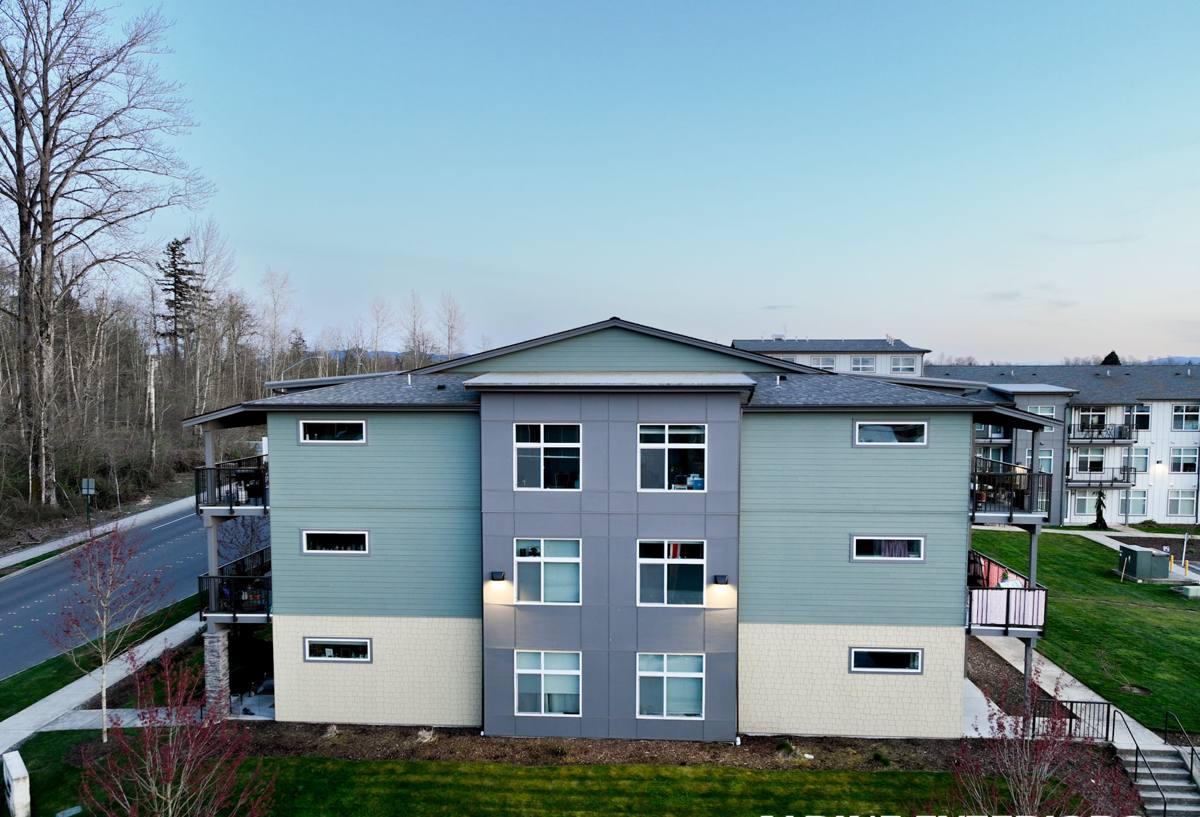
How Vinyl Siding Performs in a Marine Climate
Vinyl siding has a real place in the market. It's inexpensive to buy and install, it doesn't need painting, and for a lot of the country it does a perfectly adequate job for a decade or two. The trade-offs show up more clearly in a marine environment like Fairhaven's:
Heat and cold movement
Vinyl is a plastic product, and it expands and contracts with temperature more than fiber cement does. In our climate that's less about extreme heat and more about the cumulative effect of repeated wet-dry, warm-cool cycling over many winters — panels can start to bow, buckle, or pull loose from their nailing hem, especially on south- and west-facing walls that see the most temperature swing.
Water management at the seams
Vinyl siding is installed as an overlapping system with a lot of small gaps and laps by design — it's meant to breathe and drain, not seal. That works fine in a moderate climate. In a location that gets sustained driving rain off the water, those laps are more exposed to wind-driven moisture, and over time trapped moisture behind the panels can contribute to sheathing and framing problems that aren't visible until they're serious.
Salt air and UV
Salt air accelerates the breakdown of the UV inhibitors in vinyl's color pigment. Homes closer to the water tend to see chalking and fading happen faster than the same product would fade further inland. Once vinyl fades unevenly, there's no repainting it back to original color without replacing panels — the color is baked into the material itself.
Moss and organic growth
Vinyl's textured surface and the shadow lines created by its lap profile give moss and algae plenty of places to take hold on shaded walls, and the plastic surface doesn't offer much for cleaning solutions to bite into without risking damage to the finish.
How James Hardie Fiber Cement Performs Here
James Hardie siding is a cement, sand, and cellulose fiber composite — it behaves more like a durable masonry product than a plastic one, and that difference is exactly what matters in this climate.
Dimensional stability
Because it's not a plastic, fiber cement doesn't expand and contract with temperature the way vinyl does. It holds its shape and its fastening through the wet-dry cycling that defines a Pacific Northwest winter, which means fewer buckled panels and fewer callbacks over the life of the siding.
Moisture resistance
James Hardie's HZ5 product line is specifically engineered for climates with sustained moisture exposure — the kind Whatcom County gets. The material itself doesn't rot, and when it's installed with correct flashing, gapping, and drainage detailing behind it, it manages driving rain far better than a lap-and-gap plastic system.
Non-combustibility
Fiber cement doesn't burn. That's not a marine-climate issue specifically, but it's a genuine, verifiable difference from vinyl (which will melt and burn) that matters for insurance considerations and for peace of mind.
Factory finish
ColorPlus finish is baked on at the factory under controlled conditions, with UV-cured coating layers designed to resist fading longer than field-applied paint — or than color-through vinyl exposed to salt air. It also means touch-up paint is available that's formulated to match, rather than a homeowner guessing at a hardware-store color.
Moss and mildew resistance
The factory finish and the material's harder, less porous surface make cleaning easier and give moss and mildew less to grip onto compared to vinyl's textured plastic surface, though any siding on a shaded wall in this climate still benefits from periodic gentle cleaning.
Side-by-Side: What Actually Differs
| Factor | Vinyl Siding | James Hardie Fiber Cement |
|---|---|---|
| Material behavior | Plastic — expands/contracts with temperature | Cement composite — dimensionally stable |
| Driving rain / wind-driven moisture | Lap-and-gap system, more exposed at seams | Engineered HZ5 line, better moisture management when properly installed |
| Salt air / UV fading | Color-through pigment, fades and chalks faster near the water | Factory-applied ColorPlus finish, engineered for UV resistance |
| Fire behavior | Combustible, will melt | Non-combustible |
| Moss/algae resistance | Textured plastic surface holds growth | Harder, less porous surface, easier to clean |
| Repair after impact | Panel often needs full replacement, color match can be difficult on older siding | Section can be cut and patched; ColorPlus touch-up available |
| Typical warranty structure | Varies widely by manufacturer, often prorated | Long-term, transferable manufacturer warranty on the product; ColorPlus finish warranty separate |
Cost Factors Over the Life of the Siding
Sticker price isn't the whole story, and homeowners deserve the full picture rather than just the number on the estimate. Here's how the two products compare across the factors that actually affect total cost of ownership:
| Cost Factor | Vinyl | James Hardie |
|---|---|---|
| Upfront material + install | Generally lower | Generally higher |
| Expected service life before major work | Shorter in marine/high-moisture climates | Longer when installed to spec |
| Repainting needed | No, but faded panels usually mean full replacement of that section | Not for a long time — ColorPlus is factory-cured; eventual repaint is possible since it's a real substrate |
| Moisture-related repair risk | Higher if seams and laps aren't well-maintained | Lower with correct flashing and drainage plane installation |
| Resale/appraisal perception | Viewed as a budget-tier upgrade | Frequently viewed as a premium, durable upgrade |
The honest way to think about it: vinyl usually wins on day-one cost, and James Hardie usually wins on cost-per-year-of-service, especially in a climate that's harder on exterior materials than average.
Installation Sensitivity — Why the Installer Matters as Much as the Product
This is the part that gets left out of most siding comparisons, and it matters just as much as the material choice. Vinyl siding is more forgiving of installation shortcuts — it's a lightweight, snap-together system that a less experienced crew can put up reasonably well. Fiber cement is less forgiving. James Hardie siding has to be cut, fastened, and flashed to manufacturer specification — correct nailing patterns, proper gapping at butt joints, correctly integrated flashing and weather-resistive barrier behind the siding, and correct clearance from grade, decks, and roof lines. Skip any of those steps and even the best siding material in the world can trap moisture or fail early.
That installation sensitivity is exactly why we don't treat James Hardie as a drop-in replacement for whatever a crew is used to installing. We install it exclusively, to Hardie's written specifications, because a product this good only performs the way it's engineered to when it goes on correctly.
What to Ask Before You Choose
- Is the siding rated for a marine/high-moisture climate, or is it a general-purpose product being sold for our conditions?
- What's the manufacturer's warranty, and is it transferable if you sell the home?
- Who backs the finish — is the color factory-applied or field-painted, and what's covered if it fades?
- Has the installer been trained and certified on this specific product's installation requirements?
- What flashing, house wrap, and drainage plane details will be used behind the siding?
- How does the product handle wind-driven rain specifically, not just general water exposure?
- What does realistic maintenance look like over 10, 20, and 30 years?
Why We Standardized on James Hardie
We made a deliberate decision to install only James Hardie fiber cement siding, and it comes down to what we see holding up on homes in this exact climate. Salt air off the bay, sustained wet-season rain, and shaded walls that stay damp long enough to grow moss are not edge cases for a Fairhaven home — they're the baseline. Vinyl can be a reasonable, budget-conscious choice in a lot of places, and we're not going to pretend otherwise. But when we weigh dimensional stability, moisture management, fire performance, and a finish engineered to hold its color against salt and UV, James Hardie is the product we're willing to put our name behind and warranty our workmanship on.
Every home is different, and the right siding decision depends on your budget, your home's exposure, and how long you plan to stay in it. If you'd like to talk through what James Hardie would look like on your specific house, we're happy to walk the property with you and put together a free, no-pressure estimate — just fill out the form below.