 Fairhaven Siding
 Puget's Exterior Challenge: Salt Air, Rain, and Moss
Homes in and around Puget sit close enough to the water that salt air is a daily fact of life, not an occasional nuisance. Combined with Whatcom County's long wet season and the moss growth that comes with months of shade and moisture, this stretch of the Salish Sea coastline is genuinely tough on exterior building materials. It's a different set of stresses than what a siding crew in a dry inland climate deals with, and it changes what "good work" actually means out here.
Salt-laden air corrodes exposed metal fasteners, degrades certain paint films faster than inland exposure would, and works its way into any gap in a building envelope that isn't properly sealed. Add wind-driven rain that comes at a house sideways rather than straight down, and you have a climate that punishes shortcuts in flashing, caulking, and material selection. Moss and algae, meanwhile, thrive on the north and west faces of homes that stay damp and shaded for weeks at a stretch, especially through the fall, winter, and early spring months.
Why This Matters More Than It Seems
None of these stresses cause dramatic, sudden failures. They cause slow ones — a little bit of moisture intrusion behind siding each winter, a little more paint breakdown each summer, a little more moss creep each year. By the time a homeowner notices soft spots, peeling paint, or streaking, the damage has usually been building for years. That's the real argument for choosing exterior materials and installation practices suited to this specific coastline, rather than whatever's cheapest or most common inland.
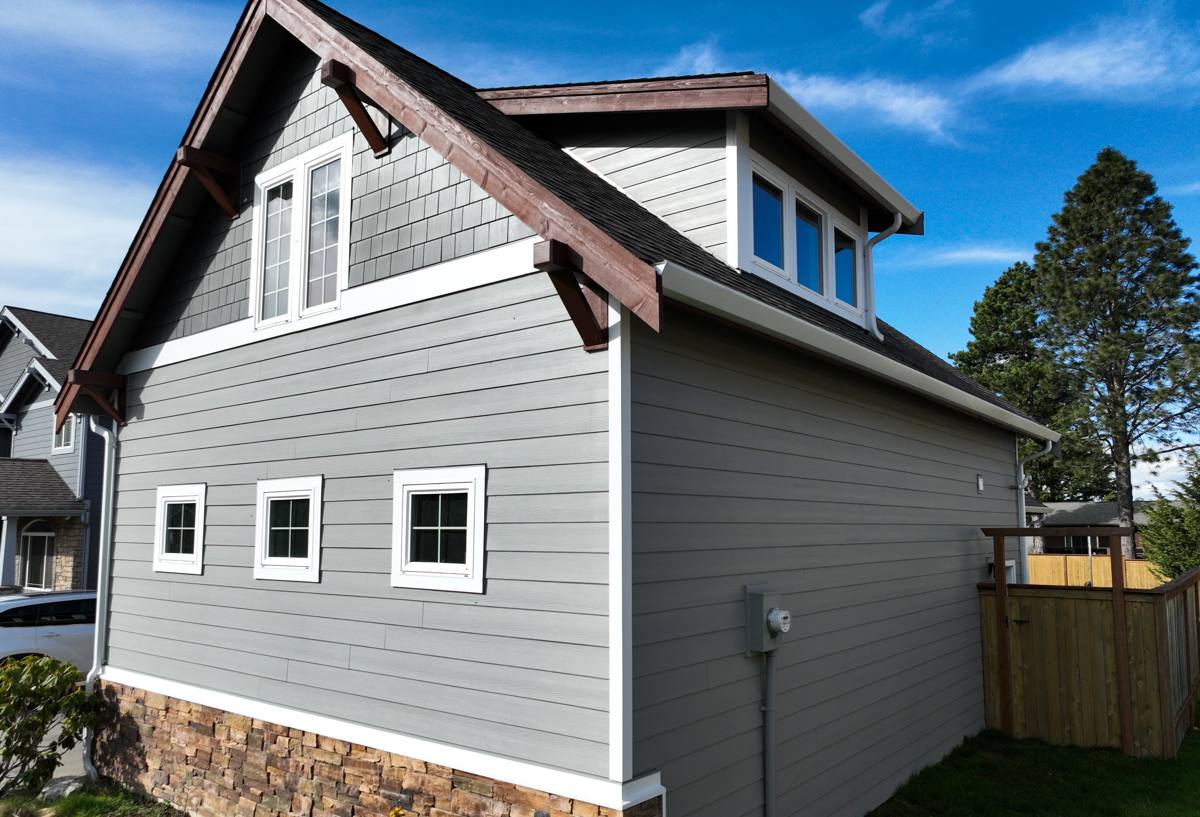
How Puget's Climate Shows Up on Real Homes
We see a consistent pattern of wear on homes throughout this part of Whatcom County, and it tends to concentrate in a few predictable spots:
- North- and west-facing walls that stay damp longest develop moss and algae staining first
- Butt joints and seams in older lap siding open up as material swells and shrinks with moisture cycles
- Exposed fasteners and trim corrode or bleed rust stains where salt air reaches unprotected metal
- Paint and finish coatings on wood-based products chalk, fade, and peel faster than manufacturer estimates suggest
- Ground-level siding and skirting near decks and lower walls hold moisture longer where airflow is limited
These aren't hypothetical concerns — they're the reason certain siding materials hold up better than others in this specific environment, and why the installation details around flashing, drainage planes, and fastener choice matter as much as the material itself.
Why We Install Only James Hardie Fiber Cement Siding
We made a deliberate decision to standardize on James Hardie fiber cement siding and no longer install vinyl, LP SmartSide, or wood-based siding products, including cedar. That's not a marketing position — it's a practical one, built around what actually holds up on homes exposed to salt air and sustained wet weather.
Fiber cement is non-combustible and dimensionally stable, meaning it doesn't expand and contract with moisture the way wood-based siding does, which reduces the seam-opening and joint failure we see on older installations. James Hardie's ColorPlus finish is baked on in a factory-controlled process rather than field-applied, which gives it more consistent coverage and better resistance to the fading and chalking that salt air and UV exposure accelerate. Hardie also engineers specific product lines (their "HZ5" designation) for climates like this one, with formulations aimed at regions that see significant moisture exposure.
We're not going to tell you every other product is worthless — vinyl is inexpensive and low-maintenance in mild climates, and cedar has a look some homeowners genuinely prefer. But for the specific combination of salt air, driving rain, and moss-friendly shade that Puget homes deal with, we've found fiber cement performs more predictably over the long run, and we'd rather install one product well than offer several we're less confident in.
Siding: What Correct Installation Looks Like Here
Material choice only gets you part of the way. On the coast, installation details are what determine whether siding lasts 10 years or 40. For every Puget project, our approach includes:
Drainage and Moisture Management
A proper rain screen or drainage gap behind the siding lets any moisture that does get past the exterior cladding drain and dry out, rather than sitting against the sheathing. This matters more here than in drier climates because the moisture load is simply higher and the drying window between rain events is shorter.
Flashing and Fastening
Every window, door, and penetration needs flashing detailed to shed water outward rather than trap it. We use corrosion-resistant fasteners appropriate for coastal exposure, since standard fasteners can corrode and streak over time in salt air.
Clearance and Ventilation
Siding installed too close to grade, decks, or roof lines traps moisture and invites the moss and mildew growth we mentioned earlier. Proper clearances and attention to airflow around lower walls make a measurable difference in how long a finish lasts.
Beyond Siding: Roofing, Windows, and Decks
Siding doesn't work in isolation — it's one piece of a building envelope that has to work together, which is why we handle roofing, windows, and decks as well, rather than treating siding as a standalone product.
Roofing
A roof that's shedding water improperly or losing granules undermines even a perfect siding job, since water finds its way down behind fascia and trim. We check roof-to-wall transitions and flashing details as part of any siding project.
Windows
Old or poorly flashed windows are one of the most common sources of hidden moisture intrusion we find when we open up a wall. Replacing windows at the same time as siding lets us properly integrate flashing and moisture barriers in one continuous system, rather than patching around old details.
Decks
Decks attached to the house create a junction point that needs careful flashing to keep water from running behind siding at the ledger board — a detail that's easy to get wrong and expensive to fix later.
Comparing Exterior Materials for This Climate
| Material | Salt Air Resistance | Moisture Behavior | Typical Maintenance |
|---|---|---|---|
| James Hardie fiber cement | Strong; non-combustible and dimensionally stable | Doesn't swell or rot; factory finish resists fading | Occasional wash; repaint interval is long |
| Cedar / primed wood | Moderate; finish is vulnerable to salt exposure | Absorbs moisture, prone to swelling and rot at joints | Frequent refinishing and moisture monitoring |
| Vinyl siding | Generally stable but can fade and become brittle | Doesn't rot, but seams and J-channels can trap moisture | Low, but limited repair options if damaged |
| LP SmartSide (engineered wood) | Moderate; performance depends heavily on sealing details | Vulnerable at cut edges and seams if not properly sealed | Requires vigilant caulk and paint maintenance |
This isn't a claim that other materials fail outright — it's a reflection of the trade-offs we weigh before recommending anything to a homeowner near the water. It's also why, after years of installing multiple product lines, we narrowed to fiber cement for the work we do now.
Why a Local Crew Matters
A crew that works Whatcom County's coastline regularly develops a feel for details that don't show up in a manufacturer's installation manual — where moss tends to accumulate first on a given home orientation, how much clearance to leave near a deck ledger in a wet winter, which flashing details actually hold up after a few seasons of driving rain. That kind of judgment comes from repetition in this specific environment, not from a general contracting background applied to a new region.
It also means someone is local if a warranty question or minor issue comes up down the road, rather than a crew that installed the siding and moved on to a different region entirely.
Keeping Your Exterior in Good Shape Between Projects
Whatever material is currently on your home, a few habits go a long way toward slowing the wear this climate causes:
- Rinse moss and algae off shaded walls before it has a chance to establish and stain the finish
- Keep gutters clear so overflow doesn't run down siding and saturate it repeatedly
- Check caulking around windows and trim annually, since gaps let salt-laden moisture behind the cladding
- Trim back vegetation that keeps a wall shaded and damp for long stretches
- Watch for soft spots, dark staining, or peeling paint, and address them before they spread
Getting Started
If you're weighing a siding, roofing, window, or deck project for your Puget home, we're happy to take a look and talk through what your specific home is facing — no pressure, no obligation. Reach out for a free estimate and we'll give you an honest read on what your exterior actually needs.