 Fairhaven Siding
 Happy Valley's Exterior Climate Problem
Happy Valley sits close enough to Bellingham Bay and the Fairhaven waterfront that salt-laden air is a daily fact of life for the homes there, not an occasional nuisance. Add Whatcom County's long, wet fall-through-spring stretch and the tree cover that shades a lot of these lots, and you get three forces working on a house's exterior at once: salt exposure, near-constant moisture, and shade that keeps siding damp long after the rain stops. That combination is what drives moss growth, slow paint failure, and rot at the vulnerable points of a house — corners, butt joints, and anywhere trim meets siding.
None of this is unique to one street or one lot. It's the shared reality of this part of Fairhaven, and it's why we treat Happy Valley as its own service area rather than lumping it in with drier inland neighborhoods. What works on a house in the Sumas Valley doesn't necessarily hold up here.
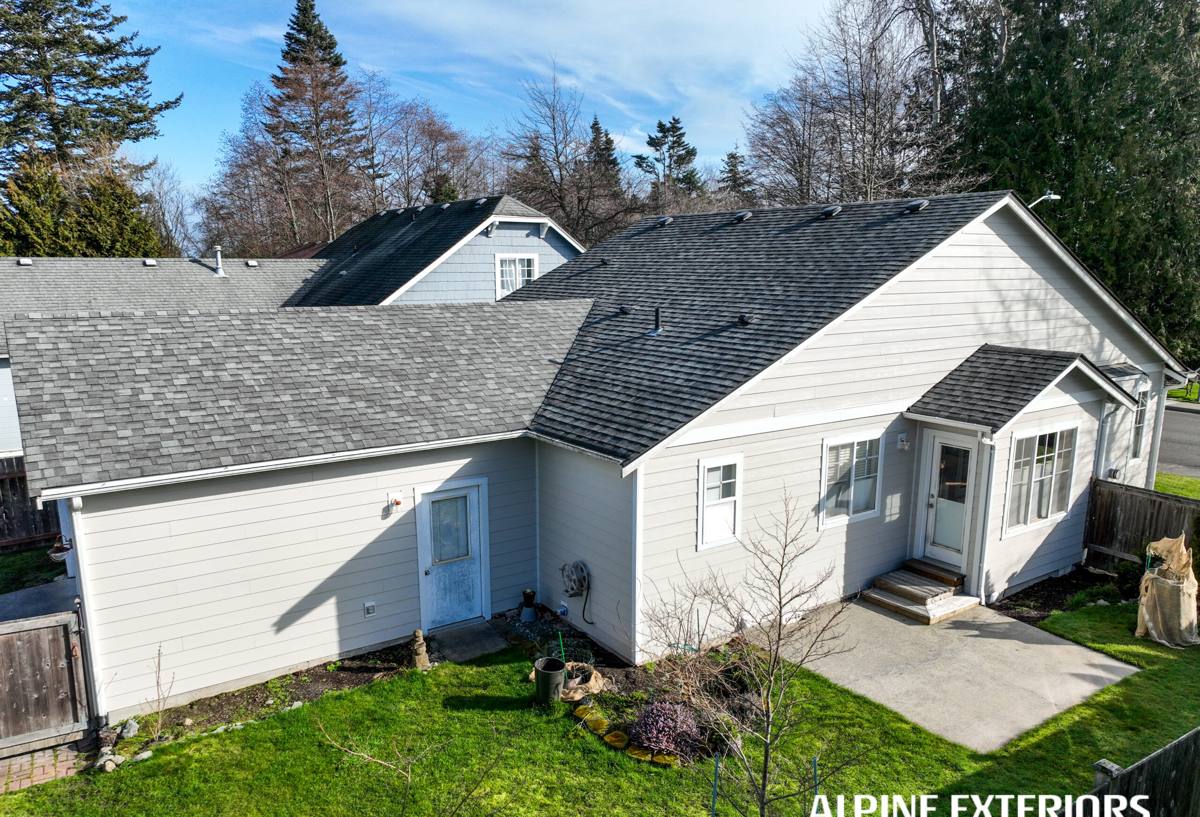
Why Moss Season Matters More Than People Think
"Moss season" in Whatcom County isn't a marketing phrase — it's the several months a year when north-facing and shaded siding stays wet enough for moss and algae to actually take hold. Once moss establishes on a siding surface, it holds moisture against the substrate long after the surrounding area has dried. On wood-based products, that's the beginning of a slow rot cycle. On the wrong siding material, it can also mean the surface itself starts to degrade before the moss problem is even fully visible.
What This Looks Like in Practice
- Green-black staining that returns within a season or two of pressure washing
- Soft or spongy spots near ground level, under gutters, or where two siding pieces butt together
- Paint that's chalking, peeling, or bubbling faster on the shaded side of the house than the sun side
- Caulk joints that have shrunk, cracked, or pulled away from trim
If a homeowner in Happy Valley is seeing two or more of these at once, it's worth having someone look at the whole envelope, not just patch the spot that's visible from the street.
Salt Air's Slower, Quieter Damage
Salt air doesn't rot wood the way standing moisture does — its damage is more about accelerating everything else. Salt residue holds moisture at the microscopic level on a surface, which means paint and finishes break down faster, fasteners corrode sooner, and any small crack or gap becomes a faster entry point for water. Over enough years, a siding product that would have lasted two or three decades somewhere inland can start showing its age noticeably sooner this close to the bay.
This is a big part of why we standardized on James Hardie fiber cement for every siding job we do, including in Happy Valley. Fiber cement is not organic material — it isn't a food source for moss or algae, and it doesn't rot the way wood or wood-composite products can when moisture gets behind the surface. Salt air is still a factor to plan for, but it's not attacking the core material the way it would with a wood-based product.
Why We Only Install James Hardie
We get asked fairly often why we don't offer vinyl, LP SmartSide, cedar, or primed spruce as options. The honest answer is that we made a call, based on what we see on houses in this climate, to standardize on one product system rather than sell whatever a homeowner might have seen advertised.
What That Decision Comes Down To
- Non-combustible core. Fiber cement doesn't burn the way wood-based sidings can, which matters more every year given regional wildfire smoke seasons and general fire risk.
- Factory-cured ColorPlus finish. The color is baked on at the factory under controlled conditions, rather than field-applied paint that has to cure in our actual weather — which in Happy Valley often means damp, cool conditions that are hard on wet-applied finishes.
- HZ5 engineering for this climate. Hardie's HZ5 product line is engineered for wetter, harsher climate zones like ours, with moisture and freeze-thaw performance in mind — this isn't a generic product sold the same way in Arizona and Washington.
- A transferable warranty that holds up. Because the material and finish are backed by the manufacturer as a system, the coverage is more straightforward than trying to track separate warranties for a wood substrate and a field-applied paint job.
We're not going to tell a homeowner that other products are junk — vinyl and LP SmartSide both have real use cases and long track records elsewhere. But for what this specific stretch of Whatcom County coastline puts a house through, we decided fiber cement was the only material we were comfortable standing behind long-term, so it's the only thing we install.
How We Approach a Happy Valley Siding Job
Every job starts with a walk-around, not a quote pulled from a satellite photo. In a neighborhood like this, that matters more than usual — shade patterns, gutter placement, grade slope, and how close the house sits to mature trees all change what we recommend for flashing, ventilation, and drainage plane detailing before a single board goes up.
What a Typical Job Includes
- Removal of the old siding and inspection of the sheathing underneath for hidden moisture damage
- Repair or replacement of any compromised sheathing, framing, or trim found during tear-off
- Installation of a proper weather-resistive barrier and flashing details at windows, doors, and penetrations
- Hardie fiber cement installation to manufacturer spec, including correct fastening, clearances, and caulking
- Final trim, caulking, and touch-up paint at any factory-cut edges
That second step — checking what's under the old siding — is where a lot of the real story of a Happy Valley house gets told. It's common to find a section of sheathing near a downspout or a shaded corner that's been quietly absorbing moisture for years. Catching that during a siding job, rather than after a new product is nailed over it, is the difference between a repair and a much bigger problem five years later.
Siding Doesn't Work Alone: Roofing, Windows, and Decks
A siding job in this climate is only as good as the roof, windows, and trim it ties into. We handle all four trades — siding, roofing, windows, and decks — because in a wet, shaded neighborhood like Happy Valley, water problems rarely respect the line between one contractor's scope and another's.
| Exterior Component | Common Happy Valley Issue | How It Connects to Siding |
|---|---|---|
| Roofing | Moss buildup, worn flashing at walls | Bad roof-to-wall flashing sends water directly behind siding |
| Windows | Failed seals, old flashing tape or none at all | Window leaks often show up first as staining on nearby siding |
| Decks | Ledger board rot where deck meets house | Deck ledger connections are a frequent hidden moisture entry point |
| Gutters/Trim | Overflow from moss-clogged gutters | Splashback and overflow are a leading cause of siding staining at the base |
When we're on-site for a siding estimate, we'll flag anything we see on the roof, windows, or deck connections that's likely to undercut the new siding — not to upsell unnecessary work, but because it genuinely affects how long the siding job lasts.
Cost Factors Specific to This Area
Every house is different, so we're not going to publish a number that doesn't mean anything without seeing the job. What we can say is which factors tend to move the price up or down for homes in this part of Fairhaven specifically.
| Factor | Why It Matters Here |
|---|---|
| Hidden sheathing damage | More common under shaded, moss-prone sections; found during tear-off, not before |
| Access and lot slope | Sloped lots and mature landscaping can affect staging and material movement |
| Trim and detail complexity | Older homes in established neighborhoods often have more trim detail to match |
| Full envelope vs. spot repair | Full re-siding lets us correct flashing and drainage issues; spot repairs can't |
Why a Local Crew Is the Right Call Here
A crew that works Whatcom County regularly knows what a north-facing wall in Happy Valley looks like after five wet winters, versus what the same wall looks like on a sun-exposed lot a few miles inland. That's not something you can fully learn from a spec sheet — it comes from doing the tear-offs, seeing where the rot actually shows up, and adjusting flashing and ventilation details accordingly. A crew unfamiliar with this specific coastal, shaded, moss-heavy environment is more likely to install a technically correct job that still underperforms here.
Being local also means we're not disappearing after the invoice clears. Warranty work, a caulking touch-up, a question a few years down the line — that's easier to handle well when the crew that did the work is still working in the same neighborhood.
Signs It's Time to Call
- Moss or algae staining that returns quickly after cleaning
- Soft, spongy, or discolored siding near the ground or under windows
- Visible gaps, cracked caulk, or warping at siding joints and corners
- Paint failing noticeably faster on shaded or bay-facing walls than elsewhere on the house
- Any known history of leaks around windows, the roofline, or a deck ledger
If any of that sounds familiar, it's worth having a look before the next wet season adds to the problem. We're happy to come out, walk the property, and give a straight assessment of what's going on — with a free, no-pressure estimate if siding, roofing, window, or deck work turns out to make sense.