 Fairhaven Siding
 Siding Built for Life on Lummi Island
Lummi Island sits out in the Salish Sea, reached by a short ferry crossing from the Lummi Peninsula, and that setting shapes everything about how a house should be built and maintained here. Homes on the island face a combination of conditions that mainland Whatcom County properties often get in smaller doses: near-constant marine humidity, salt-laden air coming off the water, driving winter rain that hits siding sideways instead of straight down, and long stretches of the year when shaded walls barely dry out between storms. Fairhaven Siding Company has worked on homes throughout this stretch of Whatcom County long enough to know that generic siding advice doesn't hold up out here. What protects a house in a drier inland neighborhood isn't necessarily what protects a house a few hundred yards from tidal water.
This page walks through what we actually see affecting siding, roofs, windows, and decks on island and shoreline properties, and why we've standardized on one siding product rather than offering the usual menu of options.
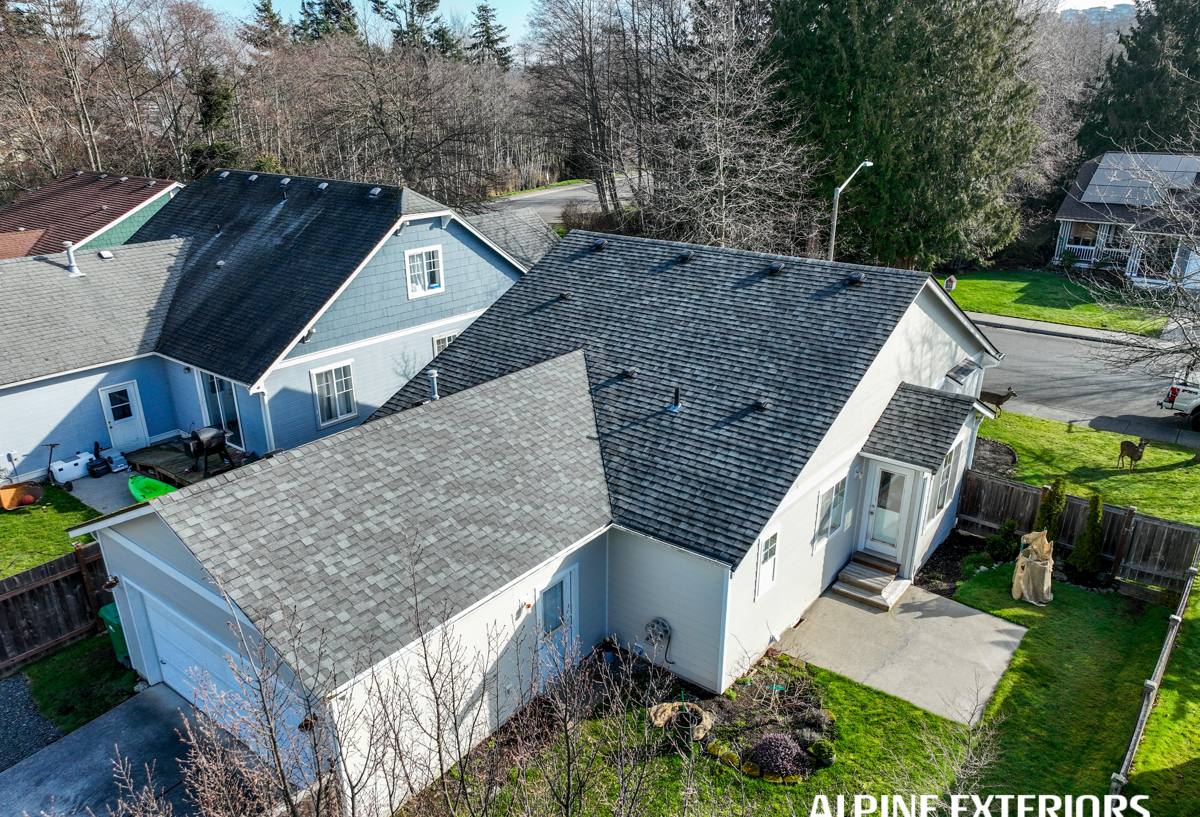
What Salt Air and Marine Exposure Do to a House
Salt air isn't just a smell — it's airborne moisture carrying dissolved salts that settle on every exterior surface, including siding, trim, fasteners, and window hardware. Over years, that exposure does a few predictable things:
- Accelerates corrosion on exposed metal fasteners, flashing, and hardware if the wrong materials or finishes were used
- Draws moisture into porous or poorly sealed siding materials, since salt is hygroscopic and pulls humidity out of the air
- Breaks down paint and factory finishes faster than the same products would fail inland
- Contributes to premature fading and chalking on lower-grade coatings
None of this means a house on Lummi Island is doomed to constant repairs. It means the materials and installation details matter more here than they would forty miles inland, and cutting corners on either one shows up faster on an island lot than it would in a sheltered subdivision.
Wind-Driven Rain and Wall Assemblies
Whatcom County's weather off the Salish Sea tends to arrive at an angle. Wind-driven rain gets forced up under laps, around trim, and into any gap in the water-resistive barrier that a calmer rain would never reach. This is why flashing details at windows, doors, and horizontal trim boards matter as much as the siding material itself — a great product installed with weak flashing will still let water in, and a modest product installed with excellent flashing will often outperform it.
Moss, Algae, and the Long Wet Season
Anyone who has scrubbed a north-facing wall or a shaded roofline in this part of Washington knows the pattern: moss and algae don't need standing water, just persistent dampness and low sun exposure. Trees, prevailing shade, and the marine layer that keeps humidity elevated even on dry days all add up to a long "moss season" that can run most of the year on shaded elevations.
Moss and algae growth on siding is mostly a cosmetic and maintenance issue on a sound wall assembly, but it's worth taking seriously for two reasons. First, moss holds moisture against the surface it's growing on, extending the amount of time siding stays wet after a rain. Second, on materials that aren't dimensionally stable or that swell when wet, prolonged dampness can accelerate warping, cupping, or fastener failure over time. The siding material's ability to shrug off sustained moisture exposure — not just survive an occasional soaking — is one of the biggest differences between products that hold up here and ones that don't.
Why We Only Install James Hardie Fiber Cement
Fairhaven Siding Company installs James Hardie fiber cement siding exclusively. We don't offer vinyl, LP SmartSide, Cemplank, Allura, primed spruce, or cedar as options, and that's a deliberate standard, not a lack of access to those products.
Each of those alternatives has legitimate strengths — cedar's appearance, vinyl's low upfront cost, engineered wood's workability — but each also carries a trade-off that we think matters more on exposed, marine-climate properties like those on Lummi Island than it might elsewhere:
- Vinyl siding can warp or become brittle with UV and temperature swings, and its seams and panels can allow wind-driven rain to work behind the cladding over time.
- LP SmartSide and other engineered wood products are wood-based, which means sustained moisture exposure — the kind a shaded, salt-air wall gets for months at a time — is exactly the condition that stresses them most if any edge or fastener point isn't perfectly sealed and maintained.
- Cedar and primed spruce are natural wood and require ongoing refinishing to keep moisture out; skip a cycle or two of maintenance in a wet climate and the consequences compound quickly.
- Other fiber cement brands (Cemplank, Allura) are reasonable products, but we've standardized on one manufacturer's system, factory finish, and warranty structure rather than mixing installation standards across brands.
James Hardie fiber cement is non-combustible, dimensionally stable when wet or dry, and available in the HZ5 formulation engineered for cold, wet climate zones like ours. Its ColorPlus factory finish is baked on under controlled conditions rather than field-applied, which gives it more consistent, longer-lasting color adhesion than a job-site paint job — a real advantage when a house is going to spend a lot of its life damp. Backed by a strong transferable warranty and installed to the manufacturer's specifications, it's the product we're willing to put our name behind on the properties most exposed to this coastline.
Comparing Siding Materials for Coastal & Island Exposure
| Material | Moisture Behavior | Maintenance | Typical Lifespan Here |
|---|---|---|---|
| James Hardie fiber cement | Dimensionally stable; resists warping when wet | Occasional wash; factory finish holds color | Decades with proper installation |
| Vinyl | Can flex, warp, or gap at seams under wind-driven rain | Low, but seams/panels degrade over time | Shorter in high-exposure, windy sites |
| LP SmartSide / engineered wood | Wood-based; vulnerable if edges aren't sealed and maintained | Requires diligent caulking/paint upkeep | Variable; moisture-sensitive |
| Cedar / primed spruce | Natural wood; absorbs moisture without upkeep | Regular refinishing required | Shorter without consistent maintenance |
How Our Process Works for Lummi Island Properties
Working on the island means planning around the ferry schedule and being realistic about material delivery and crew logistics — something an out-of-area contractor unfamiliar with the crossing can underestimate, leading to delays or rushed scheduling. Our approach:
- On-site assessment: We look at sun exposure, prevailing wind and rain direction, existing moss or moisture damage, and the condition of trim, flashing, and fasteners — not just the siding surface.
- Honest scope: If only one elevation is showing damage, we say so rather than pushing a full re-side that isn't needed yet.
- Logistics planning: Material staging and crew scheduling account for the ferry crossing so the project runs on the timeline we quote, without last-minute surprises.
- Installation to spec: Correct fastener spacing, clearances, and flashing details — the parts of a siding job that don't show up in a walk-around but determine whether the wall performs in a storm five years from now.
Beyond Siding: Roofing, Windows, and Decks
Salt air, moss, and driving rain don't stop at the siding line. We also handle roofing, windows, and decks, and on island and shoreline properties these systems face the same pressures:
- Roofing: Moss on roof surfaces holds moisture against shingles and can shorten roof life if left unaddressed; roof and gutter condition also directly affects how much water ends up running down and behind siding.
- Windows: Flashing and sealing around windows is one of the most common failure points for water intrusion in wind-driven rain; window replacement is often the right moment to correct old flashing details at the same time.
- Decks: Exposed decking takes UV, salt air, and standing moisture directly, and materials/fastener choices matter as much here as they do on the walls above.
Looking at the whole exterior together — rather than treating siding, roofing, windows, and decks as separate problems — is usually how we catch the small issues before they become expensive ones.
Signs Your Siding May Need Attention
- Persistent moss or algae staining on shaded walls that returns quickly after cleaning
- Soft spots, bubbling, or visible warping, especially near the ground or at corners
- Paint or finish that's chalking, peeling, or fading unevenly
- Gaps opening up at seams, trim boards, or around window and door flashing
- Rusting or staining around fasteners or metal trim
- Rooms that feel damp or musty along exterior walls
Any one of these on its own isn't necessarily an emergency, but on an island property, several appearing together is usually a sign the wall assembly is losing its ability to keep moisture out.
What to Ask Before Hiring a Siding Contractor Here
Because coastal and island exposure punishes shortcuts faster than a typical inland lot, it's worth being direct with any contractor about how they handle flashing, fastener spacing, and manufacturer specifications — and whether they've actually worked on properties with similar exposure, not just similar square footage.
If you're weighing a siding, roofing, window, or deck project on Lummi Island and want a straight answer about what your home actually needs, we're happy to take a look. Estimates are free, and there's no pressure to move forward before you're ready.