 Fairhaven Siding
 Marietta's Exterior Climate: Salt Air, Driving Rain, and a Long Moss Season
Marietta sits close enough to Bellingham Bay and the greater Whatcom County shoreline that homes here deal with a specific combination of punishment most inland siding never has to survive. Salt-laden air moves in off the water and settles on exterior surfaces, accelerating corrosion on fasteners, trim, and anything with exposed metal. Add in driving rain that comes sideways during winter storms, and you've got a climate that tests every seam, joint, and caulk line on a house.
Then there's moss. Whatcom County's mild, wet winters and short, humid summers create a moss season that, practically speaking, never fully ends. It just slows down. Moss and algae hold moisture against a wall assembly, and moisture held against the wrong siding material for months at a time is where problems start — swelling, soft spots, and paint or coating failure that shows up years before it should.
None of this is unique to Marietta specifically — it's the reality for most of the Fairhaven area and Whatcom County generally — but Marietta's proximity to open water and its mix of older and newer homes means we see the full range of what this climate does to siding, from houses that were built and clad correctly decades ago and are still holding up, to houses where the wrong product or a rushed install left visible damage within a handful of years.
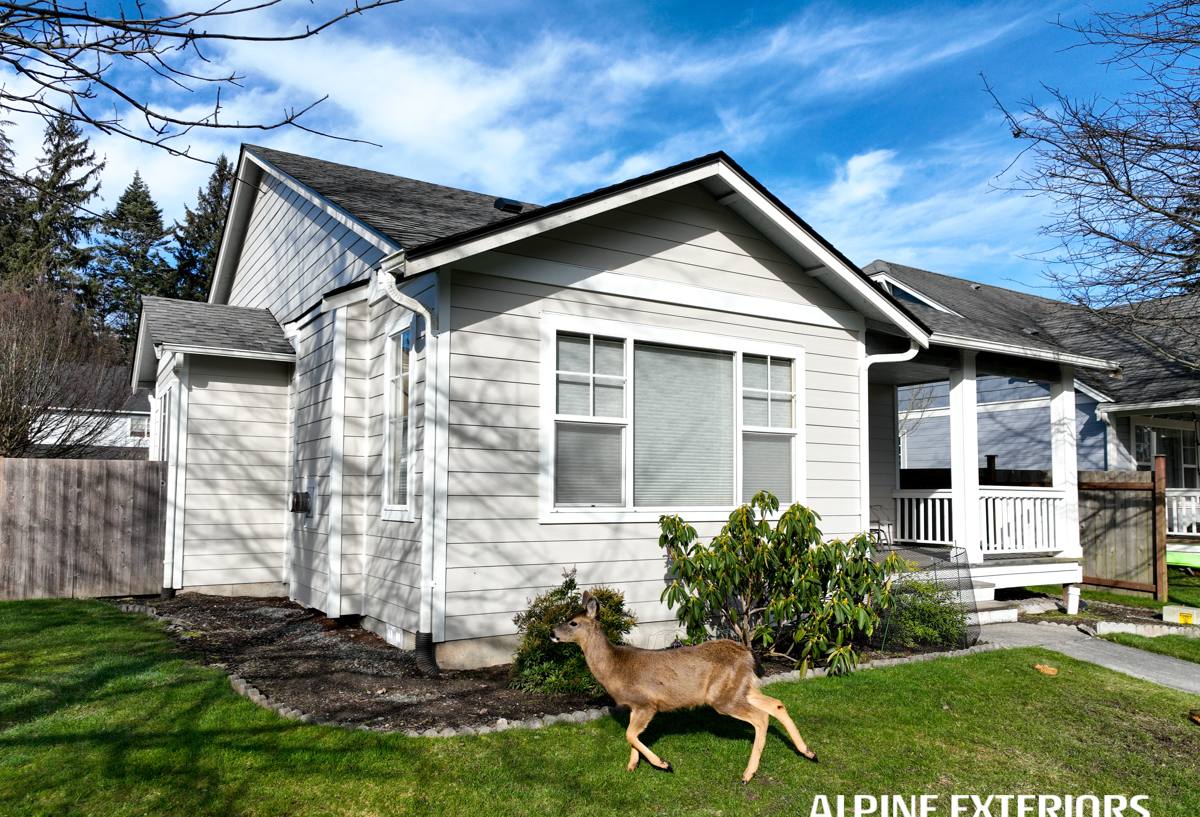
A Neighborhood We Actually Work In
There's a real difference between a contractor who drives in from out of the area for a job and a crew that works Marietta and the surrounding Fairhaven neighborhoods regularly. We know how the wind comes off the water here, which sides of a house take the worst of the driving rain, and how quickly moss can take hold on a north-facing wall that doesn't get much sun. That local knowledge shapes decisions on every project — where extra flashing attention matters, how ventilation should be handled behind the siding, and which trim details hold up and which ones don't.
A local crew also means accountability. If something needs a follow-up visit, we're not scheduling around a multi-hour drive. That matters more in a maritime climate like this one, where a small gap in caulking or a missed flashing detail can turn into a real problem after a few wet winters if it isn't caught early.
What Siding Actually Has to Survive Here
It helps to be specific about what "coastal climate" actually means for a wall assembly, because the individual stresses compound each other rather than acting alone.
| Climate Factor | What It Does to Siding |
|---|---|
| Salt air | Accelerates corrosion of fasteners and metal trim; degrades some coatings faster than inland exposure |
| Driving rain | Pushes moisture into seams, laps, and any gap in flashing or caulk, especially on wind-facing walls |
| Persistent humidity / moss | Keeps surfaces damp longer between rain events, feeding moss and algae growth that traps additional moisture |
| Temperature swings | Repeated expansion and contraction stresses joints, caulk lines, and paint or coating adhesion over time |
| UV exposure (summer) | Fades and chalks lower-quality finishes faster than a factory-cured coating |
Any one of these stresses is manageable. All of them acting on the same wall, year after year, is what separates siding that lasts thirty-plus years from siding that needs attention in year eight or ten.
Why We Install Only James Hardie Fiber Cement
We made a decision as a company to install one siding system: James Hardie fiber cement. We don't install vinyl, LP SmartSide, Cemplank, Allura, primed spruce, or cedar. That's not a marketing position — it's a standard we hold because of what we've seen this specific climate do to alternatives over time.
Wood-based and engineered-wood products depend on an unbroken paint or coating film to keep moisture out. In a climate with this much sustained dampness and moss pressure, any breach in that film — a nail pop, a scuff, a hairline crack at a joint — becomes an entry point. Once moisture gets behind the surface of an engineered wood product, it can swell, delaminate, or rot from the inside, and by the time it's visible from the outside, the damage is often already done. Vinyl handles moisture differently but has its own weaknesses here: it can warp or distort under heat and UV exposure, and its color is baked into a thin material that fades over time with no way to refinish it short of replacement.
James Hardie fiber cement is a mix of cement, sand, and cellulose fiber — it doesn't absorb and swell the way wood-based products can, and it isn't a petroleum-based material that softens or distorts under heat. Hardie's ColorPlus finish is baked on at the factory under controlled conditions, which gives it more consistent, longer-lasting color than field-applied paint. Hardie also engineers specific product lines (their HZ5 designation, for example) for regions with more moisture exposure, which is directly relevant to a location like Marietta.
To be fair to the alternatives: a well-maintained wood or engineered-wood siding job, painted and re-caulked on schedule by a homeowner who stays on top of it, can perform reasonably well for a while. Vinyl is inexpensive and low-maintenance in the sense that it doesn't need painting. We're not claiming those products fail on every house. We're saying that for the climate Marietta homes actually sit in, and for the standard we want to put our name behind, fiber cement gives us the best combination of moisture resistance, finish durability, and long-term performance without asking a homeowner to stay on top of a maintenance schedule to avoid problems.
Hardie Product Lines We Work With
- HardiePlank lap siding — the most common choice, available in several exposure widths and textures
- HardiePanel vertical siding — often used for accent sections, gables, or a more modern look
- HardieShingle — a shaped-shingle profile for homes wanting that texture without the maintenance of real wood shingles
- HardieTrim — matching trim boards for a finished, consistent look at corners, windows, and fascia
Roofing, Windows, and Decks — Treating the Whole Exterior
Siding doesn't work in isolation. A house is a system, and the same climate stresses that affect siding — driving rain, sustained moisture, UV, temperature cycling — hit the roof, windows, and any exterior decking just as hard. We handle all four because they interact directly with each other on a real project.
Roofing and siding meet at flashing details — around chimneys, at wall-to-roof transitions, at valleys draining onto lower walls. Get that wrong and water finds its way behind even well-installed siding. Windows are similarly tied in: window flashing and the siding trim around each opening are one of the most common places where water intrusion actually starts on a house, so when we're doing siding work near existing windows, that interface gets real attention rather than a quick caulk-and-move-on approach. Decks in this climate face their own version of the same problem — standing moisture, moss on horizontal surfaces, and ledger-board connections to the house that need the same careful flashing logic as a wall.
Coordinating these trades under one crew means fewer handoffs, fewer "that's the other contractor's problem" gaps, and a final result where the whole exterior envelope was thought through together instead of stitched together from separate jobs.
Our Process for a Marietta Siding Project
- On-site assessment. We walk the house, check existing siding and trim condition, look at moisture exposure by elevation, and note any rot, flashing issues, or ventilation problems under the current cladding.
- Scope and product selection. We talk through Hardie product lines, profiles, and ColorPlus color options based on the home's style and exposure.
- Tear-off and inspection. Once old siding comes off, the sheathing and house wrap underneath get inspected for hidden damage before anything new goes up.
- Weather barrier and flashing. Correct house wrap, flashing at every window, door, and penetration, and proper lap sequencing — this step is where most long-term failures are actually prevented or created.
- Installation to manufacturer spec. Hardie's warranty depends on installation following their published guidelines — fastener spacing, clearances, caulking at the right joints and not others. We install to that spec, not around it.
- Final walkthrough. We go over the finished job with the homeowner before calling it done.
Cost Factors on a Real Project
Every house is different, so we won't put a number on this page that doesn't mean much without seeing the actual home. What we can do is explain what actually moves the price up or down.
| Factor | Why It Matters |
|---|---|
| House size and complexity | More wall area and more corners, gables, and dormers means more material and labor |
| Existing siding condition | Rot or sheathing damage found during tear-off adds repair work before new siding can go up |
| Product line and profile | HardieShingle and custom trim details cost more in labor than a straightforward lap siding job |
| Access and site conditions | Steep lots, limited staging area, or multi-story sections affect labor time and equipment needs |
| Scope beyond siding | Bundling trim, windows, or deck work into the same project changes the total but often saves on mobilization costs |
The only way to get an accurate number is a walk-through, which is why we start every project with a real, in-person look at the house rather than a phone estimate.
Maintenance After Installation
Fiber cement is genuinely low-maintenance compared to wood-based alternatives, but "low-maintenance" isn't "zero-maintenance," especially in a moss-prone, salt-air climate. A little seasonal attention goes a long way toward getting the full lifespan out of the investment.
- Rinse siding periodically to clear salt residue and organic buildup, especially on walls facing the water or shaded from direct sun
- Keep gutters clear so overflow doesn't run down and pool against siding at corners or seams
- Trim back vegetation and tree cover that keeps a wall section shaded and damp longer than the rest of the house
- Watch caulk lines at trim and window joints for cracking or separation, and have gaps re-sealed before a wet season sets in
- Address any moss growth on siding promptly rather than letting it establish and hold moisture against the surface
Choosing a Contractor for This Kind of Work
Siding, roofing, window, and deck work all involve moisture management as the core skill, not just installation speed. When vetting any contractor for exterior work in this climate, it's worth asking directly about their manufacturer certifications, how they handle flashing at penetrations, what warranty actually transfers with the work, and whether they'll put the scope and materials in writing before starting. A contractor who's vague on any of those questions is worth a second look before signing anything.
If you're weighing a siding, roofing, window, or deck project for a Marietta home, we're glad to come take a look and talk through what your house actually needs. The estimate is free, there's no pressure attached to it, and you can use the form on this page to get started.