 Fairhaven Siding
 Why Ferndale Homes Need Siding Built for This Exact Climate
Ferndale sits close enough to the water and open farmland that its houses take a specific kind of weather beating: salt-laden air drifting off the Strait and bay, long stretches of driving rain pushed in by winter storms, and a moss season that can run from October clear through April. None of these on their own is unusual for Whatcom County. Together, applied year after year to the same siding, they expose weak products fast and reward well-engineered ones.
Salt air is corrosive to fasteners and can accelerate finish breakdown on lower-grade materials. Driving rain doesn't just wet a wall's surface — it drives moisture sideways and upward into laps, seams, and butt joints if those details weren't built to shed water. And moss doesn't just look bad; a sustained moss or algae mat holds moisture against the siding surface for weeks at a time, which is exactly the condition that rots wood-based products and de-laminates cheaper composites. A siding choice that ignores any one of those three factors is a siding choice that will need attention again sooner than it should.
What We Install in Ferndale — and Why
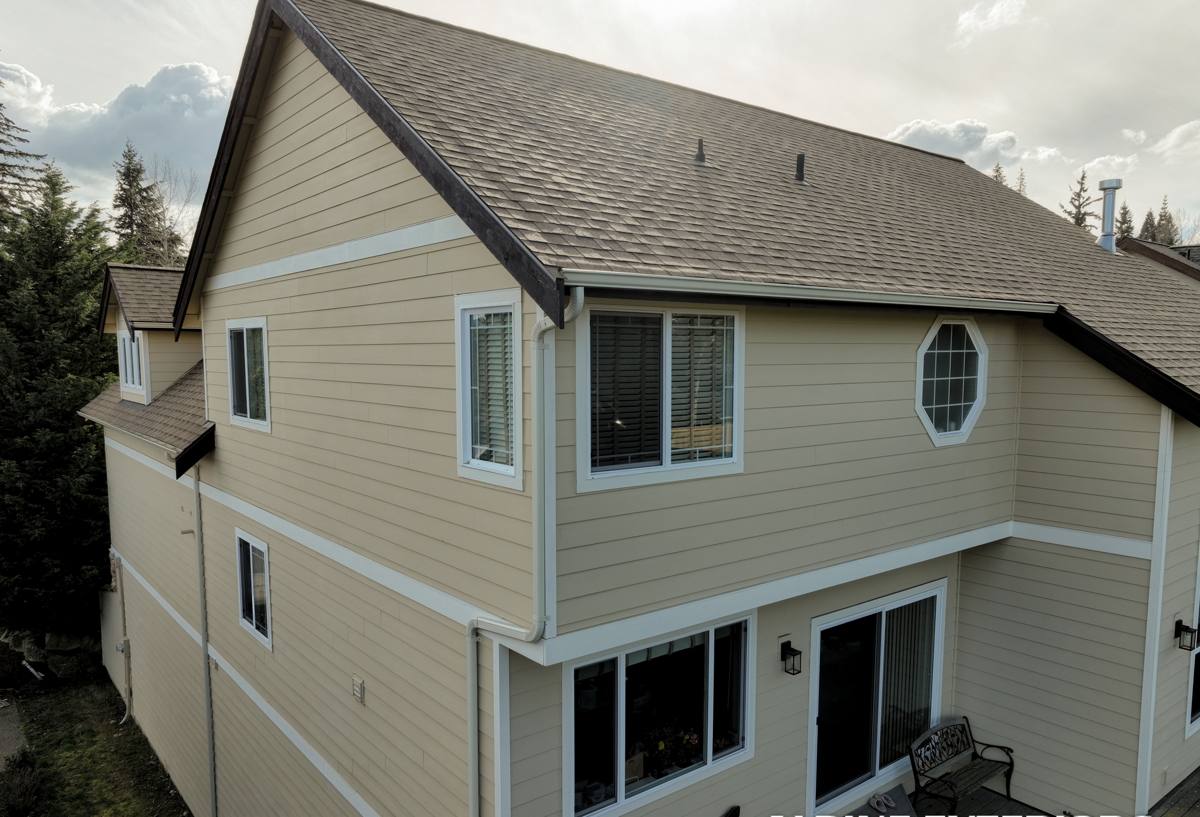
We install James Hardie fiber cement siding exclusively. We don't install vinyl, LP SmartSide, cedar, primed spruce, Cemplank, or Allura — not because those products have no legitimate use anywhere, but because after years of working exteriors in this specific climate, Hardie is the one system we're comfortable standing behind on a Whatcom County home. It's non-combustible, it's engineered specifically for wet regional climates through Hardie's HZ10 product line (the version specified for the Pacific Northwest), and it carries a factory-applied ColorPlus finish that isn't relying on field-applied paint to do the weather-resistance work.
That specificity matters here. A siding product engineered for a dry inland climate, or one that depends on a perfect field paint job to perform, is fighting Ferndale's climate instead of working with it. HZ10 fiber cement is formulated and tested for exactly this — sustained moisture exposure, freeze-thaw cycling, and coastal air.
What Correct Fiber Cement Installation Actually Involves
- Proper rain-screen or drainage plane behind the siding so any incidental moisture has somewhere to go instead of sitting against the wall sheathing
- Correct fastener spacing, type, and embedment — under- or over-driven nails are one of the most common causes of early fiber cement failure
- Manufacturer-specified clearances at grade, decks, and roofs so splash-back and ponding water can't wick into the bottom course
- Caulked and flashed penetrations at every window, vent, and fixture — not just caulk alone
- Butt joints backed and sealed per Hardie's published details, not just butted and caulked over
- Factory-cut and factory-primed edges left exposed as little as possible; field cuts sealed with the correct touch-up product
Every one of these details is a place where installation quality outweighs the product itself. A misinstalled premium product will underperform a correctly installed midgrade one. We treat the install spec as non-negotiable, not a checklist to speed past.
How Salt Air Changes the Job
Fastener corrosion is the practical issue with salt exposure — over time, standard fasteners can weaken or streak the siding face with rust if the wrong hardware is used. We spec corrosion-resistant fasteners appropriate for coastal exposure on every Ferndale project, not just the homes closest to open water. Salt air doesn't stop at a hard line a few blocks inland; it travels on wind and settles gradually, so a home a mile from the water still sees meaningfully more exposure than one thirty miles inland in the county.
ColorPlus factory finish also matters more here than in a drier climate. A factory-baked-on finish resists the chalking and fading that field-applied paint is more prone to under repeated salt and moisture cycling, which means fewer repaint cycles over the life of the siding.
Driving Rain and Water Management
Wind-driven rain in this region doesn't fall straight down — it hits siding at an angle and works into any gap that isn't properly lapped or flashed. This is where installation detail work does more than the siding material itself. Correct lap dimensions, flashing above windows and doors, and a functioning drainage plane behind the cladding are what actually keep a wall assembly dry during a real Pacific Northwest storm, not just a light rain shower.
We also pay close attention to horizontal trim and butt joint placement on Ferndale homes, since these are the highest-risk spots for wind-driven rain intrusion if they're not backed and sealed to spec.
Moss, Algae, and Long-Term Surface Health
A moss season that stretches most of the year means siding spends a lot of time in shade, under tree cover, or on north-facing walls that rarely dry out fully between rains. Fiber cement doesn't feed mold or moss growth the way wood-based siding can, and it doesn't swell or delaminate from sustained dampness the way some engineered wood products do. That's a meaningful difference on a property with mature trees or a shaded north elevation — a common layout on older Ferndale lots.
Homeowners can still expect some surface growth over time in shaded, damp spots; that's a Pacific Northwest reality for any exterior surface. The difference with correctly installed fiber cement is that a wash-down keeps it looking right without threatening the material underneath, which isn't true of every siding type.
What a Ferndale Siding Project Looks Like With Us
Our Process
- On-site assessment — we look at wall exposure, tree cover, drainage, current siding condition, and any moisture damage before quoting anything
- Detailed proposal — product line, color, trim details, and a clear scope so there are no surprise change orders mid-project
- Tear-off and sheathing check — we inspect what's behind the old siding before covering it back up, since that's the only chance to catch hidden rot or moisture damage
- Drainage plane and flashing installation — the unglamorous part that determines whether the job lasts
- Hardie panel or lap installation — to manufacturer spec, with corrosion-resistant fasteners
- Final walkthrough — trim, caulking, and touch-up review with the homeowner before we call it done
Why a Crew That Already Works Ferndale Matters
Installation quality is only half the equation — the other half is knowing what this specific area throws at a wall assembly. A crew that mostly works drier inland regions may not default to coastal-grade fasteners or think twice about a shaded north wall's drying time. A crew that's already worked Whatcom County exteriors builds those calls into the estimate and the install plan from day one, without needing to be told.
Fiber Cement vs. Other Siding Options for This Climate
| Factor | James Hardie Fiber Cement (HZ10) | Vinyl | Wood / Engineered Wood |
|---|---|---|---|
| Moisture tolerance | Engineered for wet climates; doesn't rot or swell | Doesn't absorb water, but can warp and gap over time | Vulnerable to rot and swelling under sustained moisture |
| Salt air resistance | Strong with correct fasteners; factory finish resists breakdown | Can become brittle and discolor faster near salt exposure | Finish breaks down faster; more frequent repainting near coast |
| Moss/algae impact | Surface growth washes off without damaging material | Surface growth washes off; material itself is inert | Sustained dampness under growth can accelerate decay |
| Fire resistance | Non-combustible | Combustible | Combustible |
| Finish longevity | Factory ColorPlus finish, long repaint interval | Color molded in; can fade and chalk | Field-painted; regular repainting required |
Vinyl holds up reasonably well against moisture on its own, and that's a fair point in its favor — but its performance in wind and heat, plus its combustibility, is why we don't put it on Ferndale homes when fiber cement is the alternative. Wood and engineered wood products can look excellent initially, but this climate's moisture load is precisely the condition that shortens their service life the fastest.
Cost Factors on a Ferndale Fiber Cement Project
| Factor | How It Affects the Project |
|---|---|
| Home size and wall complexity | More corners, gables, and dormers mean more cutting, flashing, and labor time |
| Current siding condition | Rot or hidden moisture damage found during tear-off adds sheathing repair before new siding goes on |
| Panel vs. lap style | Different Hardie profiles carry different material and labor costs |
| Trim and accent detail | Custom trim packages and accent bands add labor beyond a straightforward re-side |
| Access and site conditions | Tree cover, tight lot lines, or multi-story walls affect scaffolding and staging time |
We don't quote from a distance — every estimate follows an on-site look at the actual wall conditions, because two homes of the same square footage can have very different scopes once you account for what's underneath the existing siding.
A Practical Checklist Before You Choose a Siding Contractor
- Do they install one system to spec, or a wide mix of products with varying installation standards?
- Will they inspect sheathing during tear-off before covering it back up?
- Do they spec corrosion-resistant fasteners for coastal exposure, or use whatever's standard stock?
- Can they explain their flashing and drainage-plane approach in plain terms?
- Do they have experience specifically in Whatcom County's wet, coastal-influenced conditions?
If your Ferndale home's siding is showing moss buildup that won't wash off, soft spots near the base, or a finish that's chalking and fading faster than it should, we're happy to take a look. We offer free, no-pressure estimates — no obligation, just a straight assessment of what your home actually needs.