 Fairhaven Siding
 Why Ferndale Decks Wear Out Faster Than the Brochure Says
Ferndale sits close enough to Bellingham Bay and the Strait of Georgia that salt-laden air reaches yards that never see the water directly. That air attacks exposed metal — nail heads, screw threads, joist hangers, bolts — long before most homeowners notice anything wrong with the decking itself. Add in Whatcom County's wet season, where driving rain off the Pacific can run for days at a time, and you get decks that stay damp at the framing level for weeks even when the surface looks dry. Shade from mature evergreens, common on older Ferndale lots, keeps that moisture around even longer and gives moss and algae a head start every fall.
None of this means a deck is doomed. It means a deck built or repaired without accounting for the local conditions tends to fail from the inside out — at the ledger board, the fasteners, and the framing — well before the decking boards themselves look worn. A replacement done right this time should outlast one built without that in mind by a decade or more.
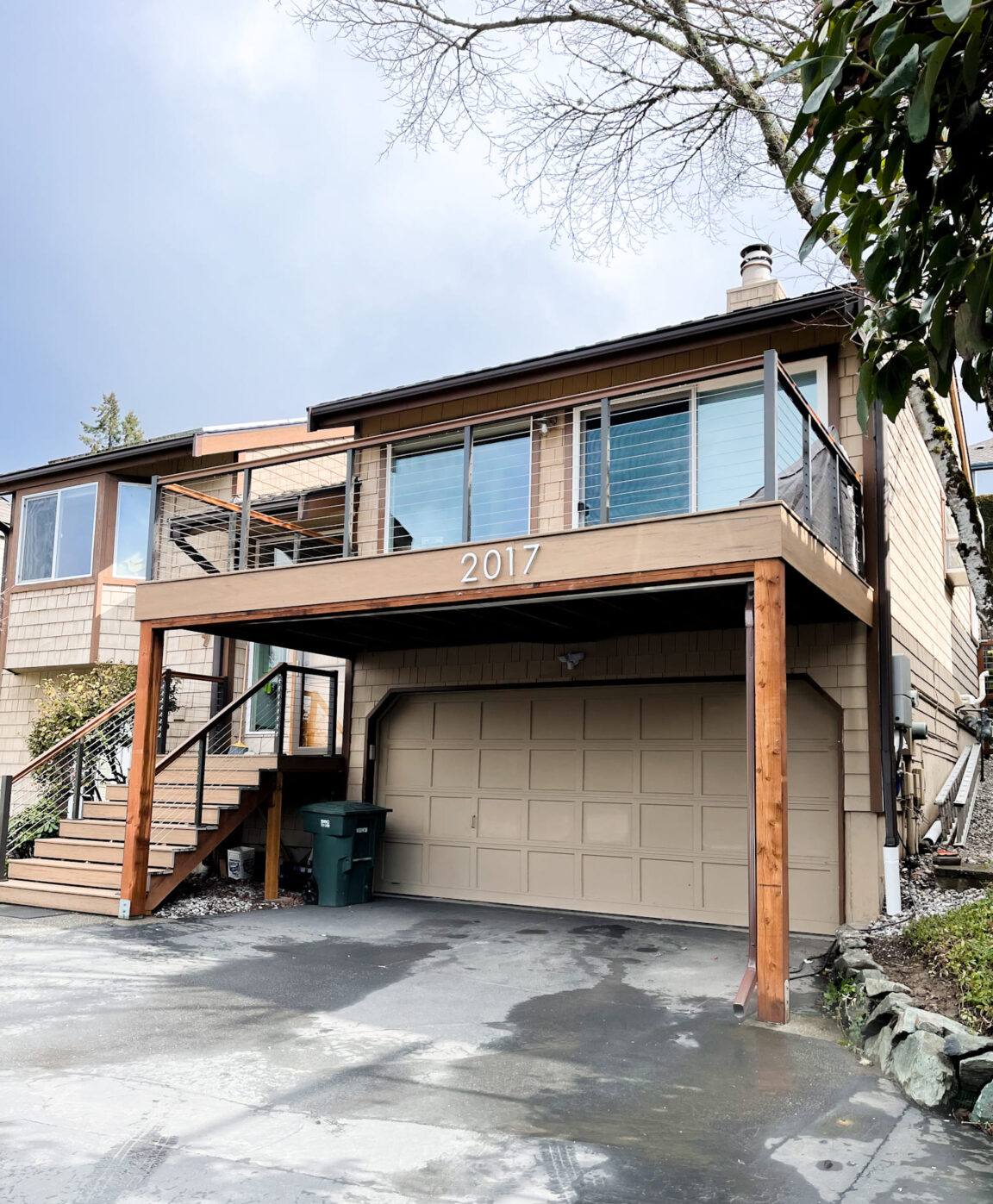
Signs a Ferndale Deck Needs Replacement, Not Another Repair
Some deck problems are cosmetic and some are structural. Knowing the difference saves money — replacing boards on a deck with a compromised frame just delays the real fix, and full replacement of a deck that only needs new decking wastes a perfectly good structure. Here's what tells us which situation we're looking at:
- Soft, spongy, or bouncy spots underfoot — usually rotted joists or a failing ledger connection, not a surface problem
- Rust streaks below fasteners or hardware, or fasteners that back out or snap when touched — common near Ferndale's coast where standard hardware corrodes faster than inland
- A visible gap, dark staining, or sag where the deck meets the house — often a sign the ledger board flashing has failed and water has been getting into the rim joist
- Persistent moss or black-green algae film that returns within weeks of cleaning, even after pressure washing
- Boards that are cupping, checking deeply, or crumbling at the ends where cut lumber wasn't resealed
- Railings or posts that flex, or a guardrail that no longer meets a firm push test
- A deck built more than 20-25 years ago, especially one attached with nails instead of structural screws or bolts at the ledger
If what you're seeing is limited to surface wear — faded or splintering boards on an otherwise solid frame — a resurfacing or board replacement may be the more honest answer, and we'll tell you that instead of selling a full rebuild you don't need.
What a Correct Deck Replacement Actually Involves
The Ledger Connection and Flashing
This is the single most important detail on any deck attached to a house, and it's the one most often done poorly on older Ferndale builds. The ledger board — the piece bolted to your house that carries a large share of the deck's weight — has to be flashed correctly so rain can't run behind it into the rim joist and wall framing. In a climate with as much sustained rain as Whatcom County gets, a poorly flashed ledger doesn't just leak; it stays wet for most of the fall and winter, which is exactly the condition wood rot needs. We install proper flashing that sheds water away from the house, not toward it, and we check the rim joist behind it for existing damage before anything new goes up.
Footings and Framing
Footings need to be sized and set to current code depth, and framing lumber needs to be rated for ground contact where it's close to grade. We check post spacing and beam sizing against the actual span and load, not just what was there before — a lot of older decks were framed lighter than current code allows.
Hardware and Fasteners
Given how much faster standard steel corrodes with salt air in the mix, we use stainless steel or heavy hot-dip-galvanized fasteners and connectors rated for exterior and coastal-adjacent exposure, not the cheaper coated hardware that shows rust streaks within a couple of seasons. Joist tape over the top of framing members is standard on our replacements — it keeps water off the wood at every fastener penetration, which matters more here than in a drier climate.
Decking Material
The decking surface is the part homeowners see, but it's the last decision, not the first. We'll walk through the tradeoffs below once the structure underneath is sorted out.
Railings and Guardrails
Guardrail height, baluster spacing, and post attachment all have to meet current residential code, whether the old railing met code when it was built or not. We rebuild railings to current standard as part of every replacement.
Choosing a Decking Material for Whatcom County Weather
There's no single "best" decking material — there's a best fit for how much upkeep you want to do and how much shade and moisture your specific yard sees. Here's how the common options actually perform in a wet, moss-prone, salt-air-adjacent climate like Ferndale's:
| Material | Moisture & Rot Resistance | Moss/Algae Resistance | Maintenance | Typical Lifespan |
|---|---|---|---|---|
| Cedar | Good if sealed and maintained | Needs regular cleaning to stay ahead of it | Annual cleaning, periodic staining/sealing | 15-20 years with upkeep |
| Pressure-treated pine/fir | Good structurally; surface still needs sealing | Moderate; shaded areas need attention | Sealing every 1-2 years | 15-25 years |
| Capped composite | Excellent — won't rot | Good; smooth cap sheds moisture and film | Occasional washing, no sealing/staining | 25-30+ years |
| PVC decking | Excellent — fully synthetic, no wood content | Very good | Lowest of the group | 25-30+ years |
Homeowners with a lot of shade or tree cover — common in Ferndale's older, more established neighborhoods — tend to be happiest long-term with a capped composite or PVC board, simply because they don't have to fight moss growth every year the way you do with bare or lightly sealed wood. That said, plenty of people prefer the look and feel of real wood and are willing to keep up with sealing; that's a legitimate choice too, as long as you go in knowing the maintenance schedule that climate requires.
Permits and Code in Whatcom County
Most deck replacements that involve new framing, footings, or a deck built above a certain height require a permit through Whatcom County or the City of Ferndale, depending on your property's jurisdiction. Permitted work means a third-party inspector checks the footings and framing before decking goes down and signs off on the finished railing — which is a good thing, since it catches structural mistakes while they're still cheap to fix. We handle the permit application and coordinate inspections as part of the job, so you're not the one tracking down paperwork or waiting on hold with the county.
Guardrail height, stair rail requirements, and baluster spacing are all set by code and don't vary by preference — we build to current code on every job regardless of what was there before.
How Our Deck Replacement Process Works
- On-site assessment — we check the ledger connection, framing, footings, and any moisture or rot damage before quoting anything, so the estimate reflects what's actually there
- Material and layout decisions — we walk through decking options, railing style, and layout based on your yard's sun/shade pattern and how you use the space
- Permitting — we file with the correct jurisdiction and schedule required inspections
- Demolition — full removal of the old deck, checking the exposed rim joist and ledger area for hidden damage once the old boards are off
- Structural repair and framing — footings, framing, ledger flashing, and joist protection installed to current code with coastal-rated hardware
- Decking and railing installation — your chosen material installed, railings built to code
- Final inspection and walkthrough — county sign-off where required, plus our own walkthrough with you before we call it done
Why a Crew That Already Works in Ferndale Makes a Difference
A deck replacement isn't just carpentry — it's a series of decisions about flashing, hardware, and material that either account for this area's rain and salt air or don't. A crew that regularly works Ferndale and the surrounding Whatcom County coastline already knows which fastener grades hold up here, how the county's permitting and inspection process runs, and what the older housing stock in this area typically has going on underneath an aging deck before we even pull the first board. That's the difference between a deck that needs attention again in five years and one that doesn't need real work for two decades.
Living With Your New Deck Through Moss Season
Even a well-built deck benefits from a little seasonal attention in this climate. A rinse or light wash before the wet season sets in keeps organic buildup from getting a foothold, and clearing leaves and debris out of gaps between boards prevents trapped moisture. Wood decking will need periodic sealing on the schedule appropriate to the product; composite and PVC decking mainly just need an occasional wash. None of this is heavy maintenance — it's the difference between a deck that stays ahead of Whatcom County's wet months and one that's constantly playing catch-up.
If your deck is showing any of the warning signs above, or you're just ready to replace an aging deck with something built for how wet this corner of Washington actually gets, we're happy to take a look. Reach out for a free, no-pressure estimate using the form below — we'll tell you honestly whether you need a full replacement or something less.