 Fairhaven Siding
 Birchwood's Siding Wears Differently Than Siding Inland
Birchwood sits close enough to Bellingham Bay and the broader Fairhaven area that homes here take on a specific combination of weather stress: salt-tinged air moving in off the water, long stretches of driving rain through fall and winter, and a moss and algae season that can run most of the year on shaded north- and west-facing walls. None of that is dramatic on its own. It's the combination, applied year after year, that wears out siding faster than homeowners expect.
Salt air is corrosive to exposed metal fasteners and trim, and it accelerates the breakdown of lower-grade coatings. Driving rain — rain that comes in sideways during a windstorm instead of falling straight down — finds every gap in flashing, every under-caulked seam, and every spot where siding wasn't held off the wall assembly correctly. And moss doesn't just look bad; it holds moisture against the siding surface, which is exactly the condition that rots wood-based products and delaminates poorly-made composites.
None of this means Birchwood is a uniquely hostile place to own a home. It means the siding and the installation both have to be matched to the climate, not just picked off a sample board. That's the whole premise of this page.
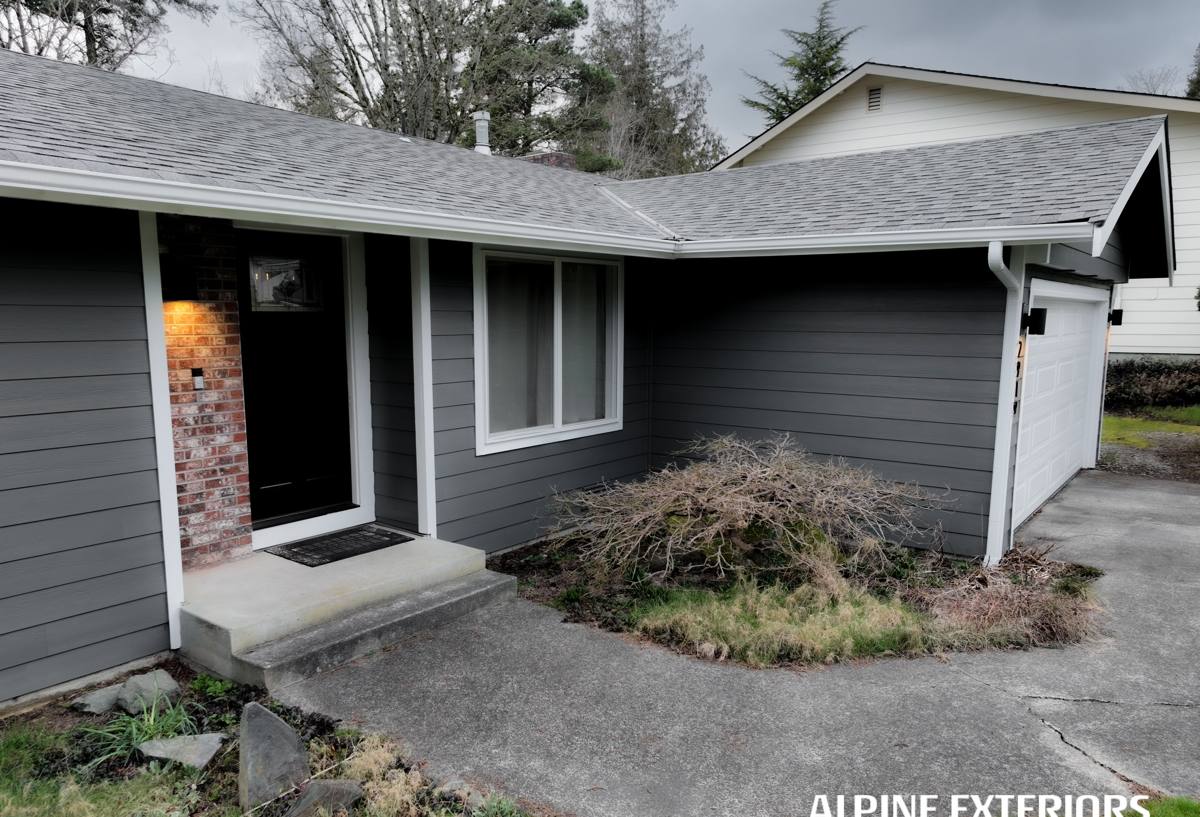
Signs a Birchwood Home Needs Siding Replacement, Not Just Repair
Repair makes sense when the damage is isolated and the underlying wall assembly is still sound. Replacement becomes the right call when the damage is systemic — when it shows up in multiple places, or when what's failing is the material itself rather than one bad spot of workmanship. Common signs we look for on Whatcom County homes include:
- Soft or spongy siding when pressed, especially near the bottom courses and around window and door trim
- Persistent moss or algae growth that returns within weeks of cleaning
- Visible cupping, warping, or separation at seams and butt joints
- Paint that's failing uniformly across a wall rather than in one weathered patch
- Bubbling, chalking, or peeling finish on multiple elevations
- Soft trim boards, especially at corners and around penetrations like hose bibs and vents
- A musty smell or visible staining on interior walls that share an exterior with damaged siding
If you're seeing two or three of these at once, that's usually a sign the whole wall system — not just the siding face — has been taking on moisture for a while. Worth a real inspection before deciding between patch repair and full replacement.
What a Correct Siding Replacement Job Actually Involves
It starts under the siding, not with it
The siding itself is the least important variable in how long a job lasts. What matters more is what's behind it: an intact weather-resistive barrier (WRB), correctly lapped and taped seams, properly integrated flashing at every window, door, and roof-to-wall transition, and enough clearance between the bottom of the siding and grade, decks, and roof lines so water has somewhere to go besides into the wall.
A full replacement is the opportunity to fix all of that. Tearing off old siding on a Birchwood or greater Fairhaven home commonly reveals water-damaged sheathing, missing or degraded house wrap, and flashing details that were never right in the first place — sometimes original to construction, sometimes left over from a prior siding job done in a hurry. Replacing the siding face over a compromised wall assembly just resets the clock on the same failure.
Fastening and clearances matter more here than in drier climates
In a region with this much wind-driven rain, fastener placement, siding overlap, and joint treatment aren't cosmetic details — they're the difference between a wall that sheds water and one that wicks it. Correct nailing patterns, factory-primed or factory-finished cut edges, and sealed (not just butted) joints all matter more here than they would in a dry inland climate.
Why We Install Only James Hardie Fiber Cement
We don't install vinyl, LP SmartSide, Cemplank, Allura, or bare wood siding like primed spruce or cedar. That's a deliberate standard, not a lack of options, and it's worth explaining honestly rather than just asserting.
Vinyl is inexpensive and low-maintenance, but it's a thin plastic product that expands and contracts significantly with temperature and can crack or warp under impact — and in a marine climate, faded and brittle vinyl is a common sight after enough seasons of sun and salt exposure. Wood-based composites like LP SmartSide use engineered wood strand technology that performs reasonably well when installation and maintenance are perfect, but they remain wood at their core, meaning cut edges, seams, and any breach in the factory coating are vulnerable to moisture intake — a real risk given how much rain Whatcom County sees. Bare wood siding like cedar or primed spruce is beautiful but demands ongoing refinishing, and in a region with this much moss and moisture, that maintenance schedule is unforgiving.
James Hardie fiber cement is non-combustible, dimensionally stable across temperature swings, and holds a factory-applied ColorPlus finish that's baked on rather than field-painted — which matters enormously in an area where field-applied paint has a shorter service life than it does inland. It doesn't rot, and it doesn't feed moss the way bare wood or some composites can. That combination is why it's the only product we put on homes.
Material Comparison at a Glance
| Material | Moisture Behavior in Wet Climates | Maintenance | Fire Rating |
|---|---|---|---|
| James Hardie Fiber Cement | Does not rot; engineered for wet climates | Occasional wash; no refinishing needed with ColorPlus | Non-combustible |
| Vinyl | Doesn't rot but can warp, crack, and fade; traps moisture behind it if installed poorly | Low, but color fades over time | Combustible |
| LP SmartSide / Engineered Wood | Vulnerable at cut edges and seams if coating is breached | Coating touch-ups, sealant checks | Combustible |
| Cedar / Primed Spruce | Absorbs moisture readily; prone to rot without upkeep | Regular refinishing/repainting | Combustible |
Our Siding Replacement Process
Every full siding replacement we do follows the same sequence, adjusted for the specific home:
- Inspection and wall assessment — we check the existing siding, sheathing, and framing for hidden moisture damage before quoting anything
- Tear-off — full removal of the old siding and trim so the wall assembly is fully visible
- Sheathing repair — any soft or rotted sheathing is replaced, not covered over
- Weather-resistive barrier — a new WRB is installed with correctly lapped and taped seams
- Flashing — window, door, and roof-to-wall flashing is installed or corrected per manufacturer detailing
- James Hardie installation — siding is installed to Hardie's fastening, clearance, and joint-treatment specifications, which is also what keeps the manufacturer warranty valid
- Trim and caulking — corners, trim boards, and penetrations are sealed correctly, not just caulked over gaps
- Final walkthrough — we review the finished job with the homeowner before calling it done
Matching the Hardie Product Line to Birchwood's Exposure
James Hardie makes climate-engineered product lines, and the right one depends on how exposed a given wall is. Homes with more direct exposure to wind-driven rain and salt-influenced air — typically west- and south-facing walls closer to the water — benefit from Hardie's HZ5 formulation, engineered for wetter, harsher climates. HardiePlank lap siding is the most common choice for full replacements, with HardieTrim and HardiePanel used for accent areas, soffits, and architectural detailing depending on the home's design. ColorPlus factory finishes are worth prioritizing here specifically because they resist the fading and touch-up cycle that field-painted siding goes through faster in coastal, high-moisture climates.
Cost Factors for a Birchwood Siding Replacement
Every home is different, and we don't quote firm numbers without seeing the house, but the factors that move the price are consistent:
| Factor | Why It Affects Cost |
|---|---|
| Home size and wall complexity | More square footage and more corners, gables, and dormers mean more material and labor |
| Condition of the existing wall assembly | Rotted sheathing or missing WRB found during tear-off adds repair work before siding can go on |
| Siding profile and trim detail | Wider board reveals, shakes, or panel accents cost more than a straightforward lap siding install |
| Number of stories and access | Second-story and steep-site work takes longer and requires more scaffolding or lift access |
| Window and door count | Every opening needs flashing work, which adds labor even if the siding material cost is the same |
An accurate number only comes from an in-person look at the home — anything quoted sight-unseen is a guess.
Why Hiring a Crew That Already Works Birchwood Matters
Siding installation isn't uniform across the country, and it shouldn't be treated that way. A crew that regularly works Fairhaven and the surrounding Bellingham neighborhoods already knows how much clearance to leave at grade given how wet the ground stays here, how to detail flashing for wind-driven rain rather than just vertical rainfall, and where moss tends to establish itself on north- and west-facing walls so those areas get extra attention during installation rather than becoming a callback two years later.
That local familiarity also shows up in smaller ways: knowing which permit requirements apply in Whatcom County jurisdictions, understanding how the local growing season affects landscaping around a job site, and being available for a warranty check or a question without a long drive. It's the difference between a contractor who installs siding and one who installs siding for this specific climate.
After Replacement: Keeping Birchwood Siding Performing Long-Term
James Hardie siding is low-maintenance, not zero-maintenance. In a climate like this, a periodic rinse to keep moss and algae from establishing — especially on shaded walls — goes a long way. Keeping gutters clear and functioning prevents water from sheeting down the siding face in ways it wasn't designed to handle. And a yearly visual check of caulking at trim and penetrations catches small gaps before they become entry points for the kind of driving rain this area gets every winter.
If your Birchwood home's siding is showing its age, or you're not sure whether you're looking at a repair or a replacement, we're glad to take a look and give you a straight answer. Reach out for a free, no-pressure estimate — the form below gets you started.