 Fairhaven Siding
 Windows Built for Sudden Valley's Particular Climate
Sudden Valley sits back in the trees along Lake Whatcom, east of Fairhaven and Bellingham proper, and that setting shapes what a window has to deal with here. Heavy fir and cedar canopy means most homes get long stretches of shade, which keeps siding and window trim damp far longer after a storm than a home out in the open. Add the lake's own humidity and Whatcom County's wet, mild marine climate, and you've got a recipe for wood rot, swollen sashes, and moss that doesn't quit from October through May.
Even though Sudden Valley is set back from the saltwater of Bellingham Bay, it shares the same marine weather pattern as the rest of the county — driving rain that comes in sideways during winter storms, and moisture that lingers instead of evaporating. Salt-air corrosion on hardware is less of an issue this far from open water, but wind-driven rain and shade-grown moss more than make up for it. A window installed without that reality in mind will show problems within a few winters, not decades.
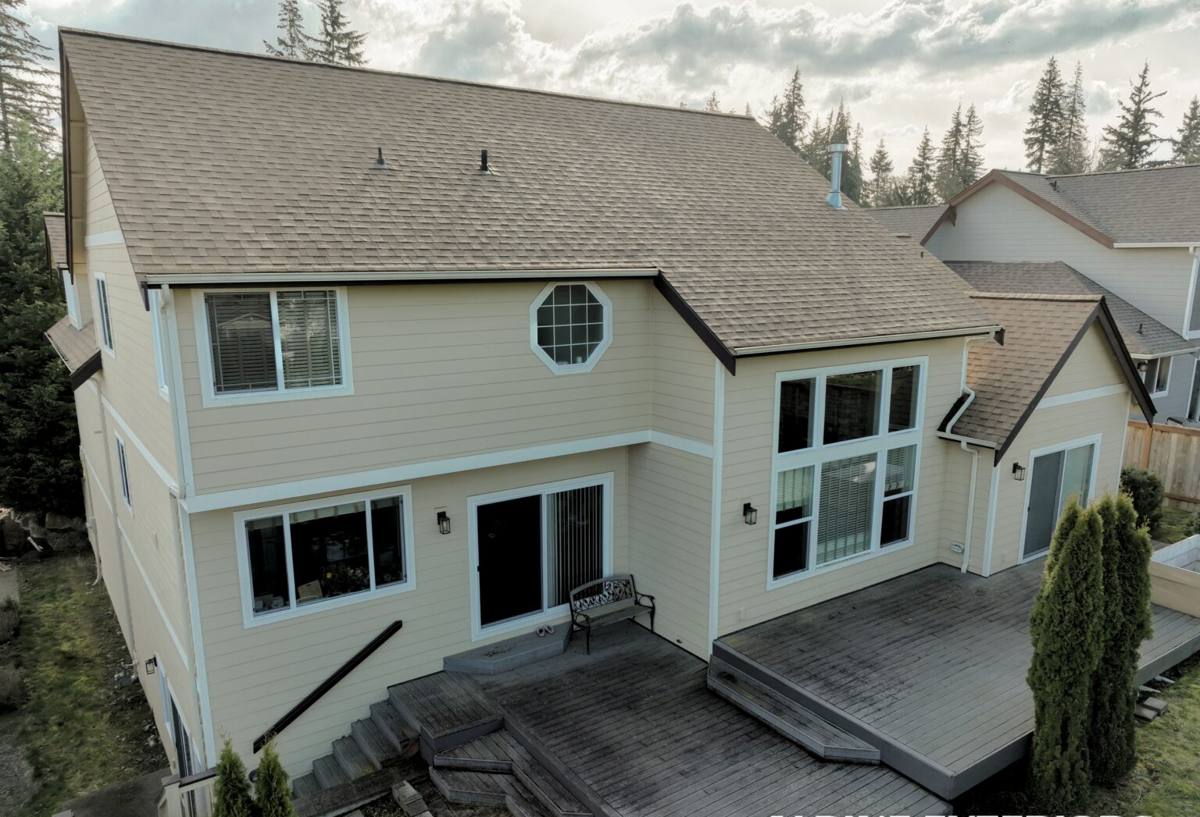
How to Tell a Window Is Losing the Battle
Most homeowners don't notice window failure until it's well underway, because the damage starts inside the wall, not on the surface. Here's what tends to show up first on homes in this area:
- Fogging or a cloudy haze between the panes — the seal has failed and the insulating gas is gone
- Soft or spongy wood at the sill or bottom corners of the frame
- Windows that stick, won't latch fully, or have started to sag in the opening
- A cold draft near the frame even when the window is latched shut
- Moss or dark green streaking building up on the sill, trim, or exterior casing
- Paint or finish peeling from the inside face of the frame, not just the outside
Any one of these on its own might just need a repair. Two or three together, especially on a shaded elevation, usually means the window and the flashing behind it are both due for replacement.
What a Correct Installation Actually Involves
Window installation looks simple from the outside — pull the old unit, set the new one, caulk the edges. Done that way, it fails fast in a climate like this. The work that actually holds up involves a few steps that are easy to skip and easy to notice years later when they were skipped.
Water Management Comes First
Before a new window ever goes in, the opening needs a sloped sill pan so any water that gets past the glass drains back out instead of pooling against the wood framing. Flashing tape has to integrate properly with the house wrap already on the wall — lapped correctly, not just stuck over the top of it — so water sheds downward and outward, never behind the siding.
The Window Itself Has to Be Square and Shimmed Right
A window that's out of square binds, leaks air around the sash, and wears its seals unevenly. Shimming at the correct points, checking level and plumb before fastening, and using the right fasteners for the framing material all matter more than most homeowners realize when they're comparing quotes.
Insulation and Sealant Are Not the Same Thing
The gap between the window frame and the rough opening needs low-expansion foam or backer rod and sealant designed for that gap — not a can of general-purpose foam that can bow the frame, and not caulk alone, which doesn't insulate. Exterior sealant is the last line of defense, not the whole system.
Choosing a Frame Material for a Shaded, Damp Lot
Frame material matters more here than it would on a dry, sun-exposed lot. The table below reflects how each common option tends to perform under Sudden Valley's specific conditions — long shade, high humidity, and heavy moss growth.
| Frame Material | Moisture Performance | Maintenance | Typical Lifespan |
|---|---|---|---|
| Vinyl | Won't rot; handles standing moisture well | Occasional cleaning to keep moss and algae off the tracks | 20–30 years |
| Fiberglass | Excellent — dimensionally stable even with constant damp/dry cycling | Low; holds paint or finish well if painted | 30–40+ years |
| Wood, unclad | Poor in heavy shade without diligent upkeep | Regular repainting/sealing, especially on north- and east-facing walls | Highly variable — often under 15 years in deep shade without upkeep |
| Wood-clad (aluminum or vinyl exterior) | Good — exterior face is protected, interior keeps a wood look | Low exterior maintenance; watch cladding seams for water intrusion | 25–35 years |
For homes tucked deep in the trees, we generally steer clients toward vinyl or fiberglass for the exterior-facing material — not because unclad wood is a bad product, but because it demands a level of upkeep most homeowners don't want to commit to on a shaded elevation. That's a maintenance-burden judgment call, not a knock on wood as a material.
Glass Packages: What's Worth Paying For Here
Double-pane, low-E glass with argon fill is the baseline we'd recommend for almost any Sudden Valley home — it cuts heat loss and helps control condensation on cold mornings, which is common on lake-adjacent, shaded lots. Triple-pane adds another layer of insulation and sound dampening, which is worth considering on north-facing rooms that never get direct sun or on homes closer to the road. It costs more up front and the return on energy savings alone is modest in this mild climate, so we treat it as a comfort upgrade, not a must-have.
Our Process, Start to Finish
- On-site assessment — we look at existing window condition, framing, flashing, and any signs of water intrusion before quoting anything
- Straightforward estimate — a written scope covering materials, flashing method, and cleanup, no vague line items
- Old window removal — careful demo that lets us actually inspect the rough opening and sheathing underneath, not just swap and go
- Repair as needed — any soft framing or compromised sheathing gets addressed before the new window goes in, not covered over
- Installation — sill pan, properly lapped flashing, correct shimming, appropriate insulation, and exterior sealant
- Interior and exterior finish work — trim, caulking, and touch-up so the opening looks finished inside and out
- Walkthrough and cleanup — we confirm every window opens, closes, and locks properly before we consider the job done
What Affects the Cost of a Window Installation
| Factor | Why It Moves the Price |
|---|---|
| Number of windows | Per-window cost typically drops on larger jobs due to shared setup and cleanup time |
| Frame material | Fiberglass and wood-clad units cost more upfront than standard vinyl |
| Condition of the rough opening | Rot or water damage found during removal adds repair time before installation can proceed |
| Glass package | Triple-pane and specialty coatings add cost over standard double-pane low-E |
| Window size and style | Large picture windows, bays, or custom shapes take more labor and often cost more per unit |
| Trim and siding tie-in | Matching existing trim profiles or repairing siding around the opening adds time |
Because rough opening condition can only be confirmed once the old window is out, we always flag that as a possible variable up front rather than let it become a surprise mid-job.
Why Local Experience in Sudden Valley Actually Matters
Sudden Valley is a private, gated community with its own roads and, for many homes, HOA design guidelines that touch exterior appearance. A crew that's worked in the community already knows how to navigate gate access and scheduling without it becoming a hassle for the homeowner, and knows to check exterior color and trim guidelines before ordering materials rather than after. That familiarity saves real time and avoids the kind of rework that happens when a crew learns those things the hard way, mid-project.
Just as important is knowing the neighborhood's building conditions firsthand — which elevations sit in near-permanent shade, how close tree lines come to the siding, and how much moss pressure a given lot actually deals with. That's the kind of thing you learn by working the area repeatedly, not by reading a spec sheet.
Keeping New Windows Performing for the Long Haul
A correct installation buys you decades, but a little seasonal attention keeps it that way. Before the fall rains set in each year, it's worth running through this:
- Clear moss and debris from sills, tracks, and weep holes so water can drain instead of pooling
- Check exterior caulking for cracks or gaps and re-seal any that have opened up
- Test that each window still opens, closes, and locks smoothly
- Look for soft spots in exterior trim, especially on shaded, north- or east-facing walls
- Wipe down interior sills if condensation has been collecting on cold mornings
None of this takes long, and catching a small issue in October beats discovering a rotted sill in March.
Get a Straight Answer on Your Windows
If your windows are fogging, sticking, drafty, or just old enough that you're wondering, we're happy to take a look and give you an honest read on whether repair or replacement makes sense for your home. Reach out for a free, no-pressure estimate — no upsell, just a clear picture of what your windows need.