 Fairhaven Siding
 Sehome sits close enough to Bellingham Bay that its roofs live under two competing pressures: salt-laden marine air rolling in off the water, and the long, wet Pacific Northwest storm season that runs from October through April. Add in the shade and dampness that comes with the mature tree cover common to this part of Whatcom County, and you get a recipe for moss growth, trapped moisture, and roofs that fail in ways a drier inland climate never produces. When wind and rain damage a roof here, the repair has to account for all of that — not just patch the hole and move on.
This page covers what storm damage roof repair actually looks like for homes in Sehome: what the local climate does to a roof over time, how to tell real storm damage from normal wear, what a correct repair involves, and why it matters to hire a crew that already knows this neighborhood rather than someone driving in from out of the area for a single job.
Why Sehome Roofs Take a Different Kind of Beating
Storm damage in this part of Washington rarely shows up as a single dramatic event. More often it's the combination of wind, rain, and moisture exposure working on a roof over years, until a storm finally exploits a weak point that's been building for a while.
Salt Air and Metal Fatigue
Homes closer to Bellingham Bay deal with a fine mist of salt air that settles on exposed metal — flashing, fasteners, gutter hardware, and vent caps. Over time this accelerates corrosion in lower-grade or unprotected metal, which is exactly the metal that's supposed to be keeping water out at roof valleys, chimneys, and skylights. A flashing seam that's been quietly corroding for a few seasons is far more likely to fail during a wind-driven storm than one that's still fully intact.
Moss and Trapped Moisture
Whatcom County's long, mild, wet stretch of months is ideal growing conditions for moss, and Sehome's tree cover keeps roofs shaded and slow to dry between rain events. Moss doesn't just look bad — it holds water against the roofing material, lifts shingle edges as it grows, and works its way under tabs and around fasteners. A roof with an established moss problem is already compromised before a storm even arrives; the storm just finds the opening moss created.
Wind-Driven Rain and Older Roof Systems
Straight-down rain is rarely the problem. It's rain pushed sideways by wind that gets under lifted shingles, through gaps in aging underlayment, or around flashing that's lost its seal. Older roofs — especially ones that were already due for attention — are the ones that take real water intrusion during a storm, while a roof in good condition sheds the same storm without issue.
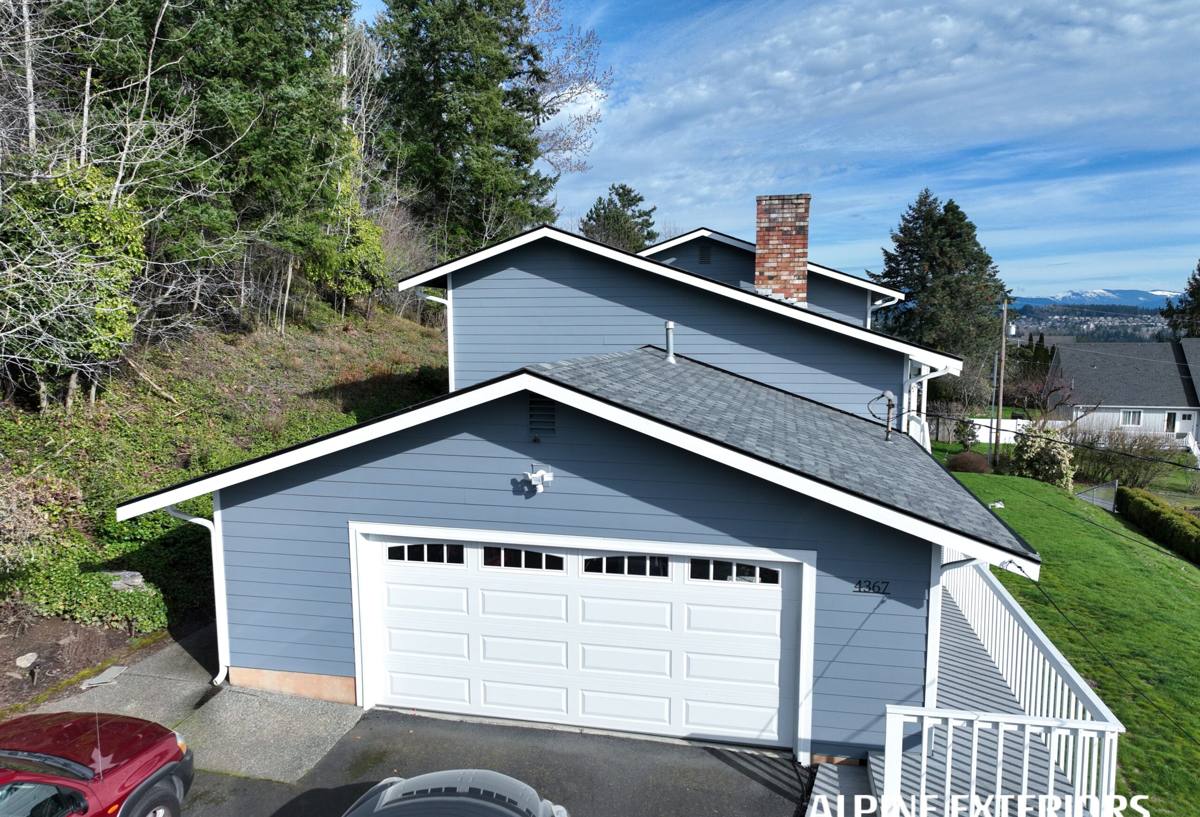
What Actually Counts as Storm Damage
Not everything a homeowner notices after a windstorm is storm damage in the insurance or repair sense, and not all storm damage is obvious from the ground. Here's what we actually look for:
- Shingles that are cracked, curled, lifted, or missing entirely, especially along ridges and edges where wind pressure is highest
- Flashing that's been bent, pulled loose, or separated from the roof deck around chimneys, skylights, and roof-to-wall transitions
- Granule loss visible in gutters or downspouts after a hail or heavy wind event
- Water stains or active dripping on interior ceilings, especially near exterior walls or chimneys
- Debris punctures from falling branches, common in Sehome's more tree-covered lots
- Soft or spongy spots on the roof deck, which usually means water has already been getting in for a while
- Gutters pulled away from the fascia or clogged with storm debris, causing water to back up under the roof edge
Some of this is visible from the ground or an attic check. Some of it isn't, which is why a proper storm inspection means actually getting on the roof, not just looking up from the driveway.
Our Storm Damage Repair Process
Storm repair work has a different rhythm than a planned roofing project. Speed matters for the first step, but the rest of the process still needs to be done right, not rushed.
1. Emergency Assessment and Tarping
If a roof has active water intrusion, the first priority is stopping further damage — not writing an estimate. That usually means a temporary tarp-down over the affected area to keep interior damage from spreading while we plan the actual repair.
2. Full Roof Inspection
Once the immediate threat is handled, we inspect the whole roof, not just the obviously damaged section. Storms rarely damage only one spot, and a repair that ignores a second weak point just means another call after the next storm.
3. Documentation
We document what we find with clear notes and photos, dated and specific to the storm event where possible. This matters for insurance claims and also gives you an honest record of the roof's condition, not just a verbal opinion.
4. Repair Plan and Straight Answer on Scope
We tell you plainly whether this is a targeted repair or something bigger, and why. See the repair-versus-replace section below for how we make that call.
5. The Repair Itself
Matching materials, correct flashing detail, and proper fastening — done to hold up against the next storm, not just pass a quick look.
6. Cleanup and Final Check
Debris removed, gutters cleared of anything the repair generated, and a final walk-through so you know exactly what was done.
Repair vs. Replace: How We Make the Call
One of the most common questions after storm damage is whether a repair is enough or whether it's time to replace the roof. The honest answer depends on the roof's age, condition, and how widespread the damage actually is.
| Factor | Repair Usually Makes Sense | Replacement Usually Makes Sense |
|---|---|---|
| Roof age | Under 10-15 years, still within expected service life | Nearing or past the material's typical lifespan |
| Extent of damage | Localized to one section or a few isolated spots | Damage spread across multiple sections or slopes |
| Moss and moisture history | Minimal to moderate, hasn't compromised the deck | Long-term moss growth has damaged decking or underlayment broadly |
| Underlying materials | Underlayment and decking still sound | Deck is soft, rotted, or underlayment has failed underneath |
| Frequency of repairs | First or second repair call in several years | Repeated storm damage calls on the same roof, year after year |
We'll walk you through where your roof falls on that table and why, rather than defaulting to whichever answer is more profitable for us. Plenty of Sehome roofs genuinely just need a targeted repair; plenty of others are past the point where another patch makes financial sense.
Working With Your Insurance Claim
Most storm damage repair work in this area involves an insurance claim, and the process goes smoother when the documentation is thorough from the start. We provide detailed photos and written scope notes that match what an adjuster needs to see, and we're available to walk an adjuster through the damage in person if that's useful. We won't tell you what your policy covers — that's between you and your insurer — but we will make sure the physical evidence of the damage is documented clearly and accurately so your claim reflects the actual condition of the roof.
Materials We Use for Storm Repairs in This Climate
Given the salt air and moss pressure in this area, our standard for storm repair work leans toward materials and details that hold up over time rather than the cheapest option that technically closes the hole.
- Flashing: corrosion-resistant metal, properly lapped and sealed — not just caulked over a gap
- Underlayment: synthetic underlayment where a section is opened up, for better water resistance than older felt products during the repair process
- Shingle matching: we match existing shingle profile and color as closely as available product lines allow, since a mismatched patch stands out and can affect resale appearance
- Fasteners: corrosion-resistant fasteners appropriate for coastal exposure, not standard interior-grade hardware
We're upfront that some lower-cost repair materials trade off maintenance burden or moisture performance for a lower price point. That's a legitimate choice for some homeowners on some projects, but for storm repair work in a marine-influenced, moss-prone climate, we default to the option that holds up, and explain the cost difference so you can decide.
Why a Crew That Already Works Sehome Matters
Storm damage repair isn't just a technical job — timing and local familiarity matter. A crew that already works in Sehome and the surrounding Bellingham area knows the roofing profiles common to the neighborhood's housing stock, understands how the local tree cover and bay proximity affect moisture and moss patterns, and isn't learning the area's permitting requirements for the first time on your project. That local knowledge shows up in faster, more accurate assessments and repairs that account for conditions specific to this part of Whatcom County, not generic advice pulled from a different climate.
It also matters after a widespread storm event, when demand for roofing crews spikes across the whole region. A contractor with an established local presence and route through the neighborhood can typically respond faster than one dispatching a crew from farther out.
After the Repair: Reducing the Next Storm's Impact
A good storm repair addresses the immediate damage, but a few maintenance habits meaningfully reduce how much the next storm season affects the same roof.
- Have gutters cleared at least twice a year, more often if the property has heavy overhanging trees
- Address moss growth before it spreads — early removal is far less invasive than repairing moss-related damage later
- Trim back branches that overhang the roofline to reduce debris impact and reduce shade that keeps the roof damp
- Have the roof looked at after any major wind event, even if there's no visible interior leak yet
- Keep a simple record of past repairs and inspections so any future contractor has the roof's real history, not a guess
Get an Honest Look at Your Roof
If a recent storm has left you with missing shingles, a leak, or just an uneasy feeling about how your roof handled the wind and rain, it's worth getting a straight answer before the next system rolls through. We offer free, no-pressure estimates for Sehome homeowners — come take a look, tell you plainly what we find, and let you decide from there. The form below is the easiest way to get started.