 Fairhaven Siding
 Composite Decking Built for York's Weather, Not Just Its Curb Appeal
York sits close enough to Bellingham Bay that salt-laden air is a daily fact of life, not an occasional nuisance. Add in Whatcom County's long wet season, heavy driving rain off the water, and months where moss and algae have nothing to compete with, and you've got a climate that is genuinely hard on outdoor decking. A deck that looks great going in but wasn't built for this specific mix of conditions will show it within a couple of seasons — soft spots, green film, fastener staining, boards that cup or gap. Composite decking done right in York isn't just about picking a nice color. It's about substructure, drainage, fastening, and ventilation choices that match what this neighborhood actually deals with year-round.
We install composite decking across Fairhaven and the surrounding Whatcom County communities, and York jobs come with their own set of considerations shaped by proximity to the water, tree cover, and the age of housing stock in the area. This page covers what a correct composite deck build looks like here specifically, not composite decking in general.
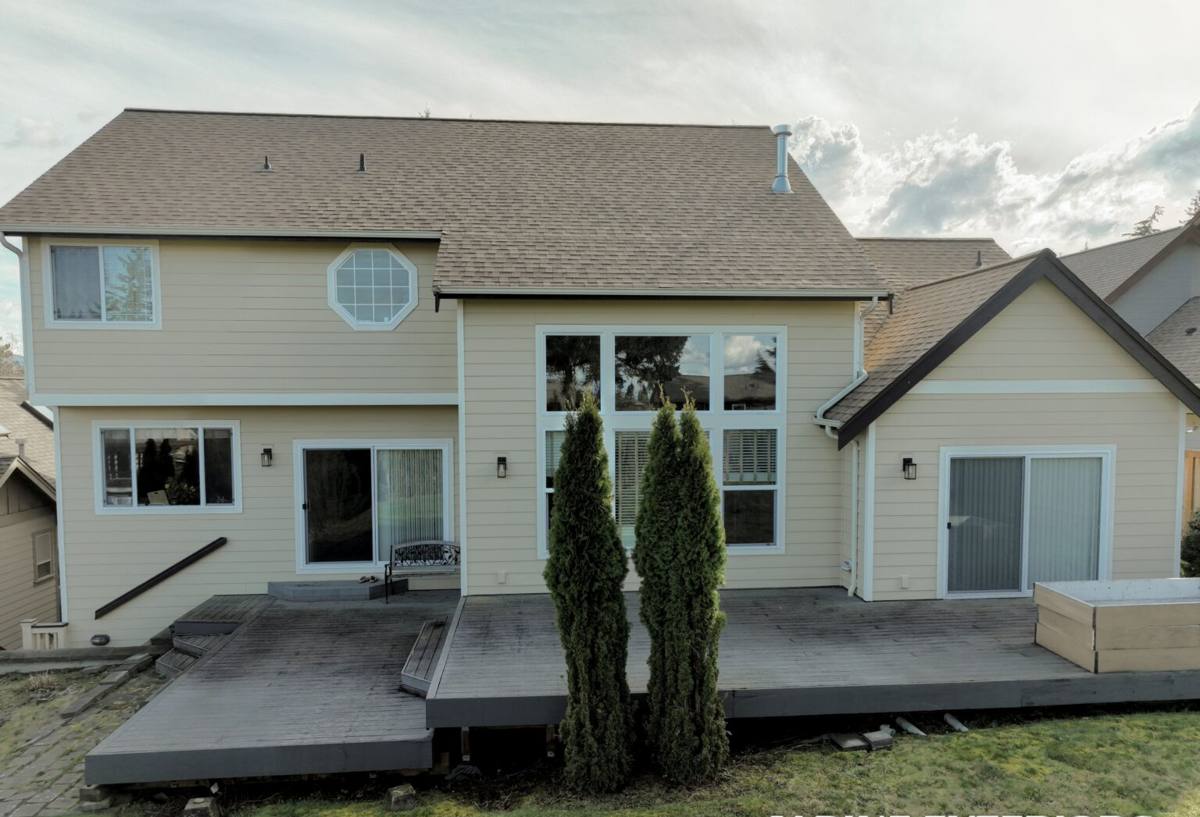
Why Composite Makes Sense in a Salt Air, High-Moisture Climate
Composite decking exists because wood decking has real limits in exactly the conditions York gets a lot of: standing moisture, cycles of wet and dry, and organic growth that thrives in shade and dampness. Composite boards are engineered from wood fiber and recycled plastic, which means they don't absorb water the way solid wood does, don't need annual staining or sealing, and resist the graying and splintering that salt air and rain accelerate in cedar or fir decking.
That doesn't mean composite is maintenance-free — no decking material truly is near the water — but it shifts the maintenance burden from "refinish every year or two" to "rinse off pollen, needles, and moss growth a few times a year." For homeowners in York who want a deck that holds up to onshore weather without becoming a recurring project, that trade-off is usually the right one.
Where Composite Still Needs Respect
Composite isn't immune to the climate — it's just better suited to it when installed correctly. Boards still need airflow underneath to dry out after rain, gaps sized correctly for expansion and contraction, and hardware that won't corrode faster than the decking itself. Skipping any of that turns a low-maintenance material into a high-maintenance problem, which is why installation quality matters as much as the product choice.
What a Correct Composite Deck Build Involves
A composite deck is only as good as what's underneath it. Most of the failures we see on older or poorly built decks in this area trace back to the substructure, not the decking boards themselves.
- Framing and joist spacing matched to the specific composite product — many composite boards require tighter joist spacing than traditional wood decking, especially on diagonal patterns or stair treads.
- Joist tape or a moisture barrier on top of the framing to keep rainwater from sitting against untreated wood and starting rot from the inside out — easy to skip, expensive to fix later.
- Proper drainage slope away from the house, so water doesn't pool against siding or foundation, which matters even more in a climate that gets sustained driving rain rather than short bursts.
- Ventilation clearance underneath the deck so moisture can actually evaporate instead of getting trapped between the ground and the boards.
- Corrosion-resistant fasteners and hidden clip systems rated for coastal or high-moisture exposure, not standard interior-grade hardware.
- Correct board gapping for expansion, contraction, and drainage — too tight and water sits on the surface; too wide and it looks sloppy and catches debris.
Get these right and a composite deck in York can go a long time with minimal intervention. Get them wrong and you end up with the exact problems composite was supposed to avoid — trapped moisture, soft framing, and premature wear.
Moss, Algae, and Salt Film: The York-Specific Maintenance Reality
Even the best composite boards will pick up a green tint or slick film if they sit in shade near mature trees, which describes a fair number of lots in and around York. Combine that with salt air depositing a fine residue over time, and you get a surface that needs periodic attention even though it's not rotting or splintering.
The good news is that this is a cleaning issue, not a structural one, and it's manageable:
| Condition | Cause | What Helps |
|---|---|---|
| Green film or moss | Shade, moisture, organic debris buildup | Periodic wash with a composite-safe cleaner; trim overhanging branches where possible |
| Salt haze or dullness | Onshore air, especially on west/water-facing decks | Rinse with fresh water regularly; avoid harsh pressure washing that can damage the cap surface |
| Slippery spots in winter | Combination of moss, moisture, and low winter sun angle | Keep surface clear of debris; some composite lines offer textured, higher-traction finishes |
| Fastener or hardware staining | Lower-grade or incorrectly rated fasteners corroding | Use coastal-rated stainless or coated fasteners from the start — this is a build-quality issue, not a composite issue |
Most of this table comes down to one point: choosing the right hardware and finish up front prevents problems that no amount of after-the-fact cleaning fully solves.
Choosing a Composite Product for a York Property
Not every composite board is built the same way, and the differences matter more here than in a drier inland climate. Capped composite boards — where the wood-plastic core is wrapped in a protective polymer shell — generally hold up better against moisture intrusion and staining than uncapped boards, which is worth the added cost for most homes this close to the water. Board texture also matters: a more textured, matte finish tends to hide the fine salt residue and pollen film better than a high-gloss finish, and it usually offers better footing when the surface is damp, which is often.
Color choice has a practical side too. Very dark composite boards absorb more heat in summer sun but also tend to show water spotting and dust less than lighter tones. Lighter boards stay cooler underfoot but can show salt film and pollen more visibly between cleanings. Neither is wrong — it's a trade-off worth thinking through based on how exposed your deck is and how much upkeep you want to do.
Our Process for a York Composite Deck Project
- On-site assessment — we look at sun exposure, tree cover, wind and salt exposure, drainage slope, and the condition of any existing structure before recommending a build approach.
- Substructure evaluation or rebuild — if we're replacing an old wood deck, we check the ledger board, framing, and any hidden rot before building on top of it. A new composite surface on a compromised frame doesn't solve anything.
- Material selection — we walk through board options, capped vs. uncapped, color, and hardware grade based on how exposed the specific location is to rain and salt air.
- Installation — correct joist spacing, moisture barrier, ventilation clearance, and gapping, with fastening systems rated for coastal humidity.
- Final walk-through — we go over basic care so you know what routine maintenance actually looks like for your specific deck and site conditions.
Why It Matters That We Already Work in York
A deck built by a crew that's only ever worked drier, inland conditions can miss things that matter here — under-spec'd fasteners, no moisture barrier, or drainage that ignores how much rain this area actually gets in a wet season. Working regularly in Fairhaven and neighboring Whatcom County communities like York means we're not guessing at what holds up; we're building to what we've already seen succeed and fail on decks nearby. That local pattern recognition — which fastener grades corrode fast near the water, which board textures actually resist moss buildup, how much slope is enough on a given lot — is the difference between a deck that needs babying every spring and one that just quietly works.
Practical Checklist Before You Commit to a Composite Deck
- Confirm the board is capped composite if your deck gets regular rain or salt air exposure.
- Ask what fastener and clip system will be used, and confirm it's rated for coastal or high-moisture conditions.
- Make sure joist spacing matches the manufacturer's spec for your chosen board and layout.
- Verify a moisture barrier or joist tape is included over the framing, not just the decking itself.
- Check that the plan includes proper drainage slope away from the house and ventilation clearance underneath.
- Ask about realistic maintenance expectations for your site's sun and tree exposure, not a generic answer.
Get a Straightforward Estimate
If you're weighing a composite deck for your York property, we're happy to walk the site, look at your sun exposure and drainage situation, and give you an honest read on what will hold up best. There's no pressure and no obligation — just a clear picture of the right approach for your home. Use the form below to request a free estimate.