 Fairhaven Siding
 Happy Valley's Climate Is Hard on Old Windows
Homes in Happy Valley sit close enough to Bellingham Bay and the Salish Sea that salt-laden air is a fact of life, not an occasional nuisance. Add Whatcom County's driving rain — the kind that comes in sideways during a fall or winter blow — and a moss season that can stretch from October well into spring, and you have a climate that finds every weak point in a window assembly. Old aluminum frames pit and corrode. Wood sashes swell, stick, and eventually rot at the corners. Single-pane and early dual-pane units fog between the glass because the seal has finally given out.
None of this happens overnight. It shows up as a slow creep: a window that used to lock easily now needs to be forced, a sill that feels soft under a thumbnail, a cold draft near the frame on a windy night. By the time most homeowners notice, the damage isn't just cosmetic — moisture has usually already worked its way into the framing behind the window, which is a bigger and more expensive problem than the window itself.
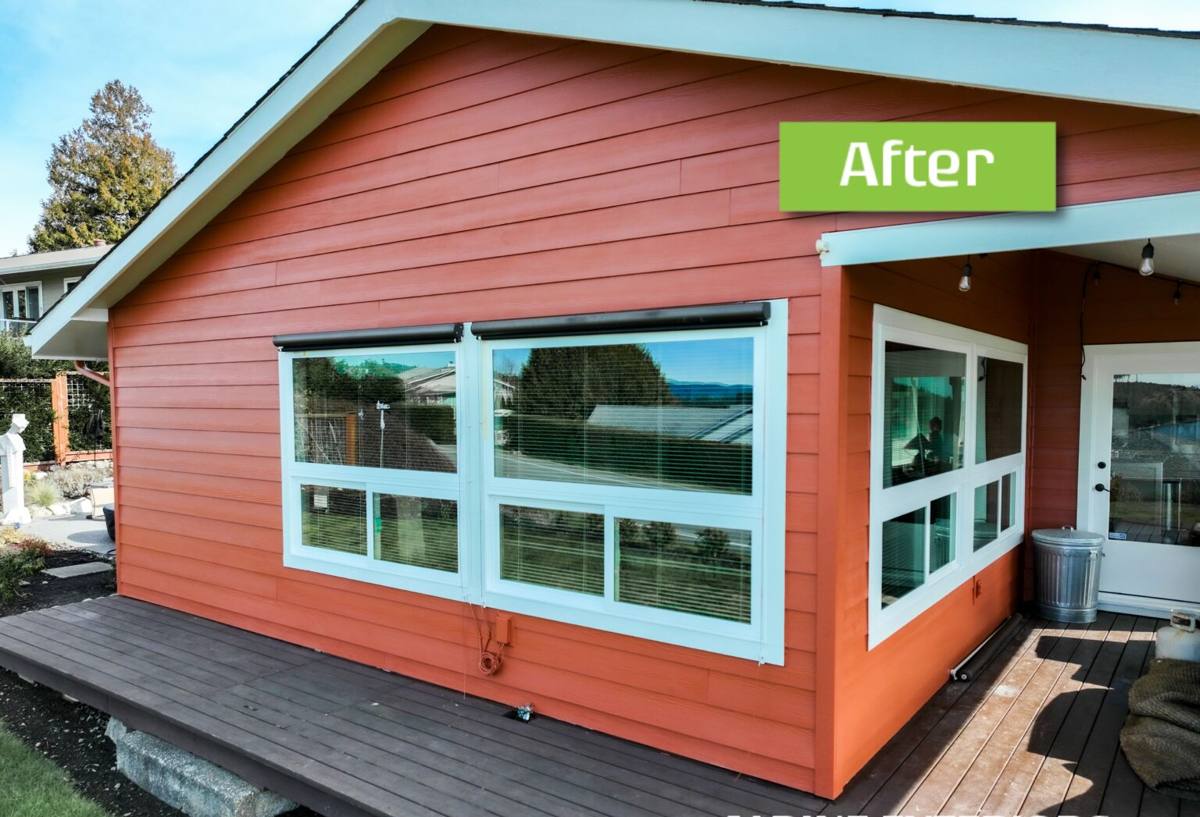
Signs Your Happy Valley Home May Need Window Replacement
A quick walk around the house, inside and out, tells you most of what you need to know. Look for:
- Fogging or a milky haze between panes of dual-pane glass — the seal has failed and the insulating gas is gone
- Wood trim or sills that feel soft, spongy, or show dark staining, especially on walls that face prevailing weather
- Windows that are hard to open, close, or lock, or that no longer sit flush in the frame
- Visible gaps, cracked caulk, or daylight around the frame from the inside
- A cold draft near the window even when it's fully closed and locked
- Moss or dark green growth building up on the sill, brick mold, or exterior trim year after year
- Rising heating bills that aren't explained by anything else in the home
- Condensation forming on the inside of the glass regularly, not just on the coldest mornings
One or two of these on their own might just mean a window needs caulking or a new sweep. Several together, especially soft wood or persistent moisture staining, usually means the window and the wall around it need a real look before you spend money on anything cosmetic.
What a Correct Window Replacement Job Actually Involves
Window replacement is often sold as a quick swap — old unit out, new unit in, done in an afternoon. In a dry climate that shortcut might not show its cost for years. In Happy Valley, where wind-driven rain hits siding directly and moss holds moisture against surfaces longer than most people expect, skipping steps catches up with a house fast.
Tear-Out and Framing Inspection
Every opening gets checked once the old unit is out, not just measured from the outside. That means looking at the sill, jack studs, and header for rot, soft spots, or old water staining before a new window ever goes in. A new window installed over a compromised frame just hides the problem for a while — it doesn't fix it.
Flashing and Weather Barrier Integration
This is the step that decides whether a window leaks in five years. Flashing tape and sill pans need to tie into the house's existing weather-resistive barrier in the right order — sill first, then jambs, then head — so water is always directed out and down, never trapped behind the siding. In a driving-rain climate, a window that's watertight on install day but poorly flashed will eventually leak; it's just a matter of which winter.
Setting, Shimming, and Sealing
The window has to be plumb, level, and square, shimmed correctly at the manufacturer's specified points, and fastened per the window's own installation instructions — not a generic method used on every brand. Interior and exterior sealant beads go in specific locations, not just wherever looks tidy, because gaps left in the wrong spot become the next leak path.
Trim and Finish Work
Exterior trim gets rebuilt or reinstalled with back-priming and proper caulk joints so water can't wick into end grain. Interior trim and sills get finished to match the rest of the room. A job isn't done until the opening looks and performs like it was never touched — clean lines outside, no drafts inside.
Choosing Window Materials for a Marine Climate
Material choice matters more here than in a drier inland climate, because salt air and sustained moisture accelerate whatever weaknesses a product already has. There's no single right answer for every home — budget, the home's style, and how exposed the wall is to weather all factor in — but the trade-offs are worth understanding up front.
| Frame Material | Moisture & Salt Air Behavior | Maintenance | Typical Lifespan |
|---|---|---|---|
| Vinyl | Does not rot or corrode; performs well in salt air | Low — occasional cleaning | 20–30+ years |
| Fiberglass | Very stable in wet, salty conditions; minimal expansion/contraction | Low | 30+ years |
| Aluminum | Prone to pitting and corrosion near salt air over time | Moderate — needs periodic attention | Varies widely with coating quality |
| Wood / Wood-clad | Best appearance, but exposed wood is vulnerable to rot without diligent upkeep | High — regular painting/sealing | Depends heavily on maintenance |
We install a range of these products depending on what a homeowner is trying to solve. For homes taking the brunt of the weather — west- or south-facing walls, or anywhere moss and moisture already collect — we lean toward vinyl or fiberglass because they simply give a wall less to fight against year after year. For homes where matching an existing wood-trim look matters more than minimizing upkeep, wood-clad is still a reasonable choice as long as the homeowner understands the maintenance commitment that comes with it. We're upfront about that trade-off rather than steering everyone toward the same product.
Glass Packages
Beyond the frame, the glass package does a lot of the work. Dual-pane, low-E glass with an argon or krypton gas fill is the standard for this climate — it cuts heat loss, reduces condensation on the interior surface, and helps with sound from wind and rain. Homes with more direct sun exposure may benefit from a low-E coating tuned for solar heat gain control rather than the standard northern-climate coating; we'll talk through which makes sense for your home's orientation during the estimate.
Our Process for Happy Valley Projects
- Free on-site assessment. We walk the exterior and interior of each window being considered, check framing where accessible, and talk through what's actually causing the problem — not just what the symptom looks like.
- Measurement and product selection. We take precise measurements for each opening and go over material, glass package, and style options based on your home's exposure and budget.
- Ordering and lead time. Windows are ordered to your home's exact openings. We give an honest lead-time estimate up front rather than a best-case guess, since manufacturing timelines shift with the season.
- Install day. Openings are protected, old units removed and inspected, framing addressed if needed, and new windows flashed, set, and sealed following manufacturer specs.
- Final walkthrough and cleanup. Every window is opened, closed, and locked to confirm proper operation, the site is cleaned up, and we go over care and warranty information before we leave.
What Affects the Cost of Window Replacement Here
Costs vary window to window, but a few factors consistently move the number up or down. This isn't a quote — every home is different — but it's a realistic look at what drives price.
| Factor | Why It Matters |
|---|---|
| Frame material | Vinyl generally costs less than fiberglass or wood-clad; wood-clad tends to be the most expensive |
| Framing repair | Rotted sills or jack studs found during tear-out add labor and material beyond the window itself |
| Window size and configuration | Large openings, bays, and custom shapes cost more than standard single or double-hung units |
| Glass package | Upgraded low-E coatings, tinted, or sound-dampening glass add cost over standard dual-pane |
| Number of windows | Whole-house replacements typically have a lower per-window cost than one-off replacements |
| Trim and siding condition | Rebuilding exterior trim or tying into existing siding correctly takes more time on older homes |
We give a written, itemized estimate so you can see exactly what's driving the cost — not a single lump number with no explanation behind it.
Why a Crew That Already Works Happy Valley Matters
Happy Valley has a mix of home ages and construction styles, which means no two window openings behave quite the same. A crew that works this specific area regularly has already seen how moisture tends to collect on certain wall orientations, how moss builds up faster on north- and shade-facing trim, and how older homes in this part of Whatcom County were originally flashed — often not to a standard that holds up to decades of coastal weather. That experience shows up in fewer surprises during tear-out and fewer callbacks after install.
It also matters for scheduling. Wind-driven rain and a long wet season mean install timing has to account for weather windows, not just calendar availability. A crew familiar with the area plans around that reality instead of promising an install date that gets pushed repeatedly once the forecast turns.
Caring for New Windows Through Whatcom County's Wet Season
New windows still need basic upkeep to get their full lifespan out of a climate like this one:
- Clear debris and moss from tracks and weep holes a couple of times a year so water can drain as designed
- Wash frames and glass periodically to keep salt residue and moss spores from building up on the surface
- Check exterior caulk lines annually, especially after a hard winter, and touch up any cracked or separated sealant
- Operate every window a few times through the year, even ones you rarely open, to keep hardware and weatherstripping working properly
- Watch trim and sills for any returning moisture staining, which can signal a sealant or flashing issue worth checking early
None of this is intensive, but skipping it in a climate that stays wet this much of the year shortens the life of even a well-installed window.
If your Happy Valley home has windows showing any of the signs above, or you're simply ready to stop fighting drafts and fogged glass, we're happy to take a look. The estimate is free, there's no pressure to sign anything on the spot, and you'll get a straight answer about what your home actually needs — just fill out the form below to get started.