 Fairhaven Siding
 Siding Built for Where Sudden Valley Actually Sits
Sudden Valley homes deal with a specific mix of weather that a lot of siding products simply aren't built to handle over the long run. You've got moisture that lingers under tree cover, a marine-influenced climate that keeps humidity high for months at a time, and driving rain that doesn't just fall straight down — it gets pushed sideways into walls, trim, and every seam in the siding. Add a moss season that can stretch from fall through spring, and you have a building envelope that's under near-constant low-grade attack.
None of that is unusual for this part of Whatcom County. But it does mean that "siding installation" here isn't a generic job you can hand to a crew that mostly works dry-climate subdivisions. The install has to account for how water moves across a wall, how long a surface stays damp, and what happens when organic growth gets a foothold in a seam or a fastener line. Get those details wrong and a house can look fine from the road for a couple of years while moisture damage builds behind the surface.
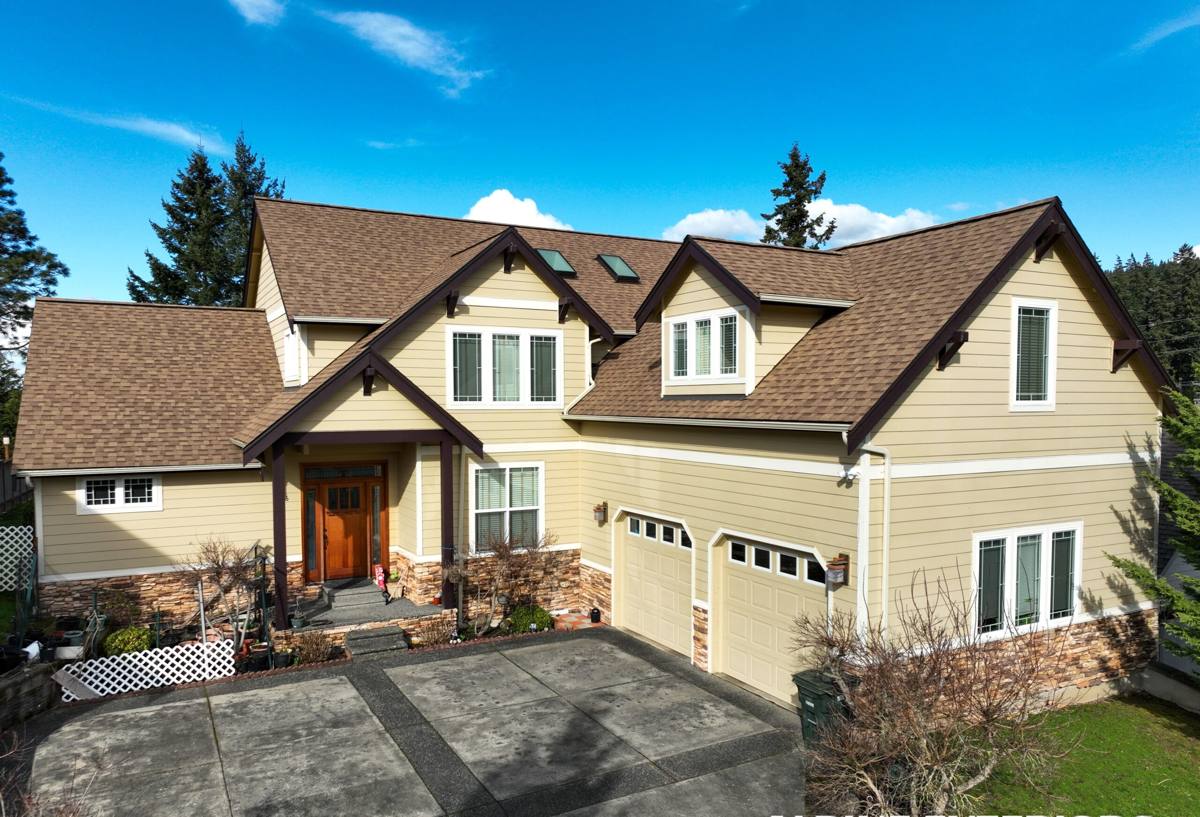
What Salt Air, Rain, and Moss Actually Do to Siding
Each of these factors stresses siding in a different way, and most siding failures we get called out to inspect are the result of two or three of them working together over time.
Salt Air
Being close to Puget Sound air means airborne salt is a real factor on fasteners, flashing, and any exposed metal trim. Salt accelerates corrosion on anything that isn't rated for coastal exposure — cheap fasteners rust, rust stains bleed through paint, and a corroded fastener eventually loses its grip on the siding it's holding.
Driving Rain
Wind-driven rain doesn't just wet a wall — it forces water up and under laps, into unsealed joints, and behind trim that wasn't flashed correctly. A siding system depends on gravity and overlap to shed water downward; driving rain works against both, which is exactly why flashing detail and lap sequencing matter more here than in calmer climates.
Moss and Sustained Moisture
Moss doesn't just grow on roofs. Given enough shade and dampness, it establishes on north-facing siding, in corner trim, and anywhere water sits instead of draining. Moss holds moisture against the surface it's growing on, which extends the amount of time siding stays wet after a storm — and prolonged wetness is what breaks down siding that isn't dimensionally stable or properly finished.
Why We Only Install James Hardie Fiber Cement Here
We stopped installing vinyl, LP SmartSide, and other wood-based or wood-composite sidings years ago, and Sudden Valley is a good example of why. Vinyl expands and contracts with temperature swings and can warp or crack over time, and its seams give wind-driven rain an easy path in. Wood-based composite products depend on an intact factory coating to keep moisture out — once that coating is compromised at a cut edge, a fastener hole, or a damaged corner, the substrate underneath is vulnerable to swelling and rot, and that risk goes up in a climate that stays damp this long.
James Hardie fiber cement is a different material category. It's cement, sand, and cellulose fiber — non-combustible, dimensionally stable, and not susceptible to rot the way wood-based products are. Hardie's HZ5 product line is engineered specifically for wet, freeze-cycle climates like ours, and the ColorPlus factory finish is baked on under controlled conditions, which gives it far more consistent moisture and UV resistance than a field-applied paint job. It's not a magic material — it still has to be installed correctly, with the right gaps, flashing, and fastening — but it gives us a starting point that's actually suited to this environment instead of one we're fighting against.
What a Correct Siding Installation Actually Involves
A siding job is only as good as what's underneath it. Most of the problems we find on older homes trace back to shortcuts taken during installation, not to the siding material itself.
Tear-Off and Wall Inspection
We remove the old siding and inspect the sheathing underneath before anything new goes up. In a climate this wet, hidden rot or soft sheathing behind old siding isn't rare — it needs to be found and addressed before a new water-resistive barrier goes over it, not covered up.
Water-Resistive Barrier and Flashing
A correctly lapped weather-resistive barrier, properly integrated window and door flashing, and correctly flashed horizontal trim are what actually keep driving rain out — the siding itself is the second line of defense, not the first. This is the step that gets rushed most often on cut-rate jobs, and it's the one that determines whether a home stays dry for thirty years or ten.
Fastening and Clearances to Hardie Spec
Hardie siding has specific fastener spacing, nailing patterns, and minimum clearance requirements from grade, roof lines, and other surfaces — clearances that matter even more where moss and standing moisture are a factor, since tight or buried clearances are exactly where organic growth and trapped water take hold. Installing off-spec doesn't just void the warranty; it recreates the moisture-trap conditions this material was chosen to avoid.
Caulking, Trim, and Finish Details
Joints get caulked with a product rated for the movement and moisture cycle we actually see here, not the cheapest tube on the shelf. Corner boards, trim, and butt joints are detailed to shed water outward, not channel it into a seam.
Our Process, Start to Finish
The process itself isn't complicated, but each step exists for a reason:
- Walkthrough and assessment — we look at your existing siding, trim, and any problem areas you've already noticed, and talk through what's driving the need for new siding.
- Written estimate — a clear scope of work and cost, with the Hardie products and colors that fit the home.
- Tear-off and sheathing check — old material comes off and we inspect what's underneath before covering anything back up.
- Weather barrier and flashing — the water-management layer goes in correctly the first time.
- Hardie installation to spec — proper fastening, clearances, and joint treatment throughout.
- Final walkthrough — we go over the finished work with you before calling the job done.
Comparing Siding Options for a Home Like This
Every siding material handles this kind of climate differently. Here's an honest comparison of the trade-offs, not just the upsides:
| Factor | James Hardie Fiber Cement | Vinyl | Wood-Based Composite (e.g. LP SmartSide) |
|---|---|---|---|
| Moisture/rot resistance | Not organic — won't rot; performance depends on correct installation | Won't rot, but seams and warping create water paths | Depends entirely on intact factory coating staying uncompromised |
| Performance in driving rain | Strong when flashed and lapped correctly | Seams and panel flex are weak points | Cut edges and fastener holes are vulnerable entry points |
| Moss/algae resistance | Dense, stable surface resists sustained growth better than porous materials | Can host growth in seams and low spots | Textured surface can trap moisture and organic growth |
| Fire resistance | Non-combustible | Combustible, can melt/deform near heat | Combustible |
| Finish durability | Factory-baked ColorPlus finish | Color molded through material, can fade/chalk | Field or factory paint, vulnerable once breached |
| Typical upfront cost | Higher material and install cost | Lowest upfront cost | Mid-range upfront cost |
Lower upfront cost is real, and we won't pretend otherwise. But for a home sitting in this specific combination of salt-influenced air, driving rain, and a long moss season, we've found the long-term maintenance and replacement cost of cheaper materials tends to erase that initial savings — which is why we standardized on one product instead of offering several.
Signs Your Sudden Valley Home May Need New Siding
A quick self-check before you call anyone — not every issue below means full replacement, but any of them are worth having looked at:
- Soft or spongy spots when you press on the siding, especially near the bottom courses or corners
- Visible moss, algae, or dark streaking that keeps coming back after cleaning
- Paint that's peeling, bubbling, or chalking heavily in patches
- Gaps opening up at seams, corners, or where siding meets window and door trim
- Warping, buckling, or panels that look wavy from an angle
- Rising utility bills that suggest the wall assembly isn't insulating like it used to
- Rust streaks bleeding from fasteners or trim
Why a Crew That Already Works This Area Matters
Installation quality on a project like this comes down to judgment calls — how much clearance to leave near a shaded, moss-prone section of wall, how aggressively to flash a corner that catches wind-driven rain, which details to spend extra time on because they'll actually get tested by this climate. A crew that's done this kind of work around Fairhaven and the wider Whatcom County area has already seen where those judgment calls matter and where they don't. That's not something you can fully replicate by reading a manufacturer's install manual — it comes from having stood on enough local roofs and walls to know what this specific weather does to a wall assembly over years, not just what it looks like on install day.
After Installation: Keeping It Performing
Correctly installed Hardie siding is low-maintenance, not no-maintenance. A yearly rinse to clear moss spores and debris before they establish, a look at caulking and trim joints every couple of years, and prompt attention to anything that looks off near ground level or under heavy tree cover will keep the system doing what it's designed to do for decades.
If you're weighing a siding project for a home in Sudden Valley, we're happy to take a look and give you a straight, no-pressure estimate — no obligation, and no pitch for a product we don't actually stand behind. Use the form below to get started.