 Fairhaven Siding
 Sudden Valley sits inland from Bellingham along the south shore of Lake Whatcom, but "inland" doesn't mean sheltered. The same marine-influenced air that moves through greater Bellingham and Fairhaven still reaches these lake-facing walls, and it combines with the humidity Lake Whatcom itself adds to the equation. Add in driving rain that hits differently depending on elevation and tree cover, and a moss season that barely takes a break in the shaded, forested lots common throughout the community, and you get an exterior environment that's genuinely hard on siding. This page is specifically about fiber cement siding for Sudden Valley homes — what the climate demands of it, what a correct installation actually involves, and how we approach the work when we're on-site.
We install James Hardie fiber cement siding, and only James Hardie fiber cement siding, on every home we side in Whatcom County. That's not a default we fell into — it's a standard we set after watching how different materials actually hold up on shaded, moisture-heavy properties like the ones throughout Sudden Valley.
What Sudden Valley Siding Is Up Against Each Year
Salt Air Drifting Inland
Whatcom County's proximity to the Salish Sea means the marine air moving through the region carries a mild salt content that doesn't stop precisely at the waterline. It travels inland with the wind, and over years it works on fasteners, flashing, and lower-grade finishes the same slow way it does closer to open water — rust bleed at nail heads, degraded caulk, a finish that chalks or fades ahead of schedule. It's rarely the dramatic failure; it's the background condition that shortens a siding system's working life if the material and hardware weren't chosen with it in mind.
Driving Rain Across Uneven, Wooded Terrain
Sudden Valley's hillside lots and tree-broken sightlines mean wind doesn't hit every wall the same way. One elevation on a house can take rain almost straight-on while another, tucked behind a slope or a stand of trees, stays comparatively sheltered — until a storm comes from an unusual direction and finds the gaps in flashing or trim that a "typical" install pattern didn't account for. Water management on a Sudden Valley home has to be planned wall by wall, not assumed to be uniform across the whole structure.
A Moss Season That Doesn't Really End
Heavy tree canopy, lake humidity, and mild temperatures add up to conditions where moss and mildew can stay active nearly year-round on shaded or north-facing walls. Siding materials that hold surface moisture instead of shedding it become a growth surface faster here than they would on a sunnier, more open lot, and once moss and algae take hold, they keep the surface underneath damp for even longer — a cycle that accelerates whatever material weakness is already there.
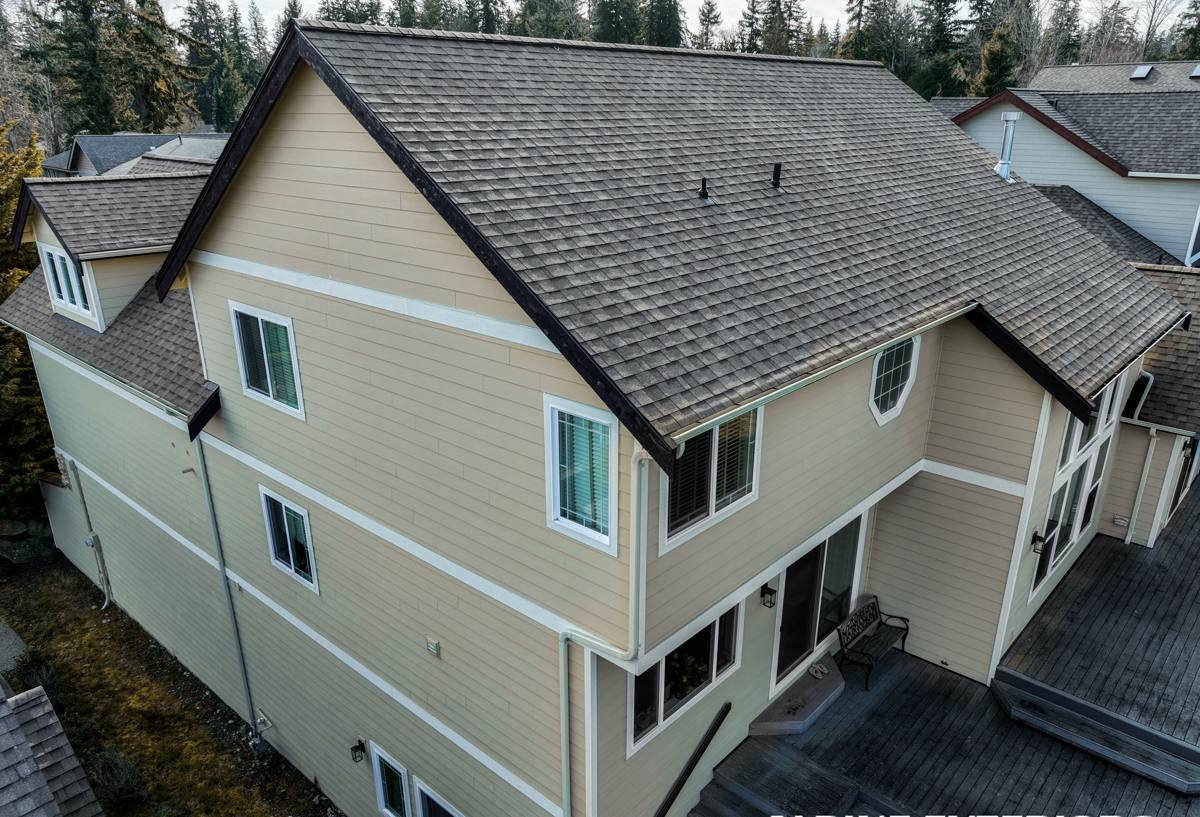
Why Fiber Cement Is the Right Answer for This Climate
James Hardie fiber cement is made from cement, sand, and cellulose fiber, cured into a dense, dimensionally stable board that doesn't absorb and release moisture the way wood-based products do. That matters directly in a climate where walls don't always get a full day of sun to dry out between rain events. It's non-combustible, which is worth noting for any home surrounded by the kind of forest cover common in Sudden Valley. And its ColorPlus finish is baked on at the factory under controlled conditions rather than brushed on in the field, so it resists the fading, chalking, and moisture intrusion that field-applied paint struggles with on a wall that stays damp longer than most. Hardie also builds climate-specific HZ product formulations — HZ5 is engineered for regions with heavy sustained moisture and freeze-thaw cycling, a closer match to lakeside Whatcom County than a generic, one-size-fits-all formulation.
The James Hardie Product Lines We Install Here
"Fiber cement siding" isn't one single product — Hardie makes several distinct siding profiles, and choosing the right one for a given Sudden Valley home depends on the home's style, wall complexity, and how much of it sits in shade.
| Product Line | Profile | Where It Fits Well in Sudden Valley |
|---|---|---|
| HardiePlank lap siding | Traditional horizontal overlapping boards, several width and texture options | The most common choice; sheds driving rain predictably on both sun-exposed and shaded elevations |
| HardiePanel vertical siding | Large vertical sheets, often paired with battens | Board-and-batten look on accent walls, gables, or modern-style homes |
| HardieShingle siding | Staggered or straight-edge shingle profile | Cottage or craftsman-style homes that want texture without going to real wood shingle's maintenance load |
| HardieTrim boards | Smooth or textured trim stock | Corners, window and door surrounds, fascia — detailing that holds paint and resists the same moisture as the field siding |
ColorPlus Finish and Color Selection
Most Sudden Valley projects use Hardie's ColorPlus finish, which comes factory-applied in a defined range of colors and carries its own finish warranty separate from the substrate warranty. Because the coating is cured at the factory rather than applied on a ladder, color consistency and adhesion are more reliable than a field-painted finish — a real advantage on a shaded property where a field coat has less sun exposure to help it cure properly in the first place.
What a Correct Installation Actually Involves
Fiber cement only performs the way it's engineered to when it goes on correctly. On a shaded, moisture-retentive lot like a typical Sudden Valley property, the margin for sloppy detailing is smaller than it would be on a dry, sun-exposed site, because any water that gets behind the cladding here has less opportunity to dry out before it does damage.
Clearance, Fastening, and Joint Treatment
- Correct clearance from grade, roof lines, and decks so the bottom edge of the siding never sits in standing water or constant splash-back
- Corrosion-resistant fasteners, driven at the spacing and depth Hardie specifies — not just "close enough"
- Butt joints treated with the correct sealant or covered with proper flashing, not just caulked and left
- Panels fastened per Hardie's published nailing pattern for the specific product and exposure, since blind-nailed and face-nailed installations have different tolerances
- Cut edges sealed before installation, since an unsealed cut edge is one of the few places fiber cement can take on moisture
Flashing and Drainage Behind the Cladding
Siding is one layer of a larger water-management system that includes house wrap, window and door flashing, and — on shaded walls that don't dry out quickly — drainage or rain-screen detailing that gives any moisture that does get behind the panel a path back out. On a home with mixed sun and shade exposure across different elevations, we don't treat every wall identically; the walls that stay damp longest get the most conservative detailing, because that's where a shortcut would actually cost something down the line.
Repair or Full Replacement: How We Make That Call
Not every siding problem on a Sudden Valley home means tearing the whole house down to the studs. Isolated impact damage, a section that failed around a window, or trim that's worked loose can often be repaired and matched into existing Hardie siding without a full re-side. But if moisture has been tracking behind the wall assembly for a while, or the existing siding is a different, older material that's simply reached the end of its service life, a patch job usually just delays a larger project — and on a shaded lot, hidden moisture tends to have done more damage than it looks like from outside. We'll tell you honestly which situation you're actually in before we recommend either path.
Our Process for a Sudden Valley Fiber Cement Project
We start with an on-site walk of the home, looking specifically at how sun, shade, and tree cover vary across its different walls, since that variation tends to be more pronounced in Sudden Valley than on a typical open, in-town lot. If we're removing existing siding, that tear-off also gives us a look at the sheathing underneath — a step that matters here, because moisture damage on a shaded wall can be present well before it shows up as a visible problem on the surface. Any repairs to sheathing or framing get handled before a single piece of new siding goes up, not discovered after the fact. From there we install house wrap, flashing, and the Hardie product line specified for that section of the house, followed by trim and finish work, then a full cleanup and walk-through so you know exactly what was done and why. We provide a written scope before work starts, so there's no ambiguity about what's included.
What This Costs: Factors That Move the Number
| Factor | What It Affects | Why It Matters in Sudden Valley |
|---|---|---|
| Wall complexity and home size | Total material and labor hours | Homes with more gables, dormers, and trim detail take longer to flash and finish correctly |
| Tear-off vs. install over existing substrate | Labor scope and what gets uncovered | Older siding on shaded walls often hides moisture damage that needs addressing before new siding goes on |
| Substrate repair | Cost added before new siding installation | Shaded, damp walls are where we most often find sheathing that needs replacing |
| Site access and terrain | Staging, scaffolding, and setup time | Sloped lots and tree-crowded access common in Sudden Valley can add setup time |
| Product line and finish selection | Material cost | Panel and shingle profiles generally cost more in material and labor than standard lap siding |
We don't quote off square footage alone — real numbers depend on the specific house, its terrain, and what we find once we're actually looking at it.
Signs Your Siding Is Telling You Something
- Moss or dark staining that returns quickly after cleaning, especially on shaded or north-facing walls
- Soft or spongy siding near the base of a wall or around window and door trim
- Visible gaps at seams, corners, or trim joints where water can track in
- Rust staining around fasteners, an early sign of ongoing marine air exposure
- Paint or finish that's peeling, bubbling, or chalking faster than expected
- Cracked or missing siding sections after a windstorm
Why a Crew That Already Works Sudden Valley Matters
Sudden Valley is a private community with its own road network and homeowners association, and a crew that already works here understands the practical side of that — scheduling around community access, and recognizing how much exposure can change from one lot to the next even within the same few streets. That familiarity shows up in decisions that actually affect how long the job lasts: which walls get extra drainage detailing because they rarely see direct sun, how flashing gets lapped on a steep, shaded roof-to-wall transition, and which fastener grade is worth the extra cost given the marine air this whole area shares with the rest of Whatcom County. Those are the details that separate a fiber cement installation that looks right on day one from one that's still performing correctly fifteen years later.
If you're weighing fiber cement siding for a home in Sudden Valley, we're glad to walk the property with you, look at how its specific walls handle sun, shade, and moisture, and give you a straight answer on what the job actually involves. Reach out below for a free, no-pressure estimate.