 Fairhaven Siding
 Siding Repair Built for South Hill's Climate
South Hill sits close enough to the water and the weather patterns that move through Whatcom County that siding here takes a different kind of beating than siding fifty miles inland. Salt-laden air off the bay accelerates corrosion on fasteners and trim. Driving rain, pushed sideways by wind off the water, finds every gap in flashing and caulk that a calmer climate would never expose. And the long, damp shoulder seasons that stretch from fall through spring give moss, algae, and mildew months at a time to take hold on north-facing walls and anything shaded by mature trees.
None of that means South Hill homes need constant repair. It means the repairs they do need have to be done correctly the first time, with materials and techniques matched to what the site actually throws at a wall. A patch that would hold up fine in a dry inland neighborhood can fail within a season here if it doesn't account for moisture cycling and wind-driven rain.
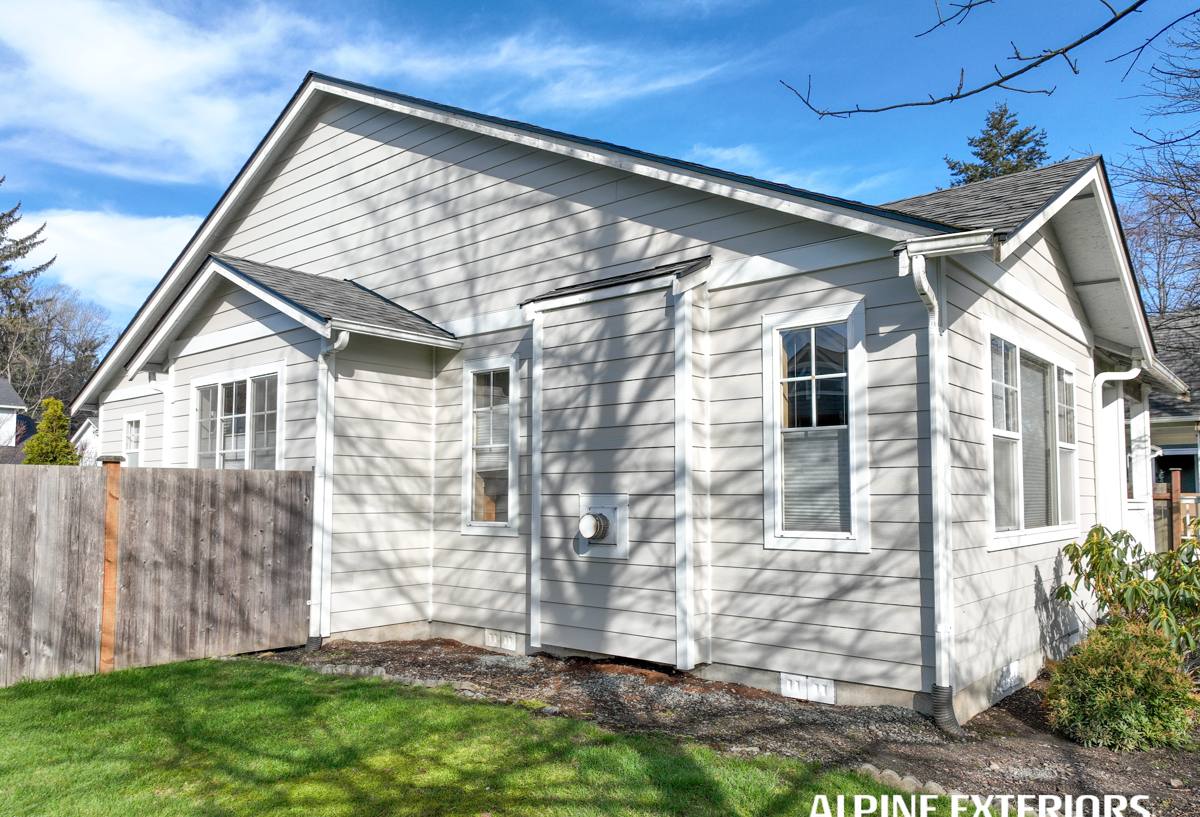
Signs a South Hill Home Needs Siding Repair
Most siding problems don't announce themselves with a hole in the wall. They show up as smaller signals that get ignored until the damage underneath is worse than the siding itself.
- Soft or spongy spots when you press on the siding, especially near the bottom courses or around window trim
- Persistent dark streaking or green-black growth that returns quickly after cleaning
- Cracked, split, or bowed boards, particularly on walls that catch the most wind and rain
- Caulk that has pulled away from trim, corners, or window and door edges
- Paint that's bubbling, peeling, or chalking unevenly in patches rather than across the whole wall
- Visible gaps at seams or where siding meets flashing, fascia, or foundation
- A musty smell near an exterior wall, or discoloration on interior drywall that lines up with an exterior trouble spot
Any one of these on its own might be minor. Several together, especially on a wall that faces prevailing weather, usually means moisture has been getting behind the siding for a while.
What a Correct Repair Actually Involves
It starts with finding out why, not just what
A repair that only replaces the damaged board without asking why that board failed is a repair that will need to be redone. Damaged siding on a coastal-influenced site is almost always a symptom — of a flashing detail that was never right, a caulk joint that failed years ago, or a grading or gutter issue sending water where it shouldn't go. Before any board comes off, the cause needs to be identified, because replacing the material without fixing the entry point just buys time.
Moisture testing before assumptions
Where rot or staining suggests water intrusion, the sheathing and framing behind the siding need to be checked, not assumed to be fine because the siding on top looks patchable. Soft sheathing or wet framing changes the whole scope of the job, and it's far better to find that out during the repair than two years later when the same spot fails again.
Matching material and finish
Fiber cement siding installed and painted years apart rarely matches perfectly unless the repair uses the correct product line and, where possible, factory-finished color matching rather than field-mixed paint. A visible patch is a cosmetic problem today and a maintenance headache later, since mismatched finishes weather at different rates.
Flashing and joint details, not just the board
Every repair is a chance to correct the small details that cause failures in the first place — proper flashing above windows and trim, correct overlap at seams, back-priming cut edges, and sealant only where sealant belongs (fiber cement systems are designed to shed water, not rely on caulk as the primary barrier).
Common Repair Scenarios We See Around South Hill
| Issue | Typical Cause | What Correct Repair Requires |
|---|---|---|
| Rot at bottom courses or trim | Splash-back, poor grading, or missing drip edge | Cut back to sound material, correct water path, replace with matched product |
| Cracked or split boards | Impact damage, improper fastening, or freeze-thaw stress on compromised material | Full board replacement, correct fastener pattern and spacing |
| Persistent moss or algae staining | Shade, low airflow, extended damp season | Clean, inspect for underlying moisture, treat and monitor rather than paint over |
| Failed caulk and gapped seams | Age, sun exposure, wind-driven rain cycling | Remove old sealant, correct joint prep, reseal only where system-appropriate |
| Corroded fasteners or streaking | Salt air exposure, wrong fastener material used originally | Replace with corrosion-resistant fasteners rated for coastal exposure |
Repair or Replace? How We Help You Decide
Not every damaged section needs a full re-side, and not every home is a good candidate for spot repair. The honest answer depends on how much of the wall system is affected and how old the existing siding is.
- Repair usually makes sense when damage is isolated to a small area, the underlying structure tested dry, and the existing siding still has useful life left.
- Replacement is usually the better call when moisture damage is widespread, the original installation has recurring flashing or drainage problems across multiple walls, or the siding material itself is at the end of its practical service life.
We'll tell you plainly which category your home falls into. A contractor who repairs everything regardless of scope isn't doing you a favor — and one who pushes full replacement on a home that only needs a section fixed isn't either.
Why We Repair With James Hardie Fiber Cement
We install and repair exclusively with James Hardie fiber cement siding. For repair work specifically, that standardization matters in a few practical ways. Hardie's HZ product lines are engineered for regional moisture and climate exposure, so a repaired section performs the same way structurally as the surrounding material — it isn't a softer or more moisture-sensitive patch grafted onto a harder-wearing wall. ColorPlus factory-finished boards give us a far better shot at a color and sheen match than field-applied paint, which matters most on visible street-facing walls. And because fiber cement is non-combustible and dimensionally stable, repaired sections hold up to the same freeze-thaw and moisture cycling as the rest of the wall, rather than becoming the next spot that fails.
This is also why we don't repair or install vinyl, LP SmartSide, primed wood, or other fiber cement brands. We've standardized on one system so that every repair we make is consistent with best practices for that specific product — not a generic patch job improvised to fit whatever material happens to be on the wall.
Our Repair Process
- On-site inspection: We assess the visible damage and check surrounding areas for signs the problem extends further than what's obvious from the ground.
- Cause diagnosis: We identify what let water or damage in, whether that's a flashing detail, a caulk failure, or a grading issue, and explain it in plain terms.
- Honest scope and estimate: You get a clear picture of whether this is a targeted repair or something bigger, with pricing that reflects the actual work — no upsell padding.
- Correct repair, not a cosmetic patch: Damaged material is cut back to sound substrate, underlying issues are corrected, and new material is installed to the same standard as new construction.
- Finish and match: We work to get color, reveal, and joint lines as close to the existing siding as the situation allows.
Why a Crew That Already Works South Hill Matters
Siding repair isn't just a materials question — it's a site-conditions question. A crew that regularly works South Hill and the surrounding Fairhaven area already understands how wind-driven rain moves across different lot orientations, which details tend to fail first on homes exposed to salt air, and how long moss and algae take to become a real problem versus a cosmetic one. That familiarity shows up in faster, more accurate diagnosis and repairs that are built for the conditions your specific wall actually faces, not generic assumptions pulled from a drier climate.
It also means accountability. A local crew has a reputation in the neighborhood to maintain and is easy to reach if a question comes up after the work is done — not a name from an out-of-area outfit that's hard to track down once the invoice is paid.
Get a Straight Answer on Your Siding
If you're seeing soft spots, staining, cracked boards, or gaps in your siding, it's worth getting an honest look before small damage turns into a bigger repair. We offer free, no-pressure estimates for South Hill homeowners — we'll tell you plainly whether you're looking at a targeted repair or something more, and why.