 Fairhaven Siding
 Siding Replacement Built for Sudden Valley's Lake and Tree-Line Conditions
Sudden Valley sits along Lake Whatcom, wrapped in mature tree cover on sloped, wooded lots that are part of what makes the community appealing to live in — and part of what makes siding replacement here a different job than it is on an open, sun-exposed lot elsewhere in Whatcom County. Homes tucked into the trees stay damp longer after a storm, pick up marine-influenced air moving through the region, and deal with driving rain that doesn't fall straight down so much as get pushed sideways into walls, trim, and seams. When siding starts failing in this environment, it's rarely one single event. It's usually the slow accumulation of moisture, shade, and organic growth finally winning out over a wall assembly that couldn't keep pace.
This page is specifically about full siding replacement for Sudden Valley properties: what actually triggers the need for it, what a correct job looks like once the old material comes off, and why we install only James Hardie fiber cement when it goes back on. If you're trying to figure out whether your home needs a repair or a full replacement, or you just want to understand what a proper job involves before you get quotes, this is written for that decision.
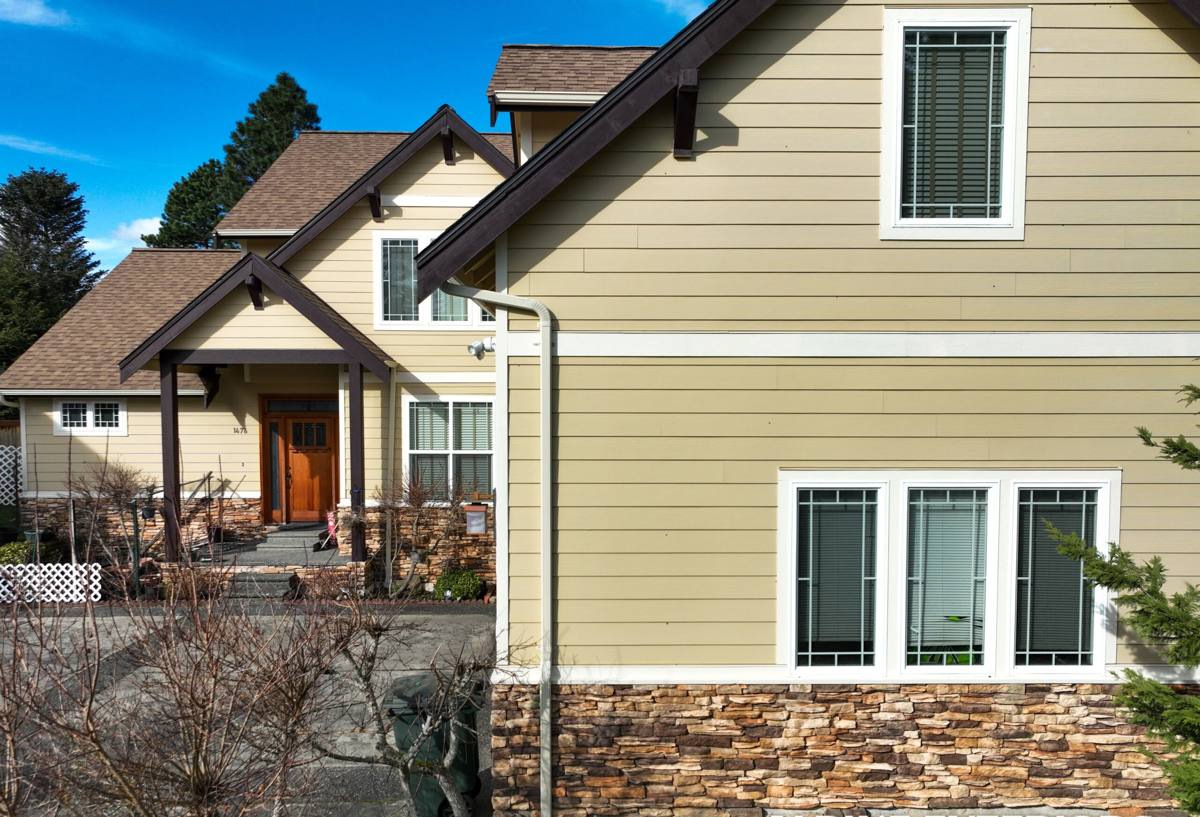
What Actually Wears Out Siding Around Lake Whatcom
Shade and Moisture That Doesn't Let Up
A lot of Sudden Valley's housing sits under a real tree canopy, and that shade keeps walls from drying out between rain events the way a cleared, sun-exposed lot would. Moisture that would evaporate off in an afternoon somewhere else can sit against a shaded wall for days. Over years, that constant dampness is what drives moss, mildew, and algae growth on siding surfaces, and it's also what pushes water into any gap in the material's defenses — a failed seam, a worn finish, a piece of trim that's come loose.
Driving Rain at the Wrong Angle
Wind off the lake and through the surrounding terrain pushes rain into lap joints and butt seams from angles that a lot of siding systems, especially older or lower-grade ones, were never really detailed to handle. That's a big part of why failure on lake-adjacent homes often starts at the seams and trim intersections rather than in the middle of a flat wall section.
Salt-Influenced Marine Air
Whatcom County's proximity to the Sound means even inland communities like Sudden Valley pick up some marine influence in the air, and that mild salt exposure works slowly on fasteners, flashing, and unprotected finishes over the years. It's rarely the headline problem, but it compounds everything else — a corroding fastener loosens its grip, and a loosened fastener lets more water in.
Signs a Sudden Valley Home Is Due for Replacement, Not Just Repair
- Soft, spongy, or visibly bowed siding, especially near the base of walls or around window and door trim
- Moss or dark staining that returns within weeks of cleaning, particularly on shaded or north-facing walls
- Peeling, bubbling, or chalking paint across multiple sections rather than one isolated spot
- Visible gaps, cracking, or separation at seams, corners, and trim joints
- Rust staining around fasteners or flashing, a sign moisture has been present for a while
- Warped, cupped, or split boards on more than one wall or elevation
- A musty smell near exterior walls, or interior drywall that feels damp or stains near an outside wall
One or two of these on a single wall section can sometimes be handled as a repair. Several of them across multiple elevations, or any sign that moisture has reached the sheathing behind the siding, usually means a repair is just delaying a bigger project.
What a Correct Siding Replacement Actually Involves
Pulling old siding off and nailing new boards up isn't the job — it's one part of it. A replacement that actually holds up in this climate depends on what happens underneath, at every stage of the tear-off.
Full Tear-Off and Substrate Inspection
We remove the existing siding down to the sheathing so we can actually see what's there, rather than covering unknown problems with a fresh layer. On lake-adjacent, shaded lots, it's common to find sheathing or framing that's taken on moisture behind siding that looked fine from the street. That damage needs to be repaired before anything new goes up, or the new siding is just sitting on a compromised foundation.
House Wrap and Flashing as One System
Water management is the part of a siding job that doesn't show once the walls are finished, and it's also the part that determines whether the replacement lasts. House wrap, window and door flashing, and siding all have to work together as one integrated system directing water back out and down, not as separate steps done in isolation. This matters more on Sudden Valley's sloped, tree-shaded lots, where wind-driven rain and slow-drying walls give water more chances to find a weak point.
Correct Fastening for a Marine-Influenced Climate
Fastener choice and pattern matter in any climate, but in an area with sustained moisture and some salt exposure, using the right fastener material and spacing is what keeps hardware from becoming the failure point a decade down the road. This is a detail that's invisible once the siding is up and easy to cut corners on if a crew doesn't specialize in this environment.
Detailing at Seams, Corners, and Penetrations
Every seam, corner, and penetration for a light fixture, hose bib, or vent is a potential entry point for water. Correct lapping, sealing, and trim work at each of these spots is what determines whether wind-driven rain actually gets shed the way the siding system is designed to shed it.
Why James Hardie Fiber Cement Goes Back On After Tear-Off
We install one siding product on every home we work on: James Hardie fiber cement. That's not a default — it's a deliberate standard, based on what holds up in exactly the conditions Sudden Valley sees.
- Non-combustible core: fiber cement doesn't feed a fire the way wood-based siding can, which matters for household safety.
- Factory-applied ColorPlus finish: the color coat is cured under controlled factory conditions rather than brushed on in the field, giving it real resistance to fading, chalking, and moisture intrusion over time, and it carries its own separate warranty.
- Climate-engineered HZ product lines: Hardie's HZ5 formulation is built for regions with heavy sustained moisture and freeze-thaw cycling, a closer match to lake-adjacent Whatcom County than a generic national spec.
- Dimensional stability: fiber cement doesn't swell, cup, or warp the way engineered wood siding can after repeated wet-season moisture cycles under tree cover.
- Strong transferable warranty: Hardie backs its products with one of the more substantial warranty structures in the industry, provided the installation follows spec — which is why installation detail matters as much as the material choice.
We don't install LP SmartSide, vinyl siding, Cemplank, Allura, primed spruce, or cedar. Those are legitimate products, and other contractors install them competently. Our decision came from a straightforward read of what a shaded, moisture-heavy, marine-influenced climate does to a wall assembly over the life of a siding system, and what we were comfortable putting our own workmanship warranty behind.
Our Replacement Process, Step by Step
- On-site assessment: we walk the property and evaluate sun exposure, tree cover, drainage, and the current siding's condition on every elevation, not just the ones visible from the driveway.
- Tear-off and inspection: old siding comes off down to the sheathing so hidden moisture damage gets found and addressed, not covered up.
- Substrate repair: any compromised sheathing or framing gets repaired before house wrap goes on.
- House wrap and flashing: installed as one coordinated water-management system around every window, door, and penetration.
- Hardie installation: boards fastened to spec, seams and corners detailed correctly for wind-driven rain.
- Trim and finish work: corners, trim boards, and caulking finished to shed water at every joint.
- Final walkthrough: we go over the finished exterior with you before calling the job done.
Siding Replacement Cost Factors in Sudden Valley
| Factor | What It Affects | Why It Matters Here |
|---|---|---|
| Substrate condition | Repair costs before new siding goes on | Shaded, lake-adjacent lots often hide moisture damage behind old siding that looked fine from outside |
| Tree cover and slope | Site access, staging, and labor time | Wooded, sloped lots common in Sudden Valley can add setup and equipment time versus an open, level lot |
| Home size and wall complexity | Total material and labor | More trim detail and roofline intersections give wind-driven rain more places to test the installation |
| Existing material | Removal effort and disposal | Older wood or aluminum siding often takes longer to strip than newer product, especially where it's failed |
| Trim and color selection | Material cost and long-term finish life | ColorPlus factory finishes hold up longer against sustained moisture and shade than field-applied paint |
These are the factors that move a price up or down, not a substitute for an actual number — real costs depend on the specific house, which is why we walk the property before quoting rather than pricing off square footage alone.
Repair or Full Replacement: How We Tell the Difference
Not every siding problem on a Sudden Valley home means starting over. A section damaged by a fallen branch, a piece of trim that's worked loose, or isolated impact damage can often be repaired and matched into existing Hardie siding without a full tear-off. But if the damage is spread across multiple elevations, if moisture has clearly been tracking behind the wall for a while, or if the existing siding is an older material that's simply run out of service life, a patch job usually just delays a larger and more expensive project a year or two down the road. We'll tell you honestly which situation you're actually looking at before you spend money either way.
Why a Crew That Already Works Sudden Valley Matters
Sudden Valley's combination of lake proximity, mature tree cover, and sloped lots isn't identical to conditions on a cleared, open lot elsewhere in Whatcom County, and a siding replacement that doesn't account for those differences tends to show it within a few wet seasons. A crew that's worked this community before knows which wall orientations stay damp longest, where extra flashing attention actually pays off, and how tree cover changes the maintenance and drying pattern of a finished wall. That's the kind of judgment that doesn't show up on a bid sheet but shows up in whether the job is still performing correctly five or ten winters later.
If your Sudden Valley home is showing signs it's due for new siding, or you just want a straight opinion on whether you're looking at a repair or a full replacement, we're glad to take a look. Reach out using the form below to schedule a free, no-pressure estimate.