 Fairhaven Siding
 New-Construction Windows in Puget: A Different Job Than Replacement
When people say "new construction windows," they mean something specific: windows installed into a framed, unfinished opening before the siding, trim, and weather barrier are closed up around them — as opposed to a replacement window that gets fitted into an existing, already-finished wall. In the Puget area of Fairhaven, most of this work comes from new home builds, additions, and full exterior remodels where the wall has been opened back to the studs. It's a different trade than replacement work, and it needs to be treated that way. Get the flashing and sequencing wrong at this stage, and the mistake gets buried behind siding for the next twenty years.
New-construction windows use a nailing flange (or "nail fin") that attaches directly to the sheathing, and the window becomes part of the building's water management system rather than sitting inside one. That means the person installing it is also responsible for how water moves around it — down the weather-resistive barrier, across the sill, and out past the siding. On a Puget lot, with Bellingham Bay's salt air and Whatcom County's wet season working against the building envelope for months at a time, that detail work is what separates a window that performs for decades from one that causes a rot problem five years in.
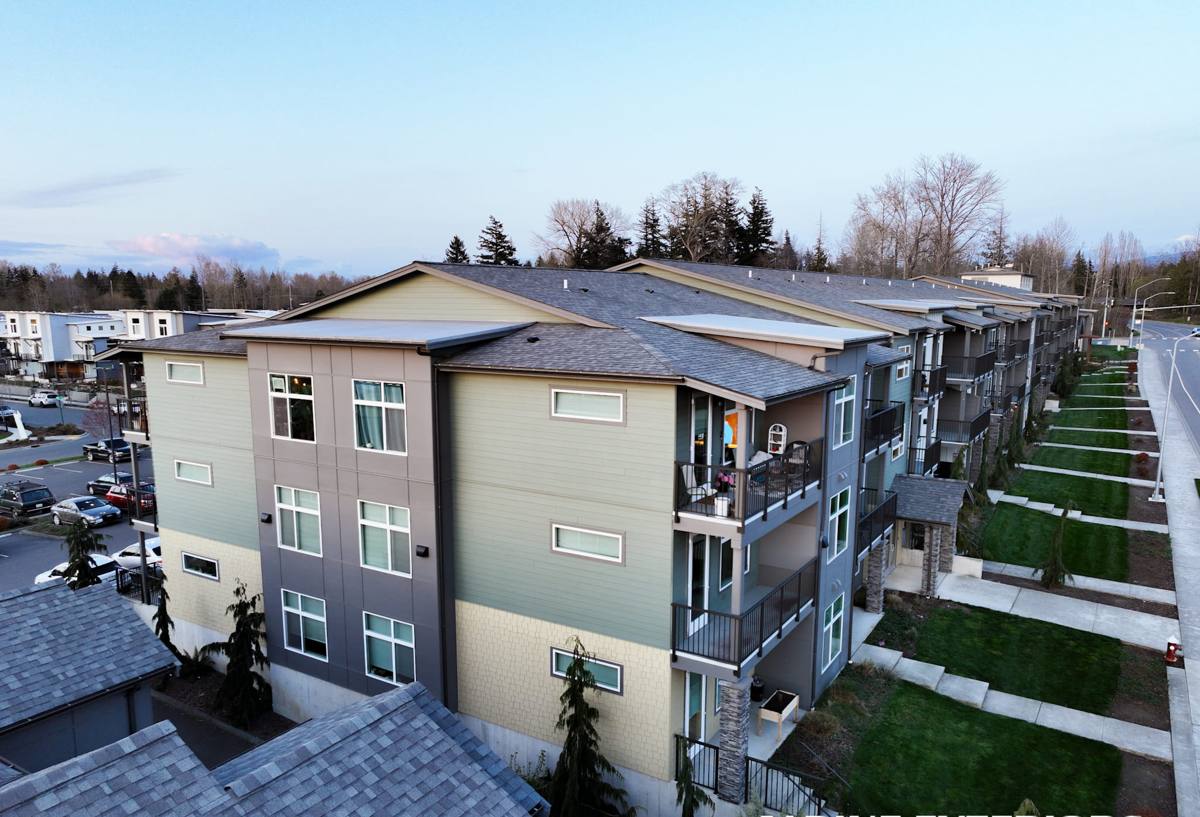
Why Fairhaven's Climate Changes How This Job Should Be Done
Puget sits close enough to the water that homes here deal with a combination most inland builders never have to think about: salty, moisture-laden air, wind-driven rain that hits walls at an angle instead of falling straight down, and a long stretch of the year where surfaces simply don't fully dry out. That combination shows up in three practical ways on a new-construction window job.
Salt air and hardware corrosion
Cranks, locks, hinges, and even some fastener types corrode faster near the water than they do a few miles inland. On a new build, this is the point to select hardware and fasteners rated for coastal exposure — not something to discover later when a lock seizes up or a fastener head rusts through the finish.
Driving rain and flashing integration
Straight-down rain is forgiving of small gaps. Wind-driven rain off the bay is not — it finds any seam that isn't properly lapped and pushed inward by wind pressure. That makes sill pan flashing, correct shingle-lap sequencing with the house wrap, and proper head flashing non-negotiable on every opening, not just the exposed ones.
The long moss season
Whatcom County's wet months keep north- and shade-facing surfaces damp for extended stretches, which is exactly the environment moss and algae need to take hold on trim, sills, and the siding around a window. A window opening that drains properly and doesn't trap standing water at the sill gives moss far less to grow on, and keeps the surrounding trim drier and more paintable long-term.
Frame Material and Glass: What Actually Holds Up Here
New construction is the one time you get to pick the window from scratch, without being boxed in by an existing frame size. That makes it worth thinking about material and glass package in terms of this specific climate, not just price per unit.
| Frame Material | Coastal/Marine Performance | Maintenance | Typical Fit |
|---|---|---|---|
| Vinyl | Good — won't corrode or rot; UV-stable formulations hold color | Low — occasional cleaning | Most standard new builds, best value |
| Fiberglass | Very good — dimensionally stable, resists moisture and salt exposure well | Low | Larger openings, higher-exposure walls |
| Aluminum-clad wood | Good exterior durability, but interior wood core needs the exterior seal to stay intact | Moderate — depends on seal integrity over time | Homes prioritizing a wood interior look |
| Bare aluminum | Weaker choice near salt air without a quality finish; thermally less efficient | Higher — finish maintenance matters | Limited use; we steer most clients elsewhere here |
On glass, a good Low-E coating with an argon-filled dual-pane unit is the baseline we'd recommend for this area — it's less about a single climate quirk and more about keeping energy bills predictable through Whatcom County's long shoulder seasons. For walls facing the water or prevailing wind, we'll also talk through impact ratings and higher design-pressure (DP) ratings, since those openings take more direct wind load and wind-driven rain than a sheltered wall.
How the Installation Actually Goes Together
The quality of a new-construction window job is almost entirely in the sequencing — the order the flashing, house wrap, and window itself get layered together. Done correctly, every layer sheds water onto the layer below it, all the way down and out.
- Rough opening check — confirm the framed opening is square, plumb, and sized correctly before anything else happens. A slightly out-of-square opening now becomes a window that won't operate smoothly for the life of the house.
- Sill pan flashing — a sloped, back-dammed pan at the bottom of the opening so any water that gets past the window has somewhere to go besides into the wall framing.
- House wrap integration — the weather-resistive barrier gets cut and lapped in the correct shingle-style order (bottom flap out over the pan, sides next, top last) so water always drains onto the layer below, never behind it.
- Setting the window — shimmed level, plumb, and square, fastened per the manufacturer's schedule, without over-driving fasteners that can bow the frame and cause operational problems later.
- Head flashing — installed and lapped over the top nailing flange so water is directed out and over the window, not down behind it.
- Sealant and backer rod — used at the right joints, not everywhere; sealing every possible gap can trap moisture in places that need to drain instead.
- Interior air sealing and insulation — a properly insulated, air-sealed perimeter that doesn't compress the low-expansion foam or backer rod meant for that gap.
Every one of these steps depends on the one before it being done correctly. That's why new-construction window work isn't really a "measure twice, cut once" job — it's closer to "sequence it right the first time," because most of it disappears behind siding and trim before anyone can go back and check it.
Working Alongside Your Builder and Other Trades
New-construction window installs happen inside a busy schedule with framers, siding crews, electricians, and often a general contractor all moving through the same house. A window crew that's used to this kind of coordination knows to:
- Confirm rough openings against the window order before framing is closed up, catching sizing mismatches while they're still cheap to fix
- Time the install after the house wrap is on but before siding starts, so flashing laps in the correct order
- Communicate directly with the GC or builder on schedule changes, since a delayed window delivery can hold up siding and trim crews behind it
- Leave clean, documented flashing details in case of a framing or building inspection before the wall is closed up
On additions and remodels specifically, there's an added layer: matching new openings into an existing wall that's already weathered and may have its own quirks from the original build. That's a slightly different conversation than a from-scratch new build, and it's worth having before windows are ordered, not after.
What Drives the Cost on a New-Construction Window Job
Every house and lot is different, so we won't quote a number here that doesn't apply to your project — but these are the factors that actually move the price up or down on a Puget new-construction install.
| Factor | Why It Matters |
|---|---|
| Number and size of openings | More openings and larger units mean more flashing details and labor hours, straightforwardly |
| Wall exposure | Walls facing prevailing wind and water may call for higher DP-rated units and more careful flashing |
| Height and access | Second-story or hard-to-access openings take longer and often need additional fall protection setup |
| Frame material selected | Vinyl, fiberglass, and clad-wood options carry different material costs, as shown above |
| Glass package | Standard Low-E vs. impact-rated or higher-performance glazing changes unit cost |
| Schedule coordination | Working within a tight builder schedule with other trades can affect crew availability and timing |
A Practical Checklist If You're Building or Adding On in Puget
Whether you're the homeowner, the builder, or the GC pulling this job together, these are the things worth confirming before windows go in:
- Rough openings verified against actual window schedule before framing is closed up
- Sill pan flashing planned for every opening, not just ground-floor or exposed walls
- House wrap sequencing confirmed to lap correctly with window flashing (bottom-up, shingle style)
- Hardware and fasteners specified for coastal/marine exposure, not standard inland-grade hardware
- Glass package matched to wall exposure — standard Low-E for sheltered walls, higher DP rating for exposed ones
- Install timed after house wrap, before siding closes the wall up
- Photos or documentation of flashing details taken before the wall is covered, for your own records
Why It's Worth Hiring a Crew That Already Works in Puget
New-construction window work rewards local knowledge more than most exterior trades. A crew that's worked other jobs in Puget and around Fairhaven already knows how wind off the bay behaves against a wall, which orientations tend to hold moisture longest through the wet season, and what level of flashing detail actually holds up here versus what's fine in a drier inland climate. That's not something you can fully substitute with a generic install checklist — it comes from having done the work on this specific stretch of coastline, in this specific weather pattern, more than once.
It also matters for something less visible: knowing which building departments and inspectors in Whatcom County expect to see flashing details before a wall closes up, and building the schedule so that inspection happens without holding up the rest of the crew. A crew unfamiliar with local process can turn a routine inspection into a scheduling headache for everyone on the job site.
If you're planning new construction, an addition, or a full exterior remodel in Puget or elsewhere in Fairhaven, we're happy to walk the plans or the framed openings with you and put together a straightforward, no-pressure estimate — just fill out the form below.