 Fairhaven Siding
 Building New in South Hill Means Building for This Climate
South Hill sits close enough to the water that salt-laden air is a daily fact of life, not an occasional nuisance. Add Whatcom County's long wet season, driving rain that comes in sideways off Bellingham Bay, and the moss and algae growth that thrives in the shade of mature trees and north-facing elevations, and you have a set of conditions that will find every weak point in a new home's window installation within a few years. On new construction, this is actually good news: you get to build the envelope correctly from the start instead of retrofitting around problems later.
A window that's simply "installed" and a window that's installed correctly for this specific site look identical on move-in day. The difference shows up three, five, ten years later — as staining, soft trim, fogged glass, or drafts that weren't there originally. Getting it right the first time costs the same as getting it wrong; it just takes a crew that knows what South Hill throws at a building envelope.
Salt Air and Hardware Fatigue
Airborne salt accelerates corrosion on any exposed metal — window hardware, screen frames, fasteners, and flashing. On homes closer to the water, we pay attention to hardware finish and fastener material up front, because replacing corroded hinges or latches on a two-year-old window is an avoidable expense.
Driving Rain and Water Management
Wind-driven rain doesn't just hit a window — it gets pushed sideways and upward into any gap in the flashing sequence. New construction gives us the rare chance to build the drainage plane and window opening together, before siding or trim covers up the details that actually keep water out.
Moss Season and Shaded Elevations
Long stretches of damp, low-light weather feed moss and algae growth, especially on north- and west-facing walls shaded by trees, which are common throughout South Hill. Growth that gets a foothold at a window sill or trim joint holds moisture against the wood or substrate far longer than open, sun-exposed areas — which is exactly where rot starts.
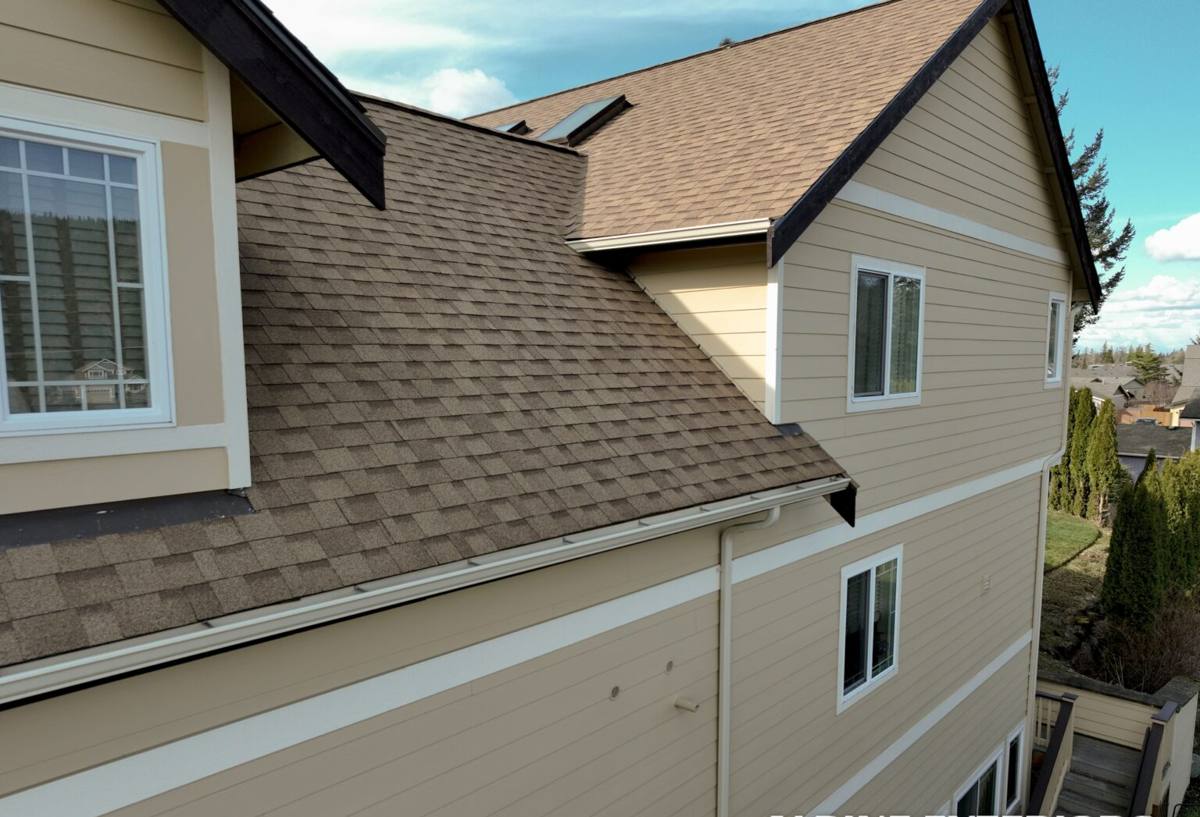
What a Correct New-Construction Window Install Actually Involves
"New construction" windows (as opposed to replacement or retrofit units) are installed with a nailing fin directly into the rough opening before siding goes on. That gives us full access to build the water management layers in the right order — but only if the sequence is followed every time, on every opening.
- Rough opening checked for square, level, and correct dimension before the window ever shows up on site
- Sloped sill pan installed so any water that gets past the window sheds outward, not into the wall cavity
- Self-adhered flashing tape integrated with the weather-resistant barrier in the correct shingle-lap order (sides, then head, then WRB laps over the top)
- Window set plumb, level, and square, then fastened per the manufacturer's schedule — not just "a few screws where it's convenient"
- Backer rod and exterior sealant at the trim-to-window joint, sized and installed to actually move with the building instead of cracking
- Interior air seal at the rough opening, which matters as much for comfort and energy bills as the exterior work matters for water
Skip or rush any one of these steps and the window will likely still pass a casual look on installation day. The failures show up during the next few wet seasons, when water finds the gap nobody sealed.
Window Selection Criteria for a South Hill Build
Beyond the installation itself, the window unit needs to be a reasonable match for the site. On new construction we're generally looking at:
- Corrosion-resistant hardware and fasteners, particularly on homes with more direct water exposure
- A frame material that tolerates sustained damp conditions without ongoing maintenance
- Glazing package appropriate for the home's orientation — west and north exposures see different sun and moisture patterns
- A manufacturer with a warranty structure that's actually honored regionally, not just on paper
Frame Material Comparison for This Climate
| Frame Material | Moisture Behavior | Maintenance | Typical Cost Tier |
|---|---|---|---|
| Vinyl | Won't rot or corrode; performs well in damp coastal air | Low — occasional cleaning | Lower |
| Fiberglass | Very stable dimensionally; handles moisture and temperature swings well | Low | Mid to upper |
| Wood-clad | Good if the cladding and seals stay intact; interior wood still needs protection from any moisture intrusion | Moderate — watch joints and finish over time | Upper |
| Aluminum | Conducts heat and cold readily; needs a good thermal break, and bare aluminum hardware is more prone to salt-air corrosion | Moderate | Mid |
None of these is automatically wrong for South Hill — the installation quality and hardware spec matter more than the frame material alone. We'll walk through the honest trade-offs for your specific elevation and budget rather than push one product line.
Our Installation Process
- Site walk and rough opening check. We verify openings against the window schedule before units are ordered, catching framing issues while they're still cheap to fix.
- Sequencing with your builder or GC. Windows go in at the right point in the build — after the WRB is up, before siding closes in the opening — so every flashing layer laps correctly.
- Sill pan and flashing installation. Every opening gets the same sequence, regardless of how many windows are on the job or how far behind schedule the project is running.
- Setting and fastening. Plumb, level, square, and fastened to the manufacturer's spec — this is also when we confirm operation (opening, closing, locking) before the wall closes around it.
- Interior and exterior sealing. Air seal inside, backer rod and sealant outside, sized for real joint movement.
- Final walkthrough. Every window operates correctly and every seal is inspected before we call the opening finished.
Mistakes We See on New Builds in This Area
Most window problems on new construction trace back to a handful of shortcuts, and they're the same handful whether the home is in South Hill, elsewhere in Fairhaven, or anywhere else in Whatcom County with similar exposure:
- Flashing tape lapped in the wrong order, so water is directed behind the barrier instead of over it
- Sill pans skipped or improvised on site instead of installed per a real detail
- Sealant used to compensate for a poor mechanical fit instead of a properly shimmed and fastened window
- Fastener material that isn't suited to salt-air exposure, leading to early corrosion and hardware failure
- No coordination between the window trade and the siding trade, leaving gaps at the trim line that go unnoticed until the first hard rain
Questions to Ask Before You Sign a Window Contract
- Who installs a sloped sill pan, and can you describe the flashing lap order you use?
- What's your fastener and hardware spec for homes closer to the water?
- How do you sequence with the siding and WRB installer to avoid gaps at the trim line?
- What's the manufacturer's warranty, and who actually handles a claim if one comes up?
- Can you name other new-construction jobs you've done in this immediate area?
Why It Matters That We Already Work in South Hill
A crew that installs windows in a dry, inland climate can do good work and still get South Hill wrong — not from lack of skill, but from not knowing which details matter most here. We already account for salt exposure on hardware selection, we already build sill pans expecting driving rain rather than occasional showers, and we already think about moss and shade patterns when we talk through trim details with a homeowner or builder. That local knowledge doesn't show up as a line item on a quote, but it's the difference between a window that's still performing well in ten years and one that needs attention in three.
We also know the practical side of building here: typical inspection timing, how local builders sequence trades, and what tends to go wrong on this soil and in this weather pattern specifically. That's the kind of thing you only pick up by doing the work here repeatedly.
Cost and Timeline Factors
Every new-construction job is different, so we won't quote a number without seeing the plans, but the main factors that move price and schedule are consistent from job to job:
| Factor | Why It Matters |
|---|---|
| Number and size of openings | Directly drives material and labor time |
| Frame material chosen | Vinyl, fiberglass, wood-clad, and aluminum carry different costs and lead times |
| Site exposure | Homes with more direct wind and salt exposure may warrant upgraded hardware or fasteners |
| Coordination with other trades | Tight scheduling with siding and WRB installers keeps the job moving without rework |
| Custom or non-standard sizes | Special-order units generally extend lead time beyond stock sizes |
Lead times for windows can run anywhere from a few weeks to a couple of months depending on the manufacturer and size, so ordering early in the build schedule matters more than almost anything else on this list.
If you're planning new construction in South Hill or elsewhere in Fairhaven, we're happy to walk your plans, talk through window selection for your specific site, and give you a straightforward, no-pressure estimate. There's a form below — reach out and we'll get back to you.