 Fairhaven Siding
 Window Installation for Homes on Lummi Island
Lummi Island sits out in open water just off the Whatcom County coastline near Fairhaven, and it's reachable only by a county-run ferry. That isolation is a big part of what makes the island worth living on, but it also means homes there take on weather with almost nothing standing between the building and the water. We install and replace windows on Lummi Island as part of the same exterior work we do throughout Fairhaven and the rest of Whatcom County, and the approach we bring to island homes is shaped by conditions that are more constant and more direct here than almost anywhere else we work: salt air coming off open water on more than one side, driving rain with no real windbreak, and a moss season that can run most of the year on shaded siding and window trim.
This page covers window installation specifically, not siding, roofing, or decks. Windows are the most vulnerable part of a home's exterior in a climate like this, because every window opening is a seam in the building envelope, and seams are where water finds a way in. The guidance below is general information for homes in this area, not a claim about any specific property.
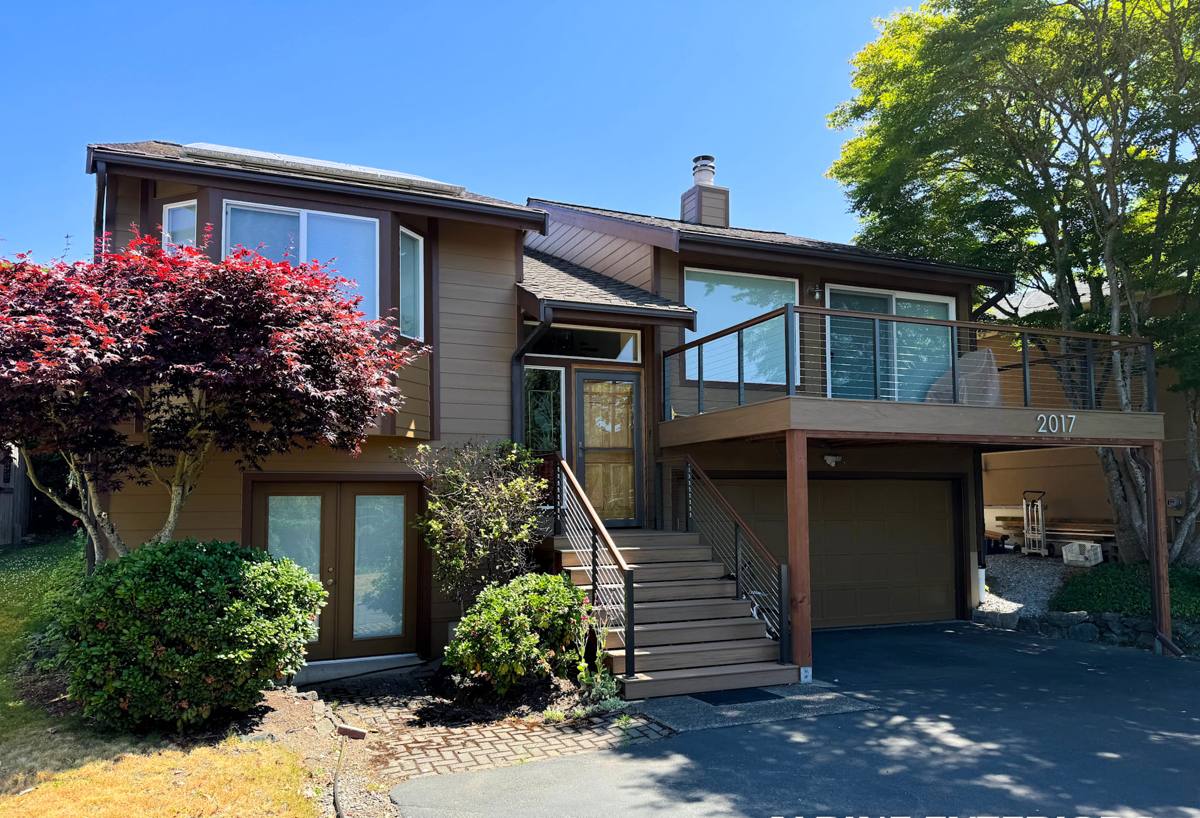
What Island Exposure Does to a Window
Salt Air From More Than One Direction
A house set back from the water on the mainland usually has some shelter from trees, terrain, or distance that cuts down how much salt-laden air reaches it. An island doesn't offer that kind of buffer. Salt in the air is corrosive to window hardware, fasteners, and lower-grade frame components, and it works faster here than it does a few miles inland. Hinges, locks, and cranks that would hold up fine on a sheltered lot can start sticking, pitting, or corroding years earlier on a home exposed to salt air on multiple sides.
Wind-Driven Rain With No Windbreak
Open water means open wind, and wind pushes rain sideways into window flashing and trim instead of letting it run straight down and off. Without hills, tree lines, or neighboring buildings to slow it down, a storm crossing open water can drive rain into a window opening at an angle that a flashing detail built for straight-down rain was never designed to handle. This is the biggest reason window installations fail in a setting like this: not the glass or the frame, but water finding its way in sideways at a seam that wasn't detailed for it.
A Moss and Mildew Season That Runs Long
Mild temperatures and near-constant moisture add up to a moss and mildew season that can stretch across most of the year on north-facing walls, shaded trim, and window sills that don't drain well. Wood trim and sills are especially vulnerable, since anything porous that stays damp for extended stretches becomes a growth surface over time. By the time moss or dark staining is visible on window trim, moisture has often been working on the wood underneath for a while already.
Choosing a Window Built for This Exposure
We don't push one window brand as the only correct answer, because the right choice depends on budget, opening size, and how exposed a particular wall is. What matters more than the label on the window is getting the frame material, glazing, and hardware grade right for an island setting.
- Frame material: Vinyl and fiberglass frames resist rot in a way uncladded wood frames don't, which matters given how much sustained moisture an island home deals with. Fiberglass tends to hold up marginally better across temperature swings and can be painted; vinyl is usually the more affordable option and performs well in this climate too.
- Glazing package: Double or triple-pane glass with a low-E coating helps with both energy performance and reducing the interior condensation that's common in damp, marine-influenced climates.
- Hardware grade: Corrosion-resistant hardware is worth specifying on an island home specifically, since standard-grade hardware wears out faster here than it would inland.
- Warranty structure: A manufacturer's product warranty only covers the window unit itself. We stand behind our installation work separately, because a well-made window installed with a weak flashing detail will still leak.
What Correct Installation Actually Involves
Flashing and Sealing the Opening
On an island exposed to wind-driven rain from more than one direction, flashing is the detail that actually determines whether a window holds up. Correct installation means the flashing laps in the right order with the surrounding weather-resistive barrier, water is directed out and away from the rough opening instead of trapped behind it, and every seam is sealed with materials rated for sustained moisture exposure, not caulk used as a substitute for flashing. Caulk breaks down and cracks over time; it's a supplement to a good flashing detail, never a replacement for one.
Integration With the Siding Around It
A window doesn't perform in isolation. If the flashing around a new window isn't tied correctly into the siding, house wrap, and trim already on the wall, water that gets past the seam travels into the wall assembly instead of staying visible where it can be caught early. We treat window installation as connected to the rest of the exterior, since the person doing the flashing needs to understand how it ties into the siding details around it, not just how to set a window square and plumb in the opening.
Repair, Reglaze, or Full Replacement?
Not every window issue on a Lummi Island home calls for full replacement. A window with a failed seal but a sound frame and working hardware is often a reasonable repair candidate. A window with rotted framing or hardware that's been failing for years usually isn't; at that point, repeated patching costs more over time than doing the job right once.
| Condition | Repair or Reglaze Usually Works | Replacement Usually Makes Sense |
|---|---|---|
| Fogged glass, sound frame and hardware | Yes — reglaze or seal replacement | Only if the frame is also compromised |
| Stiff, corroded, or broken hardware | Yes — hardware replacement | Not on its own |
| Soft or rotted sill and frame wood | Rarely a lasting fix | Yes |
| Persistent draft despite sealing | Sometimes, if flashing is the actual cause | Yes, if the unit itself is the source |
| Single-pane glass, no upgrade since original build | Possible short-term fix | Yes, for real energy and comfort gains |
Why Working on an Island Changes the Job
Window work on Lummi Island isn't just a matter of climate; the ferry crossing changes how the whole project has to be planned. Materials, equipment, and the old windows coming out all have to move on and off the island on a fixed schedule instead of a truck showing up whenever it's convenient. That means ordering and staging materials ahead of time so a crew isn't stuck mid-job waiting on a piece that missed a sailing, and it means being upfront with homeowners about how many trips a project realistically takes rather than promising a turnaround that a mainland job might support.
Disposal works the same way in reverse. Old windows, packaging, and job debris have to be hauled back off the island rather than left to pile up, which takes planning most mainland jobs don't need. A crew that's done this before builds that logistics buffer into the schedule from the start instead of discovering it partway through the project.
Cost Factors for Window Installation on Lummi Island
| Factor | What It Affects | Why It Matters Here |
|---|---|---|
| Ferry access and scheduling | Trip planning for materials, equipment, and disposal | Work has to move on and off the island on a fixed schedule, which affects how a project is staged |
| Standard size vs. custom order | Lead time and unit cost | Older island homes sometimes have openings that predate standard manufacturer sizing |
| Number of windows and frame material | Total project cost | Vinyl and fiberglass both come in a range of grades; hardware and glazing packages vary by budget |
| Existing flashing and wall condition | Repair scope before new windows go in | Wind-driven rain exposure means hidden moisture damage around old windows is common |
| Wall orientation and exposure | How much weatherproofing detail a given opening needs | Walls facing open water need more flashing attention than sheltered elevations |
Exact numbers depend on the specific home, the number and size of the windows, and what condition the existing openings are in, which is why we look at the property in person before giving a real number instead of quoting off a generic price sheet.
Signs Your Windows Need Attention
- Fogging or visible moisture trapped between panes of a double-pane window
- Drafts or cold spots near the frame even when the window is fully latched
- Wood trim or sills that feel soft, look discolored, or show visible rot
- Difficulty opening, closing, or locking a window that used to operate smoothly
- Visible gaps or daylight where the frame meets the siding or trim
- Moss or dark staining on sills or trim that returns quickly after cleaning
- Corroded, pitted, or stiff hardware on hinges, locks, or cranks
- Rising energy bills that may point to a seal or frame no longer performing
Our Process and Why a Local, Island-Experienced Crew Matters
- We look at the existing windows in person, checking frame condition, seal integrity, hardware function, and how the current flashing ties into the siding around each opening.
- We give a straightforward read on which windows are reasonable repair candidates and which make more sense to replace, along with the reasoning behind it.
- We plan material ordering and ferry logistics around your project up front, so the schedule accounts for sailings instead of getting derailed by them.
- Flashing and drainage detailing are handled as standard practice on every window we install, not offered as an optional upgrade.
- We haul out the old windows and job debris as part of the work, so the island isn't left with removed material waiting on a future trip.
A crew that already works Lummi Island regularly has solved the logistics problem that catches contractors who are new to island work: how much lead time materials need, how many ferry trips a job realistically takes, and which wall orientations on this particular island take the hardest hit from wind and rain. That experience shows up as fewer surprises mid-project and a schedule that actually holds, instead of a job that stalls because a delivery missed a sailing or a crew had to turn back for a forgotten tool.
If you're dealing with drafty, foggy, or hard-to-operate windows on a Lummi Island home, or you're planning ahead for a remodel or new construction project, we're glad to take a look and give you a straight answer. Use the form below to schedule a free, no-pressure estimate.