 Fairhaven Siding
 Why Lummi Island Siding Wears Differently
Lummi Island sits fully exposed to Puget Sound, and that exposure shapes everything about how siding ages there. Homes on the island take a steady dose of salt-laden air off the water, which settles on exterior surfaces and accelerates corrosion of fasteners, trim, and any siding material that isn't built to shed moisture cleanly. Add Whatcom County's long wet season — driving rain that comes in sideways during winter storms — and siding gets tested from multiple directions at once: wind-driven water forcing its way into seams, and salt residue breaking down finishes and hardware over time.
Then there's moss. The Pacific Northwest's shaded, damp conditions give moss and algae a long growing season, and island homes with tree cover or north-facing walls often see growth start earlier and last longer than similar homes just a few miles inland. Moss holds moisture against the siding surface, which is a problem for almost every material except the ones specifically engineered to resist it. None of this means Lummi Island siding is doomed to fail — it means repairs and materials have to be chosen with this specific climate in mind, not treated the same as a repair job in a drier part of the state.
Signs Your Siding Needs Repair, Not Just a Cleaning
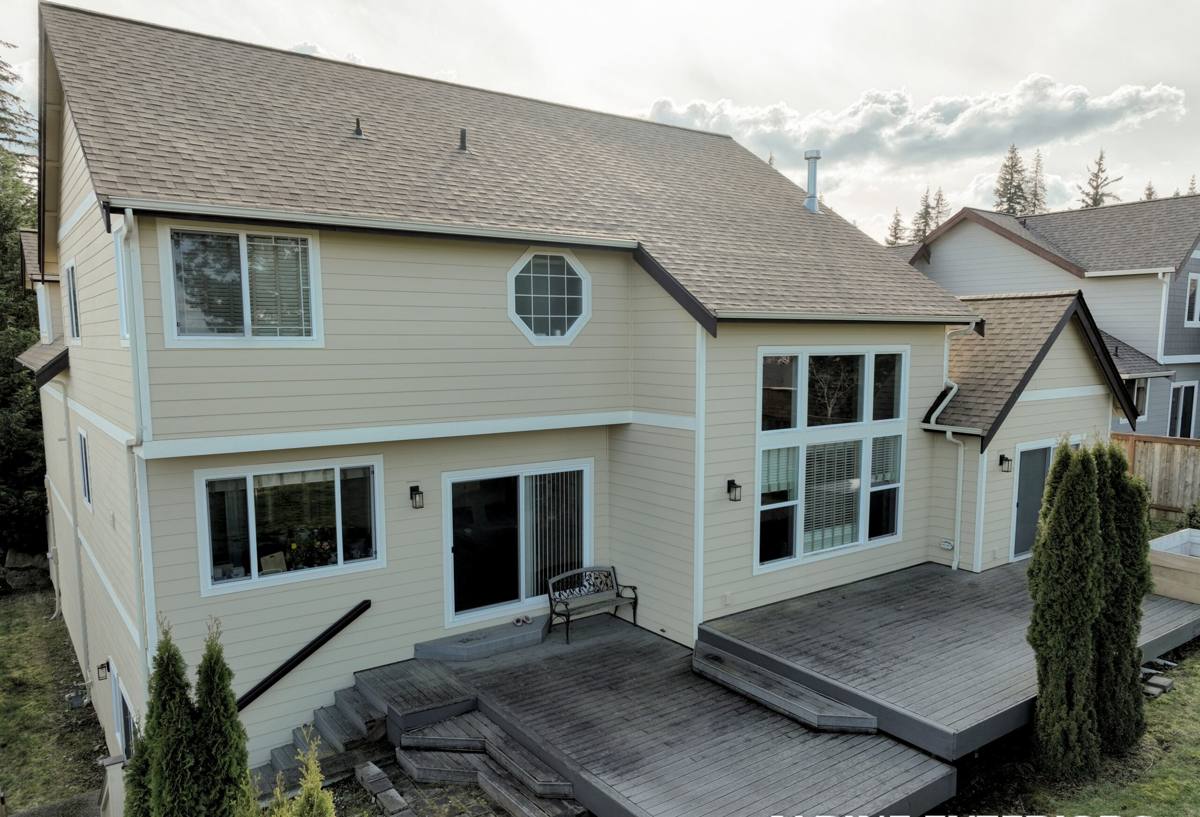
A lot of siding problems on the island start small and get dismissed as cosmetic. By the time they're obvious from the street, moisture has usually already gotten past the surface. Here's what we tell homeowners to watch for between inspections:
- Soft or spongy spots when you press on the siding, especially near the bottom courses and around window and door trim
- Paint that's bubbling, peeling, or failing in patches rather than evenly across a wall
- Visible gaps at seams, corners, or where siding meets trim, flashing, or the foundation
- Persistent moss or algae staining that keeps returning within weeks of cleaning
- Warping, cupping, or boards that no longer sit flat against the wall
- Musty smells or discoloration on interior walls that back up to exterior siding
- Rust streaks running down from fasteners or metal flashing
Any one of these on its own might be minor. Several together, especially on a wall that faces prevailing wind and rain, usually means water has been getting behind the siding for a while.
What a Correct Repair Actually Involves
Repairing coastal siding correctly is not just pulling a damaged board and nailing up a new one. A repair that's actually going to hold up on Lummi Island needs to address the cause, not just the symptom.
Diagnosing the Water Path
Before any siding comes off, the real question is how water got in. That could be failed caulking at a trim joint, house wrap that's torn or improperly lapped, flashing that was never installed above a window, or siding that was face-nailed too tight and can't drain. Replacing the visible board without fixing the entry point just means the same failure shows up again in a year or two.
Checking What's Behind the Siding
Once siding is pulled back, we look at the sheathing and house wrap underneath. If there's soft or delaminated sheathing, that has to be addressed before anything goes back up — covering damaged sheathing with new siding just hides a structural problem that will keep growing.
Matching and Finishing
Repairs need to match the existing siding's profile, reveal, and color as closely as possible, and every cut edge and fastener penetration needs to be properly sealed and primed or factory-finished before it's exposed to weather again. On a house that gets the kind of driving rain Lummi Island sees, a repair with sloppy sealant work fails faster than the original damage did.
How Different Siding Materials Hold Up in This Climate
Not every siding material responds to salt air and moss season the same way. This matters for repair work because the existing material on your home affects how it should be repaired — and whether repair or eventual replacement makes more sense.
| Material | Response to Salt Air & Driving Rain | Moss/Algae Resistance | Typical Coastal Repair Pattern |
|---|---|---|---|
| Vinyl | Can warp or become brittle with temperature swings; seams are a common water entry point | Moderate; textured surfaces trap moisture | Panel replacement often needed since cracked vinyl can't be patched |
| Cedar / untreated wood | Absorbs moisture readily; prone to rot at joints and lower courses | Low; organic surface feeds growth | Frequent spot repairs, refinishing, and board replacement |
| Engineered wood (LP-type) | Vulnerable at cut edges and fastener points if not fully sealed | Moderate | Edge and seam repairs; failures often trace back to sealing gaps |
| James Hardie fiber cement | Non-combustible, dimensionally stable, engineered for wet marine climates in the HZ5 product line | High with factory ColorPlus finish | Repairs are typically isolated impact or install-error fixes, not material breakdown |
We repair siding of all these types on Lummi Island as it comes to us. But when a repair calls for replacing a full section, a damaged wall, or when a homeowner asks what to put back up, we install James Hardie fiber cement — it's the only product we install as a company, because it's the one we've found holds up to this specific combination of salt, rain, and moss without repeat failures.
Common Repair Scenarios We See on the Island
Certain patterns show up again and again on Lummi Island homes, largely tied to orientation and exposure:
- Water-facing walls with failed caulking at trim joints, letting driving rain track behind the siding
- Lower courses near grade showing rot or staining from splashback and poor drainage
- Missing or undersized flashing above windows and doors, a common builder shortcut that shows up as staining below the opening
- Moss buildup on shaded north walls that's held moisture long enough to soften the siding underneath
- Corroded or popped fasteners on older installations, letting boards shift and open small gaps
Our Repair Process, Start to Finish
Because Lummi Island is reachable only by ferry, we plan repair visits differently than mainland Fairhaven jobs. We batch the assessment, material prep, and repair work to minimize trips and keep the project moving without unnecessary delays waiting on parts or scheduling gaps.
- On-site inspection to identify every affected area, not just the spot that prompted the call
- Investigation of the water path and condition of sheathing and house wrap behind the siding
- A written scope covering what needs repair now versus what to monitor
- Material matching and ordering, with lead time factored in for ferry-dependent scheduling
- Repair work: removal, structural fixes if needed, new material installation, and proper sealing
- Final check of flashing, caulking, and paint or finish lines before we call the job done
What Affects the Cost of a Repair
Every repair is different, but the same handful of factors drive most of the cost variation we see on Lummi Island jobs.
| Factor | Why It Matters |
|---|---|
| Extent of moisture damage | Repairs that stop at the siding cost far less than ones that also require sheathing replacement |
| Material match | Matching an older or discontinued siding profile can take more time and material sourcing than a straightforward swap |
| Number and location of repair areas | Several small spots across a home cost more in labor time than one larger, contiguous repair |
| Site access | Ferry scheduling and island access affect how efficiently a crew can mobilize materials and equipment |
| Underlying cause | Fixing a flashing or house wrap failure adds scope beyond the visible siding repair itself |
Why Hiring a Crew That Already Works Lummi Island Matters
Ferry-dependent scheduling isn't a minor detail — it changes how a repair project has to be planned. A contractor unfamiliar with island logistics can end up making multiple wasted trips, which either drives up cost or leads to shortcuts to avoid extra crossings. A crew that already works Lummi Island regularly builds material lists and scheduling around the ferry from the start, so the job moves efficiently without corners being cut to save a trip.
There's also a climate-familiarity piece. A contractor who's repaired siding on enough Whatcom County waterfront and island homes recognizes the difference between a cosmetic moss stain and a wall that's been absorbing moisture for a season, and knows which walls on an island property typically take the worst of the wind-driven rain. That judgment shortens the diagnosis phase and reduces the chance of a repair that looks fine but fails again the following winter.
If you're seeing soft spots, recurring moss, or water staining on your Lummi Island home, we're happy to take a look and give you a straightforward, no-pressure assessment of what's actually going on and what it would take to fix it right. Use the form below to request a free estimate.