 Fairhaven Siding
 Happy Valley's Climate Is Harder on Siding Than It Looks
Happy Valley sits close enough to Bellingham Bay that homes here deal with a version of Fairhaven's weather that's a little more concentrated: salt-laden air off the water, wind-driven rain that hits walls sideways instead of falling straight down, and long stretches of gray, damp months where moss and algae get a real foothold on north-facing walls and anything shaded by mature trees. None of that is exotic — it's just Whatcom County in a fairly typical year. But it adds up differently than it does on a dry-side house, and it's why siding choice and installation quality matter more here than the listing photos ever suggest.
Salt air accelerates corrosion on fasteners and trim metal. Driving rain finds every gap in flashing and caulk that a calmer climate would never expose. And moss doesn't just look bad — it holds moisture against a wall surface for weeks at a time, which is exactly the condition that breaks down siding that isn't built to handle it. A siding job in Happy Valley has to be evaluated against all three of those stresses at once, not just against how it looks going up.
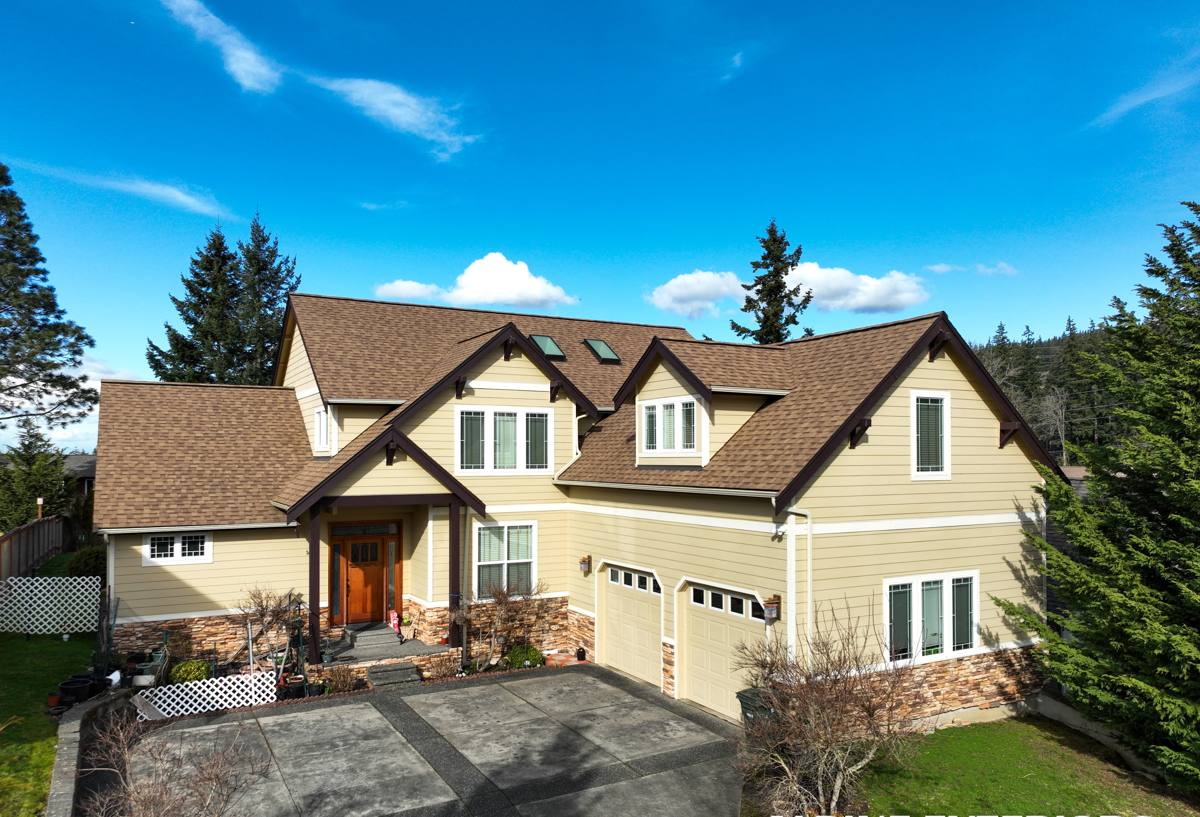
Why We Install James Hardie Fiber Cement — and Nothing Else
We are a James Hardie-only contractor. We don't install LP SmartSide, vinyl, Cemplank, Allura, primed spruce, or cedar, and we're upfront with Happy Valley homeowners about why. Fiber cement from James Hardie is non-combustible, dimensionally stable in wet-dry cycling, and finished at the factory with ColorPlus technology rather than field-painted — which matters enormously in a climate where field-applied paint has to fight salt air and constant moisture for its adhesion life. Hardie's HZ5 product line is engineered specifically for climates with more moisture exposure, which describes Happy Valley better than it describes most of the country.
We're not going to tell you every other product on the market is junk — some of them are reasonable choices in the right climate, installed the right way. But we've made a professional decision to standardize on one product system so we can install it correctly every time, back it with a real warranty, and not have to hedge on how it'll hold up against salt air, wind-driven rain, and moss over a 30-year timeline. That's the trade-off we're asking you to consider, not a claim that anything else is guaranteed to fail.
What ColorPlus Finish Actually Buys You Here
In a marine climate, the finish is doing as much work as the substrate. Factory-applied ColorPlus finish is baked on under controlled conditions and backed by its own finish warranty, separate from field-applied paint that has to bond to the board on-site, often in less-than-ideal weather. On a house exposed to salt air and repeated wet-dry cycling, that difference shows up first — years before the substrate itself would ever be at risk.
What a Correct Hardie Install Looks Like on a Happy Valley Home
Fiber cement performs exactly as well as its installation. A rushed or generic install on a good product will still fail early in this climate — the product isn't the whole story. Here's what we treat as non-negotiable on every Happy Valley project:
- Correct water-resistive barrier and flashing sequence — every window, door, and penetration flashed and lapped so water sheds down and out, never behind the plane, which matters more here given how often rain arrives with wind behind it.
- Proper fastener spec — corrosion-resistant fasteners driven to Hardie's blind-nailing or face-nailing spec, not whatever happened to be in the gun. Salt air is unforgiving of the wrong fastener choice.
- Manufacturer-spec clearances — siding held up off decks, patios, and grade per Hardie's published gaps, so moisture and moss-prone debris don't sit against the bottom course.
- Caulking only where Hardie's install guide calls for it — over-caulking traps moisture behind the board just as reliably as under-caulking lets it in.
- Ventilated rainscreen or drainage plane where the wall assembly calls for it — giving incidental moisture a path to dry out instead of sitting against the back of the siding.
Skip any one of these and you've got a wall that looks like a Hardie install for a few years and then starts behaving like a much cheaper one.
Moss and Algae: Prevention Beats Removal
On shaded or north-facing walls in Happy Valley, moss and algae growth is close to inevitable over time — it's a function of shade, moisture, and this region's damp months, not a sign anything was installed wrong. What correct installation controls is whether that growth stays cosmetic or becomes a moisture problem. Proper clearances and drainage keep organic growth from holding standing water against the board, which is the difference between an occasional wash-down and a wall assembly that's slowly staying wet.
How Our Process Works for Happy Valley Projects
- On-site assessment — we look at sun exposure, tree cover, prevailing wind and rain direction, and existing moisture or moss patterns on your specific walls before recommending anything.
- Product and line selection — HZ5 panel or plank profile, ColorPlus finish selection, and trim details matched to your home's exposure.
- Tear-off and sheathing check — old siding removed, sheathing inspected for hidden rot or moisture damage before anything new goes up. This step gets skipped by crews in a hurry, and it's the single biggest source of "why did this fail after five years" calls.
- Water-resistive barrier and flashing — installed to spec at every window, door, and penetration before the first board goes on.
- Installation to Hardie's published spec — fastener pattern, clearances, and joint treatment done per manufacturer instructions, not shortcuts.
- Final inspection and walkthrough — we walk the exterior with you before calling it done.
Why Hiring a Crew That Already Works Happy Valley Matters
Generic siding installation advice assumes a generic climate. A crew that's already worked Happy Valley and the surrounding Fairhaven area knows which walls on a given lot orientation take the worst of the wind-driven rain, which exposures grow moss fastest, and how salt air has actually behaved on siding and fasteners in this specific pocket of Whatcom County — not in a manufacturer's generic climate zone map. That local pattern recognition changes real decisions: where to add extra flashing attention, which fastener spec to insist on, and where clearances need to be generous rather than just code-minimum.
It also means less guesswork on your end. You're not the test case for a crew's first marine-climate install.
Cost Factors for a Happy Valley Hardie Project
Every home is different, and we won't quote a number without seeing your walls, but these are the variables that actually move the price on a Happy Valley project:
| Factor | Why It Matters Here |
|---|---|
| Existing sheathing condition | Hidden moisture damage from years of driving rain may need repair before new siding goes on |
| Wall exposure and orientation | Walls facing prevailing wind and rain need more flashing and drainage detail than sheltered elevations |
| Panel vs. plank profile | Lap plank vs. panel siding differ in installation labor and joint detailing |
| Trim and detail complexity | Homes with more windows, dormers, or architectural trim require more flashing and cutting |
| Access and site conditions | Slopes, tree cover, and tight lot lines common in this area can affect staging and labor time |
Signs Your Current Siding Is Already Struggling
- Persistent moss or algae bands that return within weeks of cleaning, especially on shaded walls
- Soft spots, bubbling, or visible swelling near the bottom courses or around windows
- Paint that's chalking, peeling, or needing repainting far sooner than expected
- Rust streaks near fasteners or trim, a common sign of corrosion in salt-exposed areas
- Visible gaps or separation at seams and trim joints after a hard storm season
Any of these is worth a look before it becomes a sheathing problem instead of a siding problem.
What a Real Warranty Should Cover
James Hardie backs its products with a substantial, transferable limited warranty, and ColorPlus finishes carry their own separate finish warranty. That matters in a climate that's harder on both substrate and finish than average — and it matters for resale, since a transferable warranty is something you can hand to the next owner. We'll walk you through exactly what's covered and what installation practices are required to keep that coverage intact, because a warranty is only as good as an installation that doesn't void it.
If you're weighing a siding project in Happy Valley, we're happy to come take a look, walk your specific exposures, and give you a straight, no-pressure estimate — no obligation either way.