 Fairhaven Siding
 Ferndale Roofs Take a Different Kind of Beating
Ferndale sits close enough to Bellingham Bay and the Strait of Georgia that salt-laden air is a constant factor for roofing materials, even on properties that feel "inland." Add to that the open farmland and river-bottom exposure around the Nooksack, where wind has room to build speed before it hits a roofline, and you get a combination that's harder on shingles, flashing, and fasteners than most manufacturers' warranty testing assumes. Storms here rarely announce themselves as dramatic events. More often it's a string of wet, windy fronts moving through back to back, each one loosening something a little further until a leak finally shows up inside the house.
We do storm damage roof repair work specifically for homes in this part of Whatcom County, and the patterns repeat: wind-lifted shingle tabs on west- and southwest-facing slopes, flashing that's worked loose around chimneys and vent stacks, and moss colonies that have quietly been holding moisture against the roof deck for months before a heavy rain finally pushes water through.
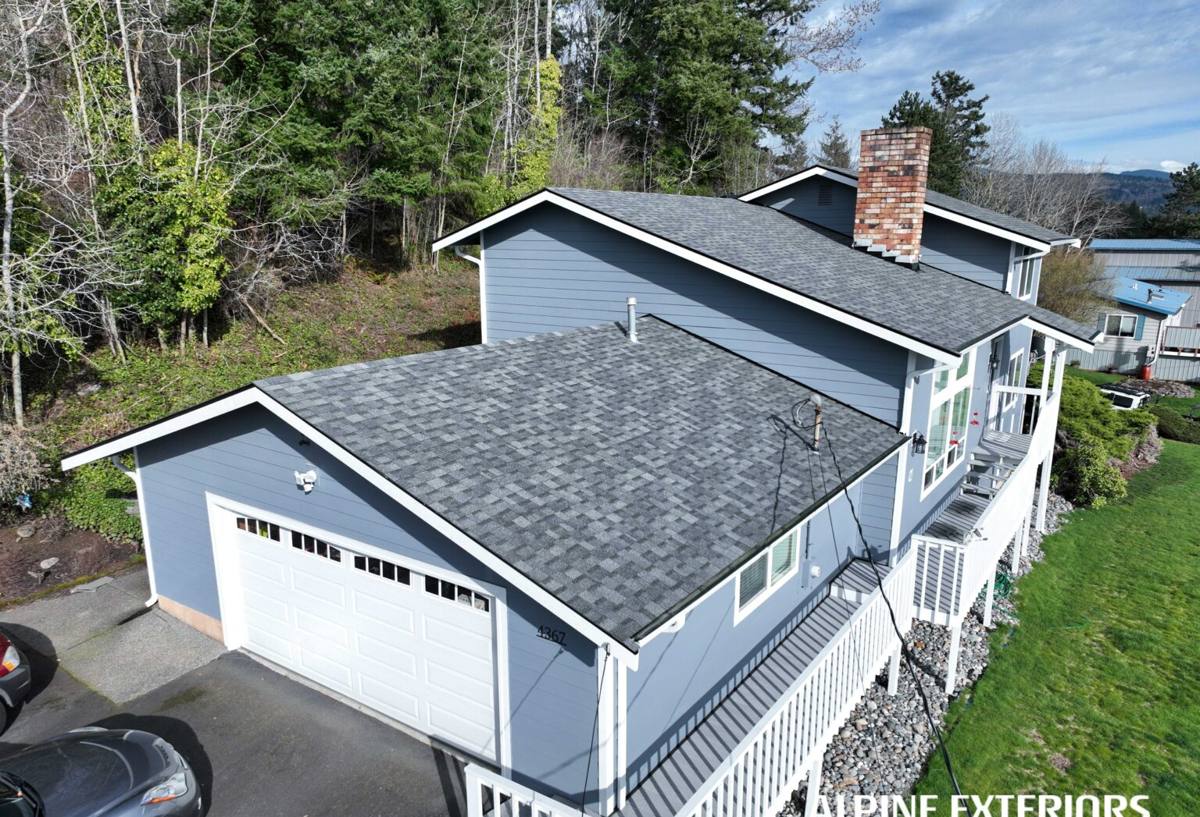
What Storm Damage Actually Looks Like on a Ferndale Roof
Homeowners often expect storm damage to be obvious — missing shingles scattered across the yard, a visible hole. Sometimes it is. More often it's subtle, and that's exactly why it goes unrepaired long enough to cause real problems.
Wind Damage
Sustained wind and gusts don't need to rip a shingle off to cause damage. They can break the sealant bond along the tab edge, which leaves the shingle looking intact from the ground but no longer watertight. Repeated flexing in wind also fatigues nail heads, backing them out slightly so they no longer hold flat against the shingle above.
Wind-Driven Rain
Rain that's moving sideways behaves differently than rain falling straight down. It gets pushed up under shingle tabs, into any gap around flashing, and through fastener holes that would otherwise shed water fine in calm conditions. This is why leaks often show up during or right after a windstorm even when no shingles are visibly missing.
Impact and Debris
Branches and windblown debris from nearby trees can crack shingles, dent metal flashing, or knock granules loose in a way that shortens the life of that section of roof even if it doesn't cause an immediate leak.
Moss-Related Damage
Moss isn't storm damage on its own, but it sets the stage for it. A moss mat holds water against the roof surface far longer than bare shingle would, softening the mat underneath and making that area more vulnerable when wind and rain do arrive.
Our Storm Damage Repair Process
We keep this straightforward because storm repair isn't the time for guesswork or upselling.
1. Ground and Roof Assessment
We start with a visual assessment from the ground and, where it's safe to do so, a walk of the roof surface. We're looking for lifted or missing shingles, compromised flashing, exposed fastener heads, and any soft spots in the decking that suggest water has already gotten past the surface layer.
2. Interior Check
If there's any sign of an active or past leak, we check attic space and ceiling lines from the inside too. Water doesn't always show up directly below where it entered, so this step matters for tracing the real source rather than just patching the most visible spot.
3. Honest Scope of Work
We tell you plainly whether this is a targeted repair, a larger section replacement, or something that's approaching the point where a full roof replacement makes more financial sense than continuing to patch. We'd rather lose a repair job to that honesty than have you pay for the same fix twice.
4. The Repair Itself
Depending on scope, this means resealing or replacing lifted shingles, re-securing or replacing damaged flashing, addressing any exposed or compromised decking, and matching materials as closely as possible so the repair doesn't stand out or create a new weak point.
5. Follow-Up
After a repair, we let you know what to watch for and when it's worth a follow-up look, particularly if more storms are forecast for the same season.
Repair or Replace? How We Decide
Not every storm-damaged roof needs to come off. But not every roof should be patched forever either. Here's the general logic we walk homeowners through:
| Factor | Leans Toward Repair | Leans Toward Replacement |
|---|---|---|
| Age of roof | Under 10-12 years | Nearing or past expected lifespan |
| Extent of damage | Isolated to one slope or section | Spread across multiple slopes |
| Decking condition | Solid, no soft spots | Soft, rotted, or delaminated in multiple areas |
| Moss/algae history | Minor, surface-level | Long-term buildup with underlying deck damage |
| Prior repairs | First or second repair on this roof | Repeated patch jobs over the same areas |
These are general guidelines, not a formula — the right call depends on what we actually find on your roof, which is why we walk you through our reasoning rather than just handing you a number.
Materials That Actually Hold Up Here
What performs well in a drier climate doesn't always perform well with Whatcom County's combination of salt air, sustained damp, and moss pressure. When we repair or replace sections of roof, we favor materials and installation details that are proven for this specific environment:
- Corrosion-resistant fasteners and flashing, since salt air accelerates rust on standard-grade metal over time
- Proper underlayment at repair edges so a patched section doesn't become the next weak point
- Ice-and-water shield detailing at valleys and eaves, where wind-driven rain concentrates
- Shingle products with algae-resistant granules in areas with heavy tree cover and persistent shade
We're not going to tell you a certain shingle brand is "bad" — most reputable products hold up fine when installed correctly. What matters more than the label is whether the installation details account for wind-driven rain and moisture cycling, which is where a lot of storm damage actually originates, not from a weak material itself.
Moss Season and Long-Term Roof Health
Western Whatcom County's moss season runs long — cool, damp, and shaded conditions favor it for much of the year, not just winter. Moss left unaddressed does two things that matter for storm resilience: it holds moisture against the roof surface, and it can work its way under shingle edges, gradually lifting them just enough for wind and rain to get underneath during the next storm. A roof that's kept reasonably clear of heavy moss buildup simply handles a wind-driven rain event better than one that isn't.
If we're already on your roof for a storm repair, we'll flag moss buildup and explain what's involved in addressing it safely — this isn't a hard sell, just useful information since the two issues are connected.
Working With Your Insurance on Storm Claims
Many storm repairs in this area are covered in whole or part by homeowners insurance, depending on your policy and the cause of damage. We can document the damage with photos and a written scope that you can submit to your adjuster, and we're glad to walk the roof with an adjuster if that's helpful for your claim. We don't handle the claim itself — that's between you and your insurer — but we make sure the documentation reflects what's actually there.
Why a Crew That Already Works Ferndale Matters
Storm damage repair isn't just about roofing technique — it's about knowing what's normal for this area versus what's a warning sign. A crew that regularly works Ferndale and the surrounding parts of Whatcom County has a feel for how local wind patterns hit different roof orientations, how fast moss reestablishes given the tree cover and moisture here, and which flashing and fastener choices actually last against the salt air coming off the bay. That local pattern recognition is what keeps a repair from becoming a repeat visit.
It also means faster response after a storm event, since we're not routing a crew in from somewhere unfamiliar with the area's roads or common roof types.
After a Storm: What to Check
If you've just been through a windstorm or heavy rain event, here's a practical checklist before you call anyone:
- Look for shingle granules collecting in gutters or downspouts — a sign of impact or wind stress
- Check ceilings and attic spaces for new water stains, even faint ones
- Scan the roofline from the ground for shingles that look lifted, curled, or out of alignment
- Note any branches or debris that landed on the roof, even if they've since blown off
- Check around chimneys, vents, and skylights for visible gaps in flashing
- Avoid climbing onto the roof yourself after a storm — wet, wind-loosened surfaces are not safe to inspect on your own
If anything on that list applies, it's worth having it looked at before the next round of weather moves through rather than waiting for a leak to confirm the problem.
Get a Free, No-Pressure Estimate
If your Ferndale home has taken storm damage, or you just want a roof checked out before the next front rolls in, we're happy to take a look and give you a straight answer about what it needs. Fill out the form below for a free estimate — no pressure, no obligation.