 Fairhaven Siding
 Why Decks in Columbia Wear Out Faster Than You'd Expect
Columbia sits close enough to Bellingham Bay and the Salish Sea that its decks live a harder life than decks built further inland. Salt-laden air corrodes fasteners and hardware from the inside out, long stretches of driving rain push moisture into every joint and seam, and a moss season that can run from early fall through late spring keeps deck surfaces damp and shaded for months at a stretch. None of that is unusual for Whatcom County — it's just the tradeoff for living this close to the water. But it means a deck that would last two or three decades in a drier climate can start showing real structural problems in half that time if it isn't built and maintained with this environment in mind.
We've repaired enough decks in and around Columbia and greater Fairhaven to see the pattern clearly: the failures aren't random. They show up in the same spots, for the same reasons, on almost every deck we're called out to look at. That's useful information, because it means a repair can be targeted instead of guesswork.
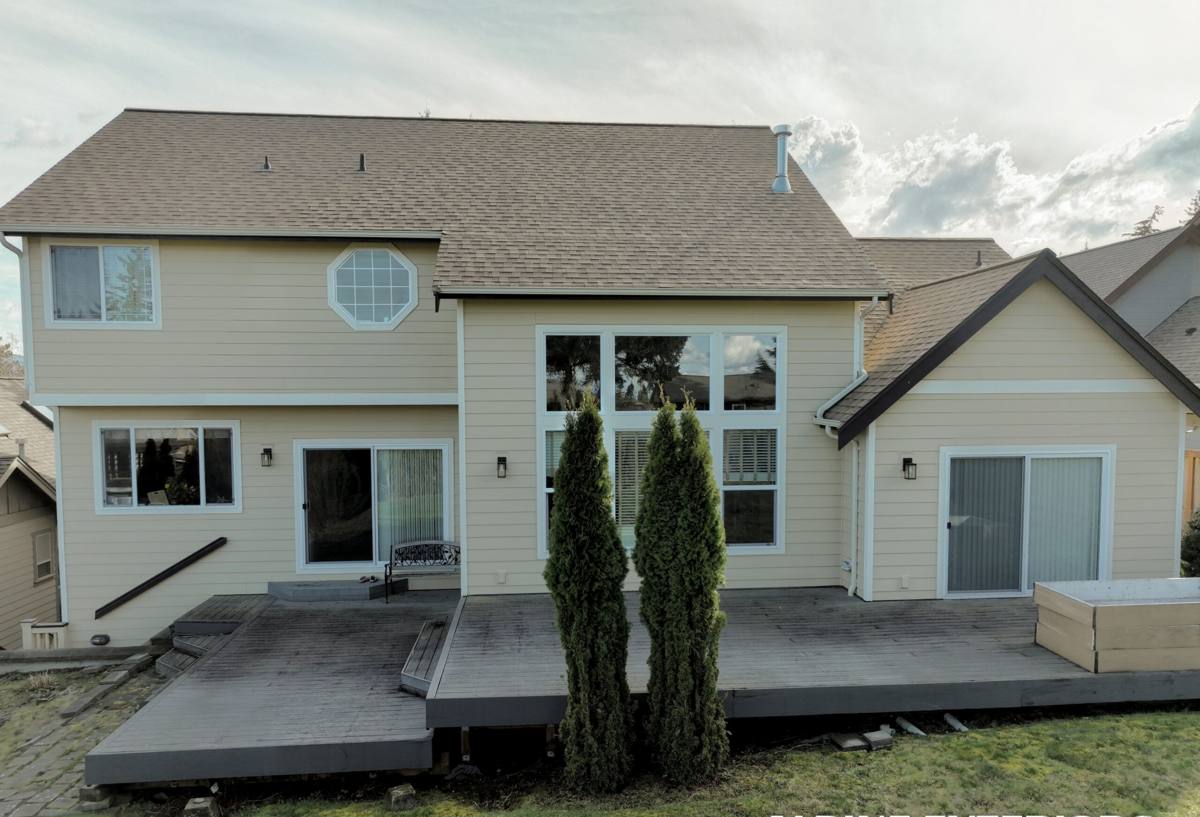
The Warning Signs Worth Taking Seriously
Most deck problems don't announce themselves with a dramatic collapse. They show up as small, easy-to-ignore details that quietly get worse every wet season. Here's what we tell Columbia homeowners to watch for:
- Soft or spongy decking boards, especially near the house or along the perimeter
- Black or green staining that doesn't wash off — a sign moss and algae have been feeding on damp wood
- Nail heads popping up or screws that spin freely without biting into wood
- Visible gaps or separation where the deck ledger board meets the house
- Railings or posts that flex or wobble under hand pressure
- Rust streaks bleeding from fasteners, hinges, or metal connectors
- A musty smell coming from underneath the deck, especially after rain
Any one of these on its own might be minor. Two or three together, especially near the ledger or support posts, usually means water has been getting into the structure for a while and it's worth having someone look underneath, not just at the surface.
Structural vs. Cosmetic
Not every issue is a safety issue. Weathered, greyed decking boards or moss on a rarely-used stair tread is a maintenance problem. Soft framing, a separating ledger board, or a railing that moves is a structural problem. The honest answer is usually that a deck needs a mix of both kinds of work — cosmetic refresh in some areas, real structural repair in others — and a good inspection should tell you which is which before any work starts.
Where Damage Actually Starts
The Ledger Board Connection
The ledger board — where the deck attaches to the house — is the single most common failure point we see. It's also the one that matters most, because it's what keeps the deck attached to the building at all. In a climate with as much driving rain as this one, flashing at the ledger has to actually shed water away from the house, not just sit there for show. When it fails or was never installed correctly, water tracks behind the siding and into the rim joist, and by the time it's visible from outside, there's often already soft wood underneath.
Joists, Posts, and Footings
Underneath the decking, joists and beams take on moisture from both directions — rain from above, splash-back and standing moisture from below, especially on decks with poor airflow or ground contact issues. Post bases are another common weak point; a post sitting in a pocket of trapped water, even briefly after every rain, will rot from the bottom up long before the rest of the structure shows its age.
Fasteners and Hardware
Salt air is genuinely rough on metal. Standard fasteners and connectors corrode faster here than in inland parts of the state, and corroded hardware loses grip strength well before it looks obviously rusted through. We check hardware condition as a standard part of every repair, not just the wood around it.
Repair or Rebuild — How We Help You Decide
This is the question every homeowner actually wants answered, and it depends on how much of the deck's structure is still sound. As a general guide:
| Factor | Leans Toward Repair | Leans Toward Rebuild |
|---|---|---|
| Ledger board condition | Solid, properly flashed | Soft, separating, or poorly flashed |
| Framing (joists/beams) | Isolated soft spots | Widespread softness or sagging |
| Decking boards | Scattered bad boards | Most boards cupped, cracked, or soft |
| Posts and footings | Stable, minimal movement | Rotted bases, undersized footings |
| Deck age | Under 15–20 years | Original construction 20+ years old |
| Code compliance | Meets current railing/attachment code | Predates current code, needs upgrades anyway |
A lot of decks fall in between — sound framing but tired decking boards, or a good structure with one bad support post. In those cases, a targeted repair extends the deck's life for a fraction of a full rebuild's cost. We'll tell you plainly when we think a repair is the right call and when it isn't — patching a deck with failing structure underneath isn't a service worth selling, and it isn't one we offer.
What a Correct Repair Actually Involves
A repair that holds up through another decade of Whatcom County winters isn't just swapping bad boards for new ones. It means:
- Inspecting from underneath — checking joists, beams, posts, and footings, not just what's visible from the top
- Correcting the source of water intrusion — re-flashing the ledger, redirecting drainage, or fixing whatever let moisture in to begin with
- Replacing compromised framing — sistering or replacing joists and beams that have lost structural strength, not just the boards on top of them
- Upgrading hardware — using corrosion-resistant fasteners and connectors rated for coastal exposure
- Replacing decking and railing components — matched to the existing deck where reasonable, or upgraded where it makes sense
- Confirming railing and guard attachment meets current code — a detail that's easy to overlook on an older deck
Skipping step one — the underneath inspection — is how homeowners end up paying for cosmetic repairs that fail again within a season or two, because the actual cause of the damage was never addressed.
Material Choices for a Repair That Lasts
What we use to repair a deck depends on what's already there and what the homeowner wants going forward. A few honest tradeoffs worth knowing:
Wood Decking (Cedar, Pressure-Treated)
Wood is affordable and repairs blend in more easily with existing wood decks, but it needs regular sealing or staining to hold up against this climate's rain and moss exposure. Skip that maintenance for a couple of seasons and you're back to the same problem.
Composite Decking
Composite resists moss staining and moisture damage better than wood and needs far less upkeep, which matters in a climate this wet. The tradeoff is higher upfront cost and the fact that it can't always be blended invisibly into an existing wood deck — sometimes a full surface replacement makes more sense than a partial composite patch.
Fasteners and Flashing
Regardless of decking material, we don't cut corners on what's hidden — flashing and fasteners rated for coastal, high-moisture exposure. This is the part of a repair that determines whether it lasts five years or twenty, and it's also the part that's easiest for a corner-cutting repair to skip because it doesn't show.
Our Process for Columbia Deck Repairs
We keep this straightforward on purpose:
- An on-site inspection, including underneath the deck, not just a walk-around
- A clear explanation of what's actually wrong and why, in plain language
- A written estimate that separates repair scope from any optional upgrades
- Scheduled work that accounts for our wet-season conditions rather than fighting them
- A final walkthrough so you know exactly what was repaired and what to watch going forward
After the Repair: Keeping Moss and Moisture From Coming Back
A good repair buys you years, but this climate doesn't let up, so a little seasonal upkeep goes a long way:
- Sweep leaves and debris off the deck surface before fall rains set in
- Keep gutters and downspouts clear so runoff isn't draining onto or under the deck
- Rinse off moss and algae buildup before it has a chance to stain or hold moisture
- Reseal or re-stain wood decking on the schedule the product actually calls for, not "whenever"
- Check railings and stair connections once a year for movement or loosening
- Keep vegetation and mulch pulled back from post bases and the deck's perimeter
Why It Matters to Hire a Crew That Already Works in This Area
Deck repair done right in Columbia isn't the same job as deck repair done right somewhere dry and inland. It means knowing which flashing details actually hold up against driving coastal rain, which fastener grades are worth the extra cost here, and how much airflow a deck really needs underneath to keep moss from taking hold again in a few years. A crew that repairs decks around Fairhaven and the rest of Whatcom County regularly has already seen how local decks fail — and more importantly, has already learned what stops them from failing again. That's not something you get from a generic repair job.
If your deck is showing any of the signs above, or you just want an honest read on whether it needs a repair or something more, we're happy to take a look. Reach out for a free, no-pressure estimate using the form below — we'll tell you straight what we find.