 Fairhaven Siding
 Decking Built for South Hill's Weather, Not Against It
South Hill sits close enough to the water that homes here take a different kind of beating than decks a few miles inland. Salt-laden air drifts up off Bellingham Bay, driving rain comes in sideways for months at a stretch, and the shoulder seasons bring a long stretch of shade, damp, and moss growth that most decking materials were never designed to handle. If you've replaced boards, chased soft spots, or scrubbed green film off a wood deck every spring, you already know what this climate does to the wrong material.
Composite decking earns its keep on South Hill because it doesn't feed the problem. It won't absorb the moisture that wood does, it doesn't need annual sealing to survive our wet season, and the better product lines resist the surface staining that salt air and organic debris cause on untreated wood. That said, composite isn't magic — it still has to be specified, ventilated, and installed correctly for this exact environment, or you'll trade one set of problems for another.
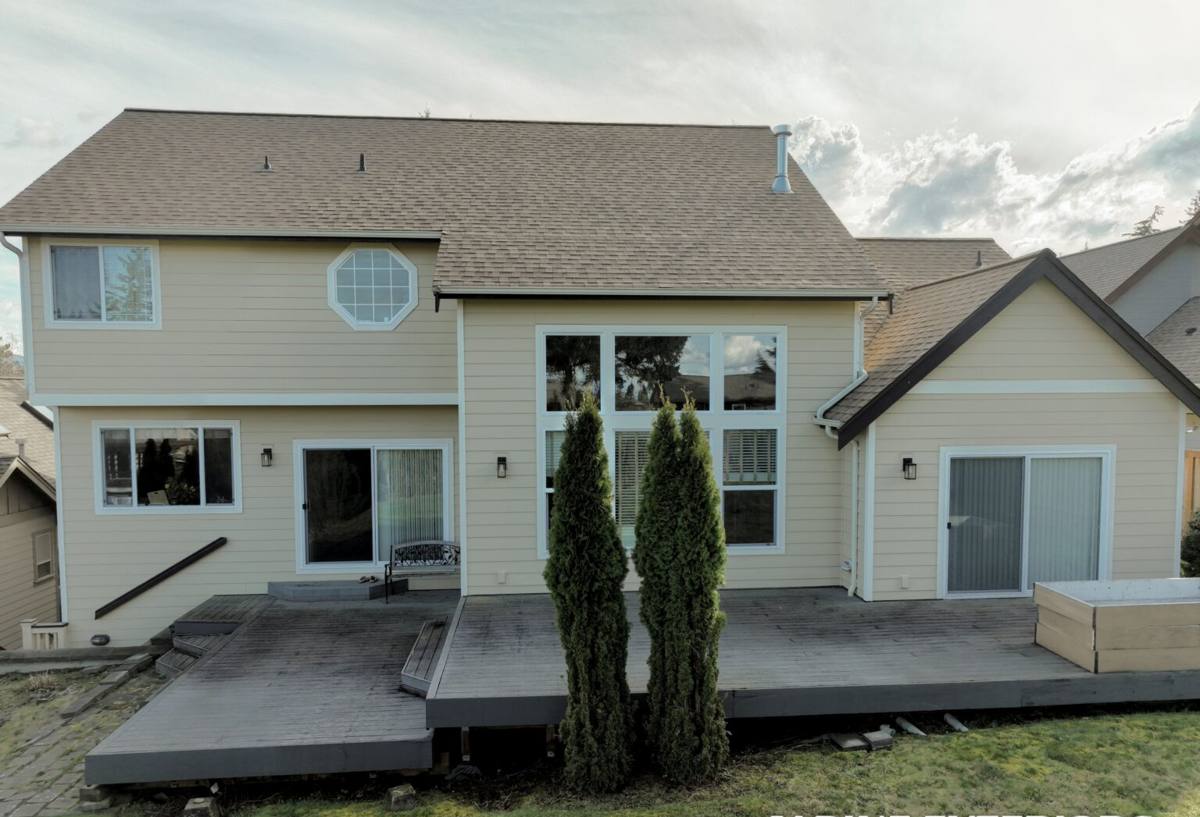
What This Climate Actually Does to a Deck
It helps to understand the specific stresses at play before talking about materials or install methods:
- Salt air accelerates corrosion on fasteners, joist hangers, and any exposed metal hardware — even hardware rated for exterior use.
- Driving rain pushes water sideways and upward under boards and against ledger connections, not just straight down, which is where a lot of decks actually rot from the inside out.
- Long moss season means anything shaded, low-airflow, or slow to dry stays damp for weeks at a time, giving algae and moss a foothold on the board surface and in the substructure below.
- Freeze-thaw cycling, while milder here than inland, still stresses fastener connections and any hairline cracking in lower-grade composite boards over years of exposure.
None of this is unique to South Hill, but the combination — coastal salt exposure plus a genuinely long wet season plus a lot of tree cover on residential lots — is a harder test than most decking gets in drier parts of Washington.
Why Wood Struggles Here Specifically
Traditional wood decking can absolutely work in Whatcom County, but it demands upkeep that a lot of homeowners underestimate: annual or biannual sealing, regular moss and mildew treatment, and close monitoring of ledger boards and joists where rot starts unseen. On a shaded South Hill lot with limited airflow under the deck, that maintenance window shrinks fast. Composite removes the sealing and staining cycle entirely, which is the main reason we see homeowners in this neighborhood switch over after one or two seasons with a wood deck.
What a Correct Composite Deck Install Involves Here
Composite decking is only as good as what's underneath it. On South Hill projects, our process pays particular attention to a few things that matter more here than in a drier, inland climate:
Substructure and Fasteners
We use corrosion-resistant, coastal-rated fasteners and hardware throughout — not just at the ledger board, but at every hanger, screw, and bracket. Standard galvanized hardware can start showing pitting within a few years this close to the water; stainless or heavy-coated hardware costs more up front and avoids a callback down the road.
Ventilation and Drainage
Composite boards need airflow beneath them to shed the moisture that driving rain pushes underneath. We set joist spacing and any picture-frame or fascia detailing to keep air moving, and we grade or flash the area under the deck so water has somewhere to go instead of pooling against footings.
Ledger and Flashing Detail
Most rot failures we find on older decks trace back to the ledger connection — where the deck meets the house. We flash this joint properly with the deck structure, which matters even more in a climate where wind-driven rain hits that seam directly for months of the year.
Board Selection for Shade and Moss Exposure
Not all composite is equal in a shaded, damp environment. We steer South Hill homeowners toward capped composite boards with a fully encapsulated core, since these resist moisture intrusion at cut ends and fastener holes far better than uncapped or lower-tier composite, which can swell or delaminate if water gets into an exposed edge.
Comparing Decking Materials for a South Hill Lot
| Material | Moisture / Rot Resistance | Moss & Algae Resistance | Maintenance | Typical Lifespan Here |
|---|---|---|---|---|
| Capped composite | High — sealed core resists water intrusion | Good with proper cleaning; won't absorb and hold spores like wood | Periodic wash-down, no sealing/staining | 25–30+ years |
| Uncapped composite | Moderate — exposed edges can absorb moisture over time | Fair; more prone to surface staining in shaded areas | Low, but edge sealing recommended at cuts | 15–20 years |
| Pressure-treated wood | Low without upkeep — ledger and joist rot common in this climate | Poor; feeds moss without regular treatment | Annual sealing/staining, moss treatment | 10–15 years with upkeep |
| Cedar | Moderate — naturally rot-resistant but still needs sealing | Fair; still needs cleaning in shaded spots | Regular sealing, moderate cost | 15–20 years with upkeep |
These are general ranges based on typical performance in a marine climate with heavy shade and salt exposure — actual results depend heavily on installation quality, site drainage, and how much sun and airflow a given deck gets.
Cost Factors Worth Understanding Before You Budget
Composite decking costs more per square foot than pressure-treated wood up front, and less over the life of the deck once you factor out annual sealing and repair work. A few things move the price on a South Hill project specifically:
- Substructure condition — if an existing deck's ledger or joists show rot, that framing needs replacing before new decking goes down, which is common on older wood decks in this area.
- Height and access — many South Hill lots have sloped grades, which affects footing depth and stair complexity.
- Board tier — capped, high-grade composite costs more than economy composite lines but holds up noticeably better against moss staining and moisture over a wet Whatcom County winter.
- Railing and fastening hardware — coastal-rated hardware costs more than standard galvanized, and it's not optional if you want the structure to last near salt air.
We'll walk through these specifics on-site rather than quoting a number blind — a deck on a shaded, exposed South Hill lot needs a different spec than one on a sunny, sheltered one, even at the same square footage.
Our Process for South Hill Deck Projects
- On-site assessment — we look at sun exposure, drainage, existing substructure condition, and how close the site sits to prevailing wind and rain direction.
- Material and layout recommendation — based on that assessment, not a one-size-fits-all package.
- Substructure work — repair or rebuild framing, install coastal-rated hardware, and set proper ventilation and drainage.
- Composite installation — including ledger flashing, board spacing for movement and drainage, and clean fastening per manufacturer spec to protect the warranty.
- Final walkthrough — we go over basic care so the deck performs the way it's supposed to through its first wet season and beyond.
Why Local Experience on South Hill Matters
A crew that mostly builds decks in drier, inland parts of the state will spec a South Hill deck the same way they'd spec one in Spokane — and it won't hold up the same. Understanding how salt air treats hardware, how long moss season actually runs here, and where driving rain hits a structure hardest isn't something you learn from a manufacturer's install manual. It's something you learn from building decks in this specific neighborhood, on these specific lots, through enough wet Whatcom County winters to know where problems actually start.
That local knowledge shows up in small decisions — hardware grade, ventilation gaps, flashing details — that don't cost much more at install time but make a real difference ten years in.
Signs Your Current Deck Isn't Handling the Climate
If you're deciding whether to repair, replace, or convert to composite, watch for these:
- Soft or spongy spots underfoot, especially near the house or stairs
- Persistent green or black staining that returns quickly after cleaning
- Rust streaks around fasteners or hardware
- Gaps opening between boards or boards cupping/warping
- Visible rot or discoloration at the ledger board where the deck meets the house
Any of these on a South Hill deck is worth a look before another wet season sets in — small issues at the ledger or substructure get expensive fast once water's been getting in unnoticed.
If you're weighing a new composite deck or wondering whether your current one is holding up the way it should, we're glad to take a look and give you a straight answer — no pressure, no upsell. Use the form below to request a free estimate for your South Hill property.