 Fairhaven Siding
 Custom Windows in Columbia: Built for a Damp, Salt-Touched Corner of Whatcom County
Columbia sits close enough to the water and to Fairhaven that homes here deal with the same marine-driven weather pattern that shapes exterior work across this part of Whatcom County: salt-laden air off the Salish Sea, long stretches of wind-driven rain, and a moss and mildew season that can run for most of the year on shaded walls and north-facing trim. Windows take more of that punishment than almost any other part of a house, because a window opening is where the building envelope has the most seams, the most hardware, and the most opportunities for water to work its way in if something wasn't installed correctly the first time.
A lot of the housing stock in and around Columbia includes older homes with original or previously replaced window openings that don't match today's standard sizes. That's where "custom" stops being a marketing word and starts being a practical necessity — the window has to be built to fit the opening that's actually there, not the other way around. We handle siding, roofing, windows, and decks for homes throughout the Fairhaven and greater Bellingham area, and on window work specifically we treat correct sizing and flashing detail as being just as important as the window unit itself.
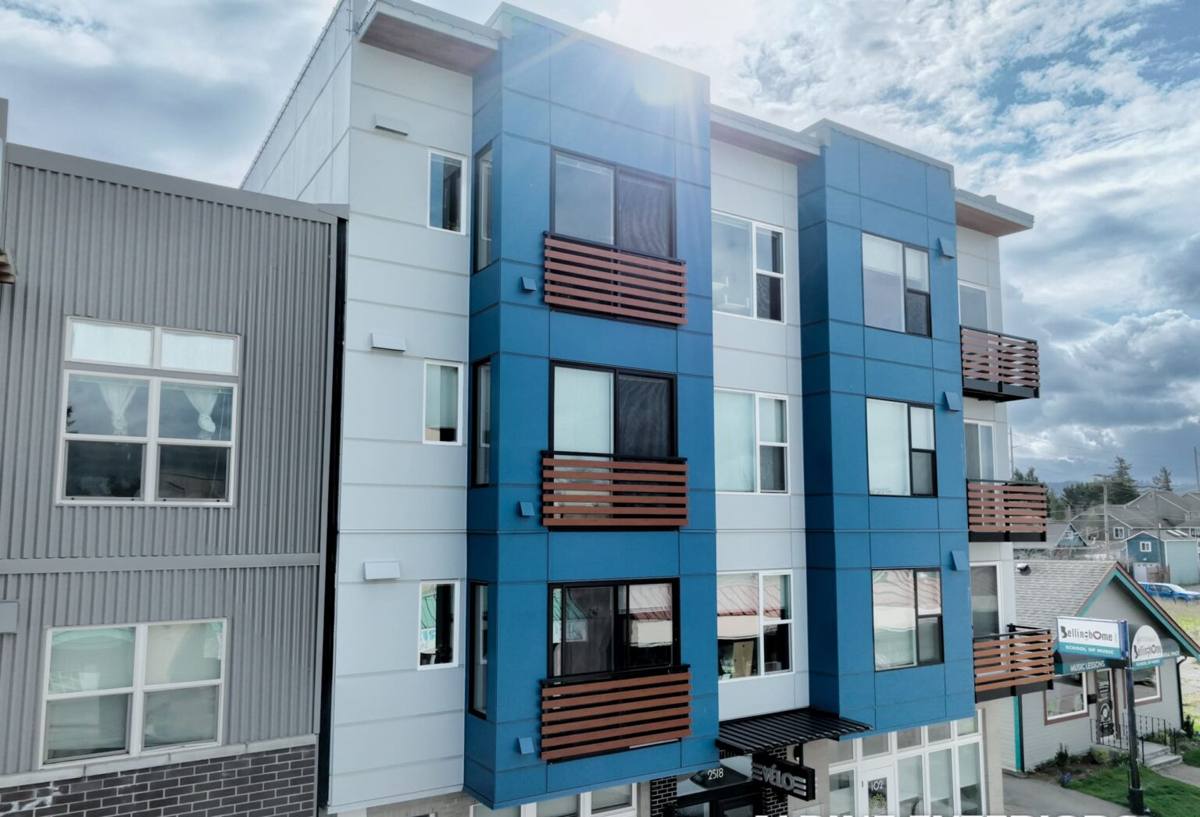
What Columbia's Climate Demands From a Window System
Salt Air and Corrosion
Homes near Fairhaven get enough salt-carrying marine air to accelerate corrosion on lower-grade window hardware, fasteners, and frame components over years of exposure. Hinges, locks, and cranks that would hold up fine in a dry inland climate can start pitting, sticking, or failing years earlier here. This is one of the first things we check on an aging window — hardware condition often tells you more about a window's real remaining life than the glass does.
Driving Rain and Wind Exposure
Storms coming off the water push rain sideways into wall assemblies rather than straight down, and that matters enormously for windows because wind-driven rain finds gaps and seams that would stay dry in a calmer setting. The window unit itself is only part of the defense — the flashing detail around it is what actually keeps that water out of the wall.
Moss, Mildew, and Prolonged Moisture
Mild temperatures and near-constant dampness through fall, winter, and spring give moss and mildew a long growing season across this part of Whatcom County, and window sills, trim, and the wood framing around older units are common places it takes hold. Anywhere water sits instead of draining away becomes a growth surface eventually — shaded elevations and windows tucked under eaves with poor drainage tend to show it first and worst.
Condensation From Temperature Swings
The gap between heated interiors and cold, wet exteriors creates real condensation pressure on glass and frames through the wet season. Older single-pane windows or double-pane units with failed seals show this constantly — fogging between panes, water pooling on interior sills, or persistent dampness on the glass itself. That's usually a sign of a failed seal, not just a cosmetic nuisance.
What "Custom" Actually Means for a Columbia Window Job
Matching Existing Openings
Many homes in this area have rough openings that were framed decades ago, sometimes to dimensions that don't match any current standard window size. A custom window job means measuring the actual opening, accounting for any settling or slight out-of-square condition, and building or ordering a unit that fits that specific opening correctly rather than forcing a stock size into a space it wasn't made for.
Older and Character Homes
Homes with older trim profiles, deeper wall assemblies, or original wood siding often need window work that respects the existing exterior detailing instead of fighting it. That can mean custom exterior trim to match existing profiles, careful integration with existing siding rather than a generic retrofit frame, or matching sightlines across a row of windows on the same wall.
Non-Standard Shapes and Configurations
Bay windows, arched openings, and multi-unit combinations all require more planning than a straightforward single-unit replacement — lead times run longer, and the flashing plan has to account for more seams and transition points. We work through those details before ordering anything, not after a unit shows up that doesn't fit.
Signs a Columbia Home Is Ready for Window Attention
- Fogging or visible moisture trapped between the panes of a double-pane window
- Drafts or cold spots near window frames even when the window is fully latched
- Wood trim or sills that feel soft, look discolored, or show visible rot
- Hardware that's stiff, corroded, or has stopped locking properly
- Visible gaps or daylight where the frame meets the surrounding siding
- Paint or finish peeling, bubbling, or chalking faster than the rest of the exterior
- An opening that's visibly out of square or was patched with mismatched trim in the past
Material and Glazing Choices for This Climate
We talk homeowners through real trade-offs rather than pushing one brand as the only right answer. For a Columbia property, the frame material and glazing package matter more than the label on the box.
| Frame Material | Strengths in This Climate | Trade-Offs to Weigh |
|---|---|---|
| Vinyl | Rot-proof, good value, low maintenance against salt air and moisture | Limited color options; can expand/contract more with temperature swings |
| Fiberglass | Dimensionally stable, can be painted, strong long-term durability | Higher upfront cost than vinyl |
| Wood, clad exterior | Traditional look for character homes; interior can be stained or painted | Cladding integrity depends entirely on correct installation and sealing |
| Uncladded wood | Historic appearance match | Highest maintenance burden in a wet, salt-influenced climate — not something we recommend without a clear maintenance plan |
- Glazing: Double or triple-pane units with low-E coatings help with both energy performance and reducing interior condensation during the wet season.
- Hardware grade: Corrosion-resistant hardware holds up meaningfully longer against marine air than standard-grade hardware.
- Warranty structure: A manufacturer warranty only covers the product — we stand behind our installation work separately, since a well-made window installed poorly will still leak.
Flashing and Installation: The Detail That Actually Determines Performance
We spend more time discussing flashing than window brands, because in this climate flashing is what separates a window that stays dry for decades from one that starts leaking within a few wet seasons. Correct installation means the flashing laps properly with the surrounding weather-resistive barrier and siding, water is directed out and away from the rough opening instead of trapped behind it, and every seam uses materials rated for sustained moisture exposure — not caulk alone. Caulk breaks down and cracks over time; it was never meant to be the only line of defense against wind-driven rain, only a supplement to proper flashing.
On repair and replacement calls around Columbia and the surrounding area, the most common source of window water damage isn't the window unit itself failing — it's flashing that was never lapped correctly during a past installation, sometimes hidden behind trim for years before the damage becomes visible.
How Window Work Connects to the Rest of the Exterior
Windows don't fail in isolation. A replacement done without attention to the surrounding siding, trim, and drainage plane can look fine for a season or two and still leak, because water that gets past a poorly integrated window travels into the wall assembly rather than staying visible on the surface. We treat window work as connected to siding and roofing rather than a standalone job — the same crew that handles the window flashing understands how it needs to tie into the siding and roof-to-wall details around it.
Our Process for a Custom Window Project in Columbia
We start with an on-site look at the existing openings, checking frame condition, hardware function, seal integrity, and how the current flashing ties into the surrounding siding. From there we measure each opening precisely, flag anything non-standard — out-of-square framing, deeper wall assemblies, unusual shapes — and give a straightforward read on repair versus replacement for each window individually rather than treating the whole house as one decision. A written scope goes over material options, glazing package, and how installation warranty is separated from manufacturer warranty before any order goes in. Because custom sizes and configurations often mean longer lead times, we build that into the schedule up front rather than surprising anyone partway through the job. Flashing and drainage detailing are standard practice on every window we install, not an upgrade homeowners have to ask for.
Why a Local Crew Matters for Window Work in Columbia
A contractor who works this part of Whatcom County regularly already understands how wind-driven rain and salt-influenced air behave here compared to a drier, more sheltered inland climate, and how much variation shows up between older Columbia homes with non-standard openings. That understanding shows up in the small decisions — how much lap a flashing detail gets, whether an opening gets remeasured instead of assumed, which hardware grade gets specified — and those decisions are what actually determine whether a custom window installation holds up for one wet winter or several decades.
If you're dealing with drafty, foggy, or hard-to-operate windows on a Columbia property, or you're planning a custom window project and want an honest read on what it will actually take, we're happy to take a look. Reach out below for a free, no-pressure estimate.