 Fairhaven Siding
 Building Decks for Chuckanut's Wooded, Waterfront Terrain
Chuckanut sits in one of the more demanding spots in Whatcom County to build an outdoor structure. Lots along this stretch tend to be steep, wooded, and close enough to the water to catch salt-laden air off the bay. Add in a heavy evergreen canopy that keeps large parts of a yard in shade for most of the year, and you've got a combination — moisture, salt, and shade — that will find every weak point in a deck faster than it would almost anywhere else in the region. A deck built here isn't the same project as a deck built on a flat, sunny lot ten miles inland, and it shouldn't be framed, fastened, or finished the same way.
This page covers what we've learned building and repairing decks specifically in this part of Fairhaven: what the site conditions demand, what a correctly built deck actually involves below the surface, and how our process is set up around those realities rather than around a generic build.
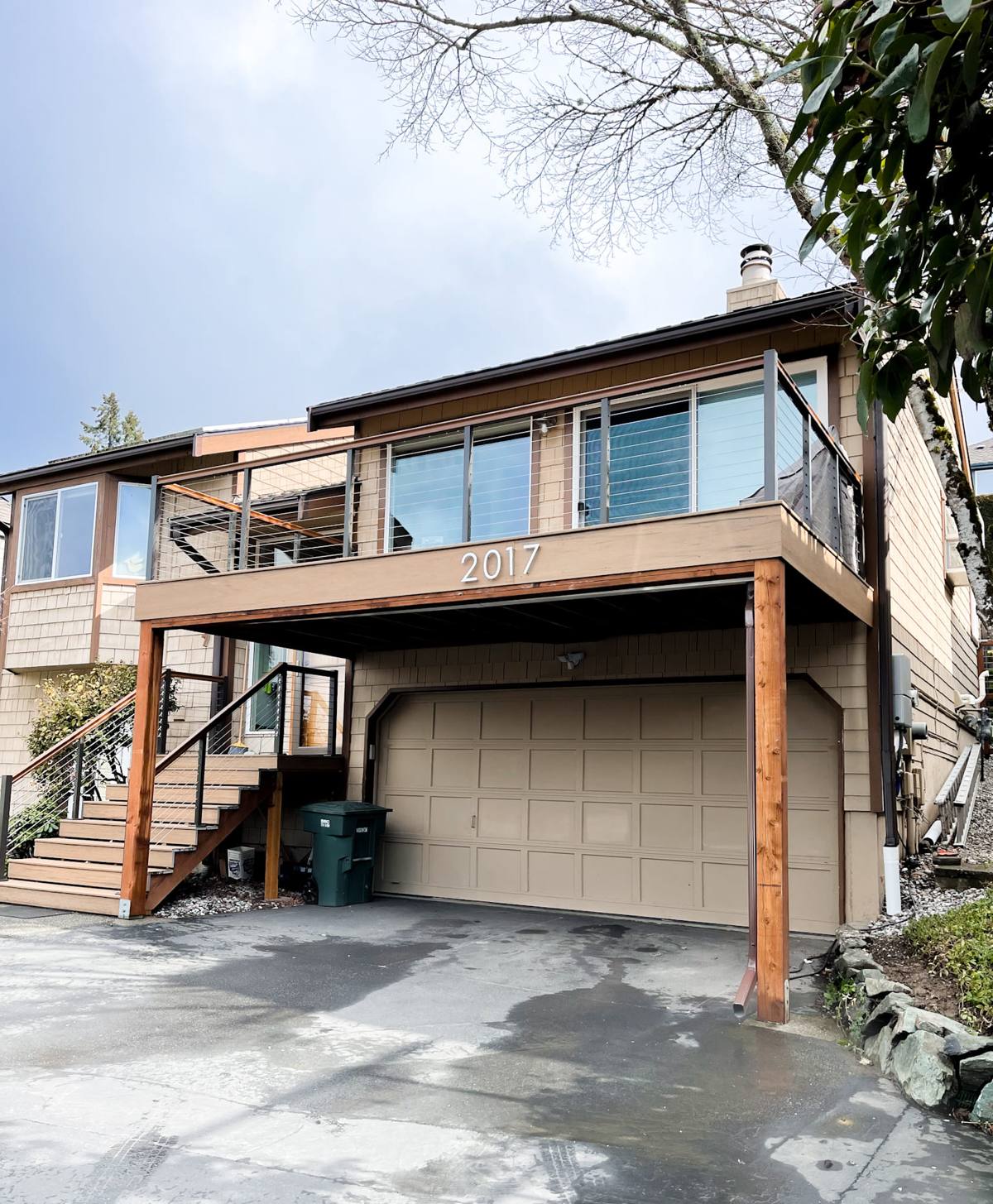
What This Microclimate Does to an Unprepared Deck
Salt Air and Corrosion
Proximity to the water means airborne salt settles on everything outdoors, including fasteners, brackets, and any exposed metal hardware. Standard zinc-coated fasteners that are perfectly adequate a few miles inland can start showing rust streaks and losing holding strength within a few years this close to the bay. Once a fastener corrodes, it doesn't just look bad — it loses grip in the wood, and a deck's structural integrity depends on every ledger bolt, joist hanger nail, and post connector doing its job for the life of the structure.
Driving Rain and Standing Water
Whatcom County gets its share of wind-driven rain, and on sloped Chuckanut lots that water doesn't always run off the way it would on flat ground — it can pool against ledger boards, run behind fascia, or collect under a deck where grading channels it toward the foundation. Wood that stays wet longer than it stays dry is wood that's on a timeline to rot, and the areas most at risk — ledger connections, post bases, and joist ends — are usually the hardest ones to inspect once a deck is finished.
Moss, Algae and Shade
Under mature tree cover, decking surfaces can stay damp for days after a rain, which is exactly what moss and algae need to establish. Beyond looking bad, a mossy deck surface is a slip hazard and, over time, holds moisture against the board itself, accelerating rot in wood decking or surface staining on composite. Moss season here isn't a few weeks — on a shaded lot it can run most of the year.
Getting the Structure Right Before the Decking Goes Down
Everything visible on a deck — the boards, the railing, the stair treads — sits on a structure that determines whether the whole thing lasts fifteen years or forty. On Chuckanut lots, three parts of that structure need extra attention.
Footings on Sloped, Rocky Lots
Steep grades and exposed rock or shallow soil are common in this area, and footing placement has to account for both the slope and what's actually under the topsoil. We dig to the depth required by local code and set footings on undisturbed, stable soil — not fill — with post bases held above grade so the post itself never sits in standing water. On a sloped lot this often means posts of varying heights, which changes how the beam and joist layout gets engineered; it's not a detail that can be eyeballed after the fact.
Ledger Attachment and Flashing
The ledger board — where the deck attaches to the house — is the single most common failure point on decks anywhere in the Pacific Northwest, and it's an even bigger concern here given the rain volume. Correct ledger work means proper flashing that directs water away from the house sheathing, lag bolts or through-bolts (not just nails) sized to the load, and a gap or flashing detail that keeps water from wicking between the ledger and the siding behind it. Done wrong, this is the connection most likely to lead to hidden rot inside a wall, which is a far more expensive fix than the deck itself.
Joist Protection
Untreated cut ends and joist tops are where rot typically starts, even on pressure-treated lumber, because the factory treatment doesn't penetrate a field cut. We seal cut ends and use joist tape or flashing on top of the joists before decking goes down, so the fastener holes in the decking aren't driving straight into exposed end grain.
Choosing a Decking Material for Chuckanut Conditions
There's no single "best" decking material — the right choice depends on how much shade the deck sits in, how much maintenance the homeowner wants to do, and budget. Here's how the common options actually perform in this specific climate:
| Material | Moisture & Moss Resistance | Maintenance | Typical Lifespan Here |
|---|---|---|---|
| Pressure-treated pine | Fair — treatment resists rot but surface still holds moss in shade | Annual cleaning, re-stain or seal every 2–3 years | 15–20 years with upkeep |
| Cedar | Good natural rot resistance, but softer surface stains and greens quickly in shade | Regular cleaning and refinishing to maintain color and resist moss | 15–25 years with upkeep |
| Composite decking | Very good — doesn't absorb water like wood, but surface can still grow algae in constant shade | Periodic washing; no staining or sealing | 25–30+ years |
| PVC / capstock boards | Best — fully sealed surface, minimal water absorption | Occasional washing only | 25–30+ years |
On heavily shaded Chuckanut lots, we generally steer homeowners toward composite or PVC decking specifically because the sealed or semi-sealed surface doesn't give moss the same foothold that raw wood grain does — it's a maintenance-burden decision, not a knock on wood as a material. Wood decking can absolutely work here; it just means committing to a real cleaning and refinishing schedule, especially in shaded sections.
Fasteners and Hardware: Where Marine Air Finds the Weak Point
Given the salt air off the bay, we use stainless steel or heavy-duty coated fasteners rated for coastal exposure on structural connections — ledger bolts, joist hangers, and post hardware — rather than the standard-grade coated fasteners that are fine for drier, inland builds. It costs more up front. It's also the difference between hardware that's still sound in twenty years and hardware that's visibly rusting in five. The same logic applies to railing brackets and any exposed screws on the decking surface — matching the fastener grade to the environment matters more here than almost anywhere else we build.
Drainage, Airflow and Keeping Moss From Taking Over
A deck that dries out between rains will always outlast one that doesn't, and drying out depends on drainage and airflow as much as it depends on the materials used. We grade the ground under the deck to shed water away from the house, keep skirting or under-deck enclosures vented rather than sealed tight, and space decking boards to allow water to pass through instead of pooling on the surface.
Homeowners can extend a deck's life considerably with a short seasonal maintenance routine:
- Sweep leaves and needle debris off the deck surface regularly — trapped organic matter holds moisture and feeds moss growth
- Rinse or gently pressure-wash the surface once or twice a year to remove early moss and algae before it establishes
- Check the ledger flashing and any visible fasteners once a year for rust staining or gaps
- Keep gutters and downspouts near the deck clear so roof runoff isn't dumping extra water onto or under the structure
- Trim back overhanging branches where possible to let more light and air reach the deck surface
- Reseal or restain wood decking on schedule rather than waiting until it's visibly weathered
Permits, Setbacks and Guardrail Requirements
Most new decks and significant deck rebuilds in this area require a building permit, and depending on the lot, may also involve setback review given how many Chuckanut properties sit on slopes or near critical areas. Guardrails are required once a deck surface reaches a certain height above grade, with minimum height and baluster spacing requirements set by code to prevent falls. We handle the permit application and inspection process as part of the job, but we'd rather flag it here plainly: skipping permits on a deck build isn't just a compliance issue, it can complicate a home sale or an insurance claim down the line.
Our Process for a Chuckanut Deck Build
- Site walk and assessment — we look at slope, soil, shade exposure, and how close the site is to salt air influence, since all three change the build spec
- Design and material selection — sized footings, framing layout, and decking material chosen for the specific site conditions, not a one-size template
- Permitting — we prepare and submit what's required for the jurisdiction before any digging starts
- Footings and framing — footings set to code depth on stable soil, ledger flashed and bolted correctly, joists protected before decking goes on
- Decking, railing, and stairs — installed with corrosion-rated fasteners and proper spacing for drainage
- Final walkthrough — we review the finished structure and maintenance expectations with the homeowner before we consider the job done
Why Hire a Crew That Already Works Chuckanut
A lot of what separates a deck that holds up here from one that doesn't isn't visible on a spec sheet — it's judgment calls about footing placement on an uneven lot, how much extra flashing a particular ledger location needs given which way it faces, or which sections of a shaded yard actually need PVC decking versus where standard composite is fine. That judgment comes from building and repairing decks in this specific area, not from a general framing crew applying a standard build to a nonstandard site. We've seen what salt air and moss season do to decks that were built without accounting for them, and we build accordingly from the first footing.
If you're planning a new deck or need to replace one that's showing its age, we're happy to take a look and put together a straightforward estimate — no pressure, no obligation. Use the form below to get in touch and we'll schedule a time to walk the site.