 Fairhaven Siding
 Siding Repair in Bow: What This Climate Puts Your Home Through
Homes in the Bow area sit in one of the wettest, dampest corners of the country, close enough to the Salish Sea to catch salt-laden air off the water and far enough into the trees and low farmland that moisture has nowhere to go once it settles in. Siding here doesn't fail because it's old. It fails because it's been asked to shed rain for months at a stretch, tolerate salt exposure carried in on the wind, and stay dry enough, long enough, that moss and algae never get a foothold. Most years, none of that happens perfectly, and that's where repair work comes in.
We're a Fairhaven-based crew, and Bow is part of our regular route — not a once-a-year trip. That matters more than it sounds like it should, and we'll get into why later on. First, it helps to understand what's actually happening to the siding on your house, because a repair that doesn't account for the cause is a repair you'll be paying for again in a few years.
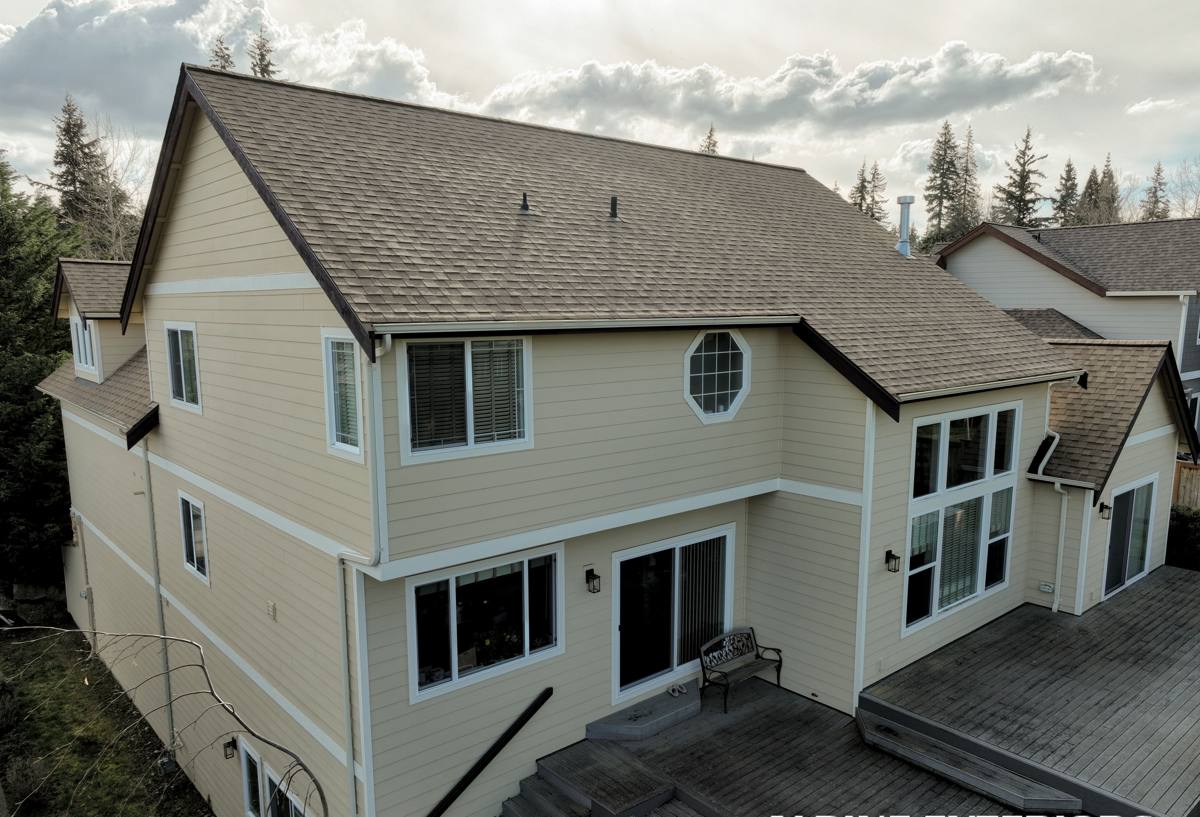
How Salt Air, Driving Rain, and Moss Season Actually Damage Siding
Three regional conditions do almost all the work of aging siding out here, and they compound each other rather than acting alone.
Salt Air
Airborne salt from the Salish Sea settles on exterior surfaces and holds moisture against them longer than plain rainwater would. On wood-based products, that means slower drying between storms and more cycles of swelling and shrinking. On fasteners, trim, and any exposed metal, it accelerates corrosion. Over years, that combination is what turns a small paint failure into a soft spot in the siding underneath.
Driving Rain
This part of Washington doesn't just get a lot of rain — it gets wind-driven rain that hits siding at an angle instead of falling straight down. That matters because siding systems are engineered to shed water moving downward, with laps, flashing, and caulk joints designed around that assumption. Driving rain pushes water sideways and upward into laps, around window trim, and behind loose caulk, which is why repair issues so often show up at butt joints, corners, and penetrations rather than in the middle of a flat wall.
The Long Moss Season
Shaded north-facing walls, roof overhangs, and anywhere airflow is limited stay damp for weeks at a time here, and moss and algae move in wherever that happens. Moss itself doesn't eat siding, but it holds water against the surface constantly, which keeps wood-based substrates wet far longer than they were designed to be, and it hides the early signs of a problem until the damage underneath has already spread.
Signs a Bow Home Needs Siding Repair Now
Most siding repairs get more expensive the longer they sit, because what starts as a surface issue is usually a water-intrusion issue underneath. If you're seeing any of the following, it's worth having it looked at before the next wet season:
- Soft, spongy, or crumbling spots when you press on a section of siding
- Paint that's peeling, bubbling, or flaking in one localized area rather than evenly across the whole wall
- Visible gaps, cracks, or separation at seams, corners, or trim joints
- Persistent moss or dark staining that keeps coming back after cleaning
- Warping or bowing panels, especially on shaded or north-facing walls
- Musty smells or visible staining on interior walls that back up to exterior siding
- Fastener heads that are rusting, popping out, or leaving streaks below them
What a Correct Repair Actually Involves
A siding repair that just covers the visible damage is a temporary fix. A correct one starts by figuring out why that section failed in the first place.
Diagnosing the Real Cause, Not Just the Symptom
Before we replace anything, we check what's behind it. Is the damage from a failed caulk joint letting driving rain in? A flashing detail that was never installed correctly? Trapped moisture from poor airflow behind a shaded wall? If we patch over the visible damage without fixing the water path that caused it, the same spot fails again — usually within a season or two, and usually worse than before.
Matching Existing Siding and Finish
Repairs stand out when the replacement material doesn't match the existing siding's profile, reveal, or color. On factory-finished fiber cement, we work to match the existing ColorPlus finish and plank profile as closely as possible so the repaired section blends in rather than becoming a visible patch. This is one of the reasons repair quality varies so much between contractors — matching takes product knowledge, not just carpentry skill.
Flashing, Caulking, and Water Management Done Right
This is the part that actually prevents a repeat repair. That means correct flashing at windows, doors, and any wall penetration; proper lap spacing so water sheds down and out instead of pooling; and sealant only where it belongs, not as a substitute for flashing. Given how much of the damage we see out here traces back to driving rain finding a gap, this step is not optional — it's the difference between a repair that lasts and one that doesn't.
Repair or Replace? What to Weigh
Not every damaged section needs full replacement, but not every problem is a good candidate for a spot repair either. Here's how we help homeowners think through it:
| Factor | Repair Often Makes Sense | Replacement Is Usually Better |
|---|---|---|
| Extent of damage | Isolated to one wall or a few panels | Recurring across multiple walls or elevations |
| Underlying cause | A single, fixable source (one bad flashing detail, one failed joint) | Widespread moisture intrusion or systemic installation errors |
| Age and condition of remaining siding | Siding is otherwise sound and holding up well | Rest of the siding is showing early signs of the same failure |
| Material match | Existing product line and color are still available or closely matchable | Discontinued color or profile makes a clean match impossible |
| Cost over time | One targeted fix resolves the issue | Repeated repairs are starting to add up to a meaningful share of replacement cost |
We'll give you an honest read on which category your situation falls into. If a repair will genuinely hold, that's what we'll recommend — we're not in the business of upselling a full replacement a homeowner doesn't need.
Why We Repair — and Install — Only James Hardie Fiber Cement
We made a decision a while back to work with one siding system: James Hardie fiber cement. It's not the only product on the market, and it's not the cheapest one either, but it's the one that holds up to this specific climate — salt air, driving rain, and a moss season that doesn't really end — better than the alternatives we used to install.
Fiber cement doesn't rot, and it isn't a food source for the moss and algae that thrive in shaded, damp conditions the way wood-based siding can be. It doesn't swell and shrink with every wet-dry cycle the way engineered wood products do, which matters a lot in a region that goes through that cycle constantly. And Hardie's factory-applied ColorPlus finish is baked on under controlled conditions, which gives it better fade and moisture resistance than field-applied paint — the kind of finish that's doing a lot of the long-term work in a climate like this one.
We don't install LP SmartSide, vinyl, primed wood, or other fiber cement brands, and that's a deliberate standard, not an oversight. When we're called out for a repair on a home with a different siding product, we'll tell you honestly what we're seeing and what your options are — but our own installation and warranty work is Hardie, because it's what we trust to actually perform out here over the long run.
Our Process for a Bow Siding Repair Call
- Inspection: We walk the affected area and check surrounding sections, flashing, and trim — not just the spot you called about.
- Diagnosis: We identify the actual water path or failure cause, not just the visible symptom.
- Written estimate: You get a clear scope — what's being replaced, what's being sealed or flashed, and what it costs — before any work starts.
- Repair: Damaged sections are removed, the underlying issue is corrected, and new material is matched and installed to spec.
- Final check: We confirm water management details — flashing, laps, caulk joints — are correct before we call the job done.
Why It Matters That We Already Work in Bow
A crew that only shows up for one job doesn't have much reason to think past that one repair. We're out in the Bow area regularly as part of the same route we run through Fairhaven and the rest of Whatcom County, which means we've seen how homes in this specific pocket of the coastline actually age — which walls take the worst of the driving rain, which orientations hold onto moss longest, which details tend to fail first. That local pattern recognition is part of what makes a repair diagnosis accurate instead of a guess, and it's part of why we can usually get out to look at a problem without a long wait.
If you've got a section of siding that's soft, stained, or just not looking right, we're happy to come take a look. The estimate is free, there's no pressure attached to it, and you'll get a straight answer about whether it's a repair or something bigger — use the form below to get started.